2025 November - What I Have Read
Substack
Harvard’s 30-Year Research Reveals: Why You Feel Overwhelmed, Exhausted, and Anxious — and How 25 Tiny Daily Habits Can Restore Inner Calm, Thomas Blake, Everyday Health [Link]
When you don’t feel like doing something, do it for ten minutes anyway.
― The 10-Minute Rule: How Small Windows Create Big Wins - Balanced Discipline [Link]
Humans exist to understand the universe. But we still don’t know what question we’re supposed to be asking.
The biggest opportunities of the 2030s will sit at intersections:
- AI + energy
- robotics + logistics
- satellites + internet
- AI + biology
- space + manufacturing
This is the philosophical layer behind his companies:
xAI expands intelligence
Neuralink expands consciousness
SpaceX expands reach
Tesla expands autonomy
― Elon Musk’s Most Important Interview in Years - Ruben Dominguez, The VC Corner [Link]
How To Remember Everything You Read - Polymath Investor [Link]
An active reading and retention framework
Your brain loves patterns. Comfort means staying in old circuits. But discomfort shocks the brain. It forces new neural pathways - that's neuroplasticity. Every uncomfortable action - cold showers, public speaking discipline- is literally rewiring your brain into a stronger version of you.
― how to be extremely disciplined - Bella Dane [Link]
How to Trick Your Brain into Doing Difficult Things - Dr. Dominic Ng [Link]
I like this one: Make it fun
- Listen to your favourite podcast during cardio
- Drink your nicest coffee while doing deep work
- Use your comfiest chair only for studying
- Light your favourite candle when writing
- Play specific music while cleaning
The 20-Minute Writing Exercise That Neuroscientists Say Can Solve Your Hardest Problems - Magdalena Ponurska [Link]
The science behind this writing exercise involves cognitive neuroscience and functions as attentional training. It works by simultaneously leveraging three mechanisms:
- Activating the Prefrontal Cortex: Writing about solving a problem in vivid, present-tense detail activates the prefrontal cortex, which is the brain's planning and problem-solving center. Studies show that the brain treats this detailed written simulation of future scenarios as a form of experience, unlike abstract goal-setting.
- Priming the Reticular Activating System (RAS): The writing exercise primes the RAS, which serves as the brain's filter for determining what you notice in your environment. By writing about being a person who "found money under rocks," the RAS starts flagging relevant opportunities or "solution-shaped things" that were previously overlooked.
- Creating Implementation Intentions: When you create a detailed mental scenario of completing a task, you are creating specific "if-then" plans known as implementation intentions. Research indicates that this technique makes people two to three times more likely to follow through than those who simply set abstract goals.
Articulation has nothing to do with sounding smart, but with sounding authentic.
What makes someone dangerously articulate, is the willingness to think out loud without fear of making mistakes. To make your intellectual curiosity visible, and to embrace the possibility of not knowing everything while speaking aloud.
In an uncertain world, embracing uncertainty becomes the foundation of dangerously articulate thinking.
If you fear uncertainty in your life, you need to leverage uncertainty to overcome it.
You need to become obsessed in your own curiosity to become genuinely useful to others.
Reading feeds curiosity. Reading improves how well you ask questions. Reading fuels better synthesis through asking better questions. Reading makes the perspective you have to offer to the world more valuable because you can synthesize everything you have read into solutions that can help people.
― How to become dangerously articulate - Craig Perry [Link]
Four daily habits you must practice: 1) reading, 2) thinking out loud, 3) teaching yourself, 4) writing.
Self-Promotion is selling your image. It demands praise. It is rooted in ego. (x)
Authentic Visibility is sharing your expertise. It offers repeatable value. It is rooted in service.
The Arrogance Trap (The Trophy): This focuses on the outcome. It states the win without showing the struggle. The reader sees a trophy and feels judged. (x)
The Service Solution (The Map): This focuses on the journey. It shares the failures, the painful moments, and the simple frameworks that finally led to success. The reader sees a map and feels helped.
The Audience of One Exercise: Picture the single, most valuable person you want to help (e.g., Sarah, Director of Product). Define them by: The Pain they struggle with, The Goal they aim for, and The Fear they are terrified of.
The Translation Test: Always translate the what (the specific task you did) into the how (the repeatable rule anyone can use).
― How to Build a Personal Brand When You’re a Senior Professional Who Hates Self Promotion - William Meller, You Visible [Link]
"The Strategy of Service
The core idea of Part 1 is professional relief: you don’t have to promote yourself. The anxiety you feel is valid because self-promotion is rooted in ego, but true visibility is rooted in service. This is about adopting the Map perspective-sharing the process and the failures-to eliminate the fear of arrogance. To keep your content focused, define your Audience of One. Finally, remember the Translation Test: your expertise is locked inside your company’s context; always translate internal success into a Portable Principle the market can immediately use."
"The Architecture of Proof
Part 2 is the strategic realization that your LinkedIn profile is a passive, magnetic sales tool. Your Headline must be a 10-second service promise. The About section earns trust by showing a past failure (the scar) that led directly to your unique framework (the solution). The most important shift is in the Experience section-stop listing activity and start listing your professional legacy by detailing the mechanism you engineered and the value it created. Finally, the Featured section provides tangible proof of your competence, fulfilling the promise made in your headline."
“The Protocol of Consistency
The core challenge is that visibility requires consistency, but self-promotion is exhausting. Part 3 turns content creation into a quiet routine. Start with the Daily Capture Ritual to source your ideas from Friction Points and Instruction Moments-the problems you already solved. Batch your writing into a 60-minute Weekly Creation Block, always following the structure of Conflict, Lesson, Illustration, Conversation. Finally, implement the Generosity Loop-committing 5 minutes a day to provide high-value contributions in the comments of others-which is a low-effort way to maximize visibility through service.”
“The Language of Quiet Confidence
Part 4 focuses on refining your voice to ensure your words are precise and evidence-based. You must eliminate the language of demand, which erodes trust, and embrace the Language Test by reframing your message to that of a generous teacher. The greatest tool is the mechanism-naming the specific process or framework you built to prove that your knowledge is systematic and repeatable. Finally, use the word “We” to project confident leadership and credit the process.”
"The Quiet Metric System
Part 5 provides the ultimate relief: you can officially ignore the noisy scoreboards. True authority is not measured by vanity metrics (Likes, views) but by Authority Metrics-specifically, the quality of inbound opportunities and Direct Messages that reference one of your named mechanisms. To sustain this, enforce the Time-Box Rule for writing and embrace the 1/3 Rule to keep the focus on low-effort engagement over high-effort creation."
Foundations: My 1999 (and part of 2000), Michael Burry, Cassandra Unchained [Link]
Articles and Blogs
We Asked Roblox’s C.E.O. About Child Safety. It Got Tense. - The New York Times [Link]
How we built OWL, the new architecture behind our ChatGPT-based browser, Atlas - OpenAI [Link]
Exploring a space-based, scalable AI infrastructure system design - Google Research [Link]
Google is seriously exploring whether AI data centers in space, powered by near-limitless solar energy and connected via optical links, could one day scale machine learning beyond Earth’s physical and environmental constraints.
Thoughts by a non-economist on AI and economics - Boaz Barak, Windows on Theory [Link]
The real economic question is not how good AI is today, but whether its exponential improvement translates into an exponential reduction in human-only tasks—something history has never seen before.
AI progress and recommendations - OpenAI [Link]
Software 1.0 easily automates what you can specify.
Software 2.0 easily automates what you can verify.
― "Sharing an interesting recent conversation on AI's impact on the economy. " - Andrej Karpathy [Link]
Estimating AI productivity gains from Claude conversations - Anthropic [Link]
Current AI already delivers large task-level time savings. Even without future model improvements, widespread adoption could meaningfully boost productivity. However, real gains depend on adoption, integration, and reorganization. The largest historical productivity revolutions came from changing how work is organized, not just doing the same tasks faster.
This study provides a lower-bound, usage-grounded lens on AI’s economic impact—useful for tracking trends, not forecasting destiny.
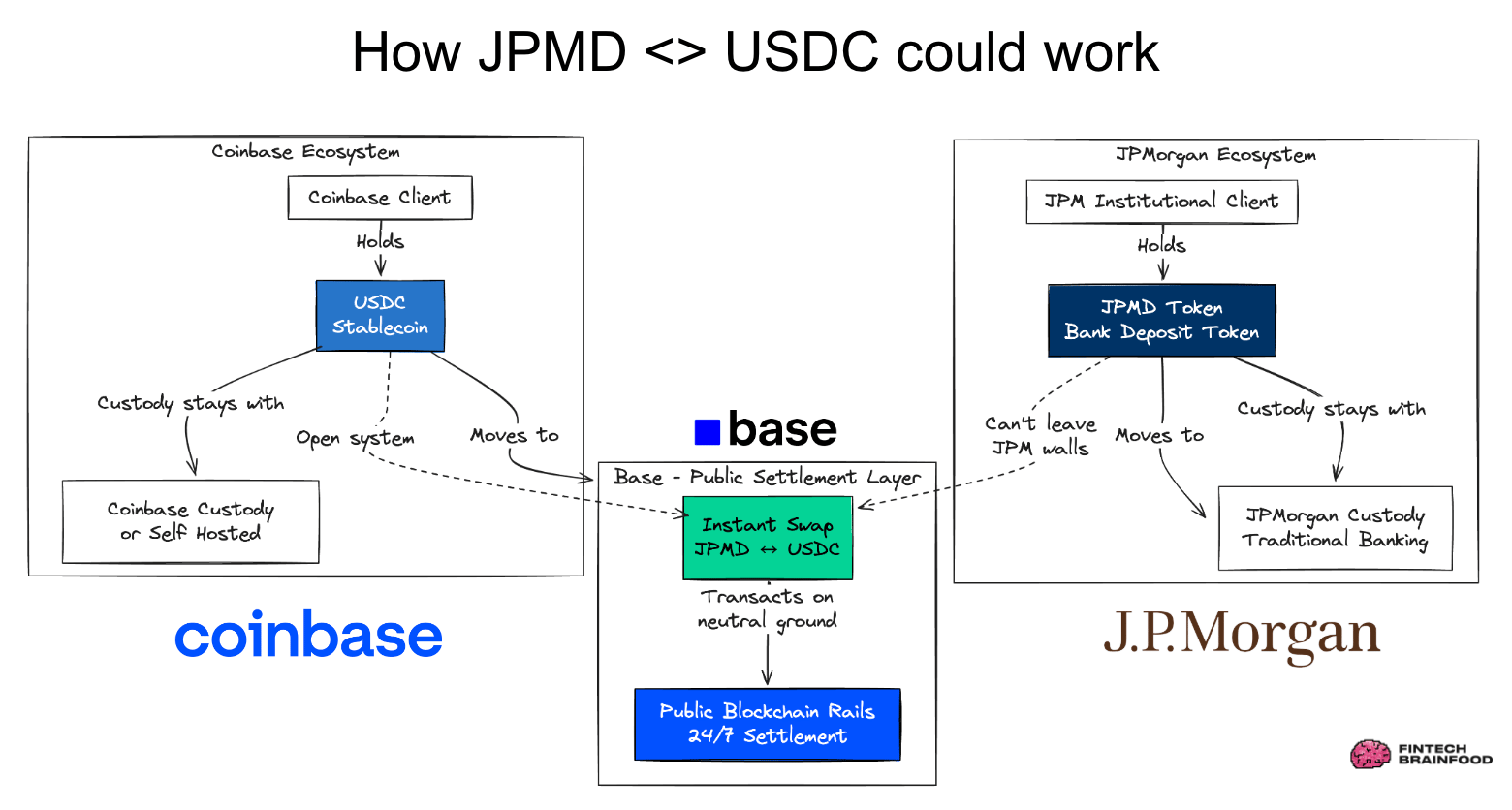
JPMorgan Rolls Out Deposit Token JPM Coin in Digital Asset Push - Bloomberg [Link]
JPMorgan’s rollout of JPM Coin shows how big banks are using blockchain to modernize real-world payments—faster, always-on, and regulated—without embracing speculative crypto.
The move reflects a wider trend among large financial institutions to modernize payment infrastructure using blockchain while staying within regulated banking frameworks.
Ramp/Brex beat the Amex/Concur experience by bundling the corporate card with AI-powered software. Instead of pulling manual expense reports from one system and importing them to another. The expense report, rules, and controls they’re all embedded together, beautifully.
I think there’s three big lessons if you’re a bank
- Software is the Product: The integrated software experience is the new competitive moat, not a "portal" bolted onto a legacy product.
- Automation is the Standard: AI-driven, "zero-touch" workflows are the new customer expectation. The manual expense report is dead.
- The All-in-One Platform Wins: Customers will always abandon a stack of siloed tools for a single, bundled platform that solves the entire workflow.
― The CFO Dashboard; Ramp, Brex or Mercury - 18 Months Later - Simon Taylor, Fintech Brainfood [Link]
This is a story about recognizing that financial services for growth companies are being re-architected into three different endgames, each optimized for a different definition of scale, control, and user value.
Across all three companies (Ramp, Brex, Mercury), the real trend is re-bundling:
- Software is the product, not a portal layered on top
- Automation and “zero-touch” workflows are now table stakes
- Bundled, end-to-end platforms beat stitched-together TradFi stacks
- UX and workflow ownership are the new moats
Traditional banks aren’t dead—but they are structurally behind.
Two signals stand out:
- JPM Coin launching on Base suggests banks are moving “open loop” on-chain
- Stablecoins are becoming real infrastructure, not just crypto-native tools
This could reshape cross-border payments, treasury management, and bank interoperability—potentially challenging SWIFT.
Google Maps releases new AI tools that let you create interactive projects - TechCrunch [Link]
Google Has Your Data. Gemini Barely Uses It. - Shlok Khemani [Link]
Google’s Gemini has access to unparalleled personal data, but it intentionally underuses it. Gemini’s memory system is carefully designed, transparent, and conservative—prioritizing safety, trust, and control over magical personalization. This restraint is elegant, but it may cost Google its biggest competitive advantage in personal AI.
Github
Tech Interview Handbook - yangshun [Link]
n8n workflows, zie619 [Link]
YouTube and Podcast
Alex Karp, CEO of Palantir: Exclusive Interview Inside PLTR Office - Sourcery with Molly O'shea [Link]
Most corporate and government leaders now believe AI software should work, and they seek out solutions when their own projects fail. The launch of AIP was an "artistic" decision made quickly (he launched it in the "darkness of night" pre-Easter to avoid resistance) based on the insight that LLMs would become commodity products and orchestration would be much more valuable. This change in customer belief has increased Palantir's authority, compressing sales cycles from five years versus nine months to five years versus two or three months.
The focus is on growing the U.S., enhancing the quality of the user experience (UX), and ensuring Palantir remains closest to the things that give America a strategic advantage for decades.
YouTube CEO Neal Mohan on AI, Censorship & the Future of Creators - All-In Podcast [Link]
YouTube CEO Neal Mohan is discussing the massive scale of the platform, the state of the creator economy, and emerging technological challenges. Mohan defended the long-standing 55/45 revenue split within the YouTube Partner Program, citing the billions paid out to creators and the strong return on investment (ROI) that high user engagement delivers to advertisers. He also highlighted the success of subscription products like YouTube Premium and YouTube TV, positioning the platform as the top streaming service in the U.S. The conversation addressed content regulation, confirming a pullback from controversial COVID-era censorship and emphasizing YouTube’s commitment to free expression despite the difficulty of managing diverse global laws and cultural nuances. Crucially, Mohan revealed that YouTube is adapting to the rise of synthetic media by developing new likeness detection tools—modeled after Content ID—and implementing transparency labels for AI-generated content to protect creator identities and address "AI slop."
Elon Musk: OpenAI Betrayal, His Future at Tesla, and the Next Big Thing — Grokipedia - All-In Podcast [Link]
Does OpenAI Need a Bailout? Mamdani Wins, Socialism Rising, Filibuster Nuclear Option - All-In Podcast [Link]
OpenAI CFO Would Support Federal Backstop for Chip Investments - WSJ Video [Link]
When you only know one field deeply, you see problems through that one lens. When you know many fields shallowly, you can't solve complex problems. But when you know one field deeply and have worked across many others, you can take a pattern from field A and apply it to solve a problem in field B.
Everytime you learn something new, immediately find 2-3 examples from completely different areas that use the same idea.
When you struggle and fail, your brain becomes super aware of what you don't know, it creates gaps in your knowledge that your brain wants to fill. When the teaching finally comes, your brain is actively looking for the missing pieces.
― how to actually become a polymath. - riskambition [Link]
How to articulate your thoughts more clearly than 99% of people - Matt Huang [Link]
What does it mean to be articulate?
To express (an idea or feeling) fluently and coherently
Fluently: ease and grace
- => delivery:
- Decrease mental load (word choice, top-down communication)
- Storytelling
- Energy
- => delivery:
Coherently: clear and logical
=> message content/structure:
Understanding the topic/issue
Knowing the objective
Fastest path to explain (less mental load)
The best speakers are the ones who are able to express the idea or the thing they need from someone in 5-10 seconds or less, Any longer than that and you honestly don't understand the thing that you're trying to explain.
Anticipating key questions
They deliberately make other people win bigger than them, not equal, not balanced, bigger. And they do it first before asking for anything.
It triggers psychological debt.
In any interaction, ask what costs me almost nothing, but would be huge for them. Maybe it's connection, maybe it's knowledge you already have, maybe it's taking an annoying task they hate. Give that first, not after, not during, first.
The most successful people aren't doing more, they are doing less, but at level that nobody else can touch, because they are not distracted by good opportunities.
Here's what separates effective people from everyone else, they treat this time (prime time) like a medical emergency, no meetings during prime time, no email, no quick questions, no administrative garbage, this is when you do the one thing that actually moves the needle.
The most effective people are actively bad at most things on purpose. They are not well-rounded, they are sharp in one place and dull in everywhere else.
― how to easily become a highly effective person. - riskambition [Link]
Epstein Files Fallout, Nvidia Risks, Burry's Bad Bet, Google's Breakthrough, Tether's Boom - All-In Podcast [Link]
FULL: Elon Musk Makes Shocking Future Predictions At U.S.-Saudi Arabia Forum Alongside Jensen Huang - Forbes Breaking News [Link]
We Asked Roblox's C.E.O. About Child Safety. It Got Tense. | EP 163 - Hard Fork [Link]
Roblox CEO is Delusional, penguinz0 [Link]
The Roblox CEO Dave Baszucki has been widely criticized after the safety interview on Hard Fork for
- his controversial push to introduce dating services and adult content onto a platform predominantly used by children, initially refusing to set the minimum age at 18.
- being repeatedly combative, defensive, and used aggressive interruptions to avoid legitimate questions.
- when asked about the platform's long-standing issue with predators on Roblox, Baszucki stated that he viewed the problem not merely as a serious issue but as an "opportunity" for safety innovation.
- unironically entertaining a question about implementing educational kid gambling on the platform, suggesting it would be a "brilliant idea" if structured legally.
OpenAI's Code Red, Sacks vs New York Times, New Poverty Line? - All-In Podcast [Link]
AI should either be a guardian angel or a cognitive amplifier.
― Satya Nadella – How Microsoft thinks about AGI, Dwarkesh Patel [Link]
The Thinking Game | Full documentary | Tribeca Film Festival official selection, Google DeepMind [Link]
Anthropic C.E.O.: Massive A.I. Spending Could Haunt Some Companies - The New York Times [Link]
Are Banks Secretly Winning the AI Race? (OpenAI Insider Explains) - Rex Salisbury [Link]