2026 July - What I Have Learned
Articles
A Script for Mark Zuckerberg - Ben Thompson, Stratechery [Link]
Takeaways:
- Meta needs to stop trying to be a hardware platform or a productivity tool. It is an entertainment and advertising company. Its biggest advantage in the AI era is that it focuses on what humans want to do "off the clock."
- By using the rental market as a baseline for compute value, Meta can heavily invest in AI infrastructure while enforcing strict financial discipline, ensuring AI is only used to directly boost the company's bottom line.
Visa moves beyond payments to become travel companion - Finextra [Link]
Takeaways:
Major global payment networks are increasingly moving beyond traditional financial transactions to build lifestyle and experiential ecosystems. By leveraging their vast merchant networks to offer exclusive consumer experiences, they can drive deeper customer loyalty and generate new revenue streams for their partners.
The Antithesis Principle - Shreyas Doshi [Link]
Takeaways:
Truths about human behavior can be applied in two directions:
- Pointed Outward (The Tactic): Using the truth to effectively influence or interact with others. Smart people easily grasp this.
- Pointed Inward (The Warning): Identifying this default human behavior and deliberately training yourself not to fall prey to it. Only wise people grasp this.
Doshi supports his argument with five practical examples showing the "Outward" (smart) vs. "Inward" (wise) application of common observations:
- Entertainment in Learning:
- Outward: Make your teaching entertaining so people learn.
- Inward: Train yourself to learn from unentertaining, "boring" content so you don't miss out on profound knowledge.
- The Power of Charisma:
- Outward: Learn charisma to grow your influence as a leader.
- Inward: Work hard not to be swayed by other people's charisma over their actual capability.
- 7-Second First Impressions:
- Outward: Try to create a great first impression.
- Inward: Stop forming fixed impressions of others based on the first few seconds of meeting them.
- The Importance of Great Managers:
- Outward: Be a great manager to help your team do good work.
- Inward: Become the kind of person who does great work even if you report to a mediocre or absent manager.
- The Love for Analogies:
- Outward: Use evocative analogies to explain your decisions to others.
- Inward: Do not use analogies to actually reason or arrive at your decisions.
What systems thinking looks like for PM'ing AI products - Christine Zhu [Link]
Takeaways:
- A product's success comes from how its components connect and interact, not just perfecting individual, siloed parts. Agents need to act holistically across the product, oblivious to a company's internal org chart.
- Tweaking parameters (like A/B testing variations) has low leverage. Real impact comes from defining structures, rules, and information flows (e.g., creating universal "contracts" for teams to build upon).
- When an AI agent enters a system as a new actor, the core value moves to the interface—how the agent communicates with the existing product surfaces.
- While building foundational contracts and feedback loops might seem slower initially, it provides a massive velocity advantage. Once the foundation is set, you can rapidly test variants and deploy features across multiple surfaces without rebuilding the plumbing.
- PMs must break out of traditional Product Development Life Cycle (PDLC) mindsets. Instead of obsessing over the "perfect roadmap," focus on building core system primitives and letting organic value grow from those systems.
- For any high-traffic job-to-be-done, ask: What does the agent need to see and do here? How does it access these ingredients across our surfaces? How are we capturing unique user corrections to make the agent smarter over time?
2026 Generative AI Landscape: The Evolution of AI Search - Similarweb [Link]
Takeaways:
- AI is creating a new layer of discovery rather than killing traditional search engines. Most users utilize both.
- AI is moving beyond standalone apps into existing ecosystems (e.g., Google AI Mode, Meta AI across social platforms, and Alexa for Shopping in e-commerce).
- AI is no longer just a trend for early adopters or Gen Z; usage is spreading evenly, indicating durable, mainstream habit formation.
- Users are bringing AI prompting habits back to traditional search engines, leading to longer, more conversational queries.
- Conversational advertising inside AI platforms is scaling, operating natively within the context of a user's prompt rather than interrupting it.
AI Engineering Productivity is Anything But Normal - Tomasz Tunguz [Link]
AI engineering productivity outcomes currently cluster into three distinct tiers based on how deeply a company integrates the technology:
The Mean (20-46% gain): The default outcome when a company simply distributes an AI IDE to its developers without changing underlying workflows.
Telemetry from Faros, Google, and GitHub confirms that basic IDE distribution yields only 21% to 46% gains (and sometimes increases bug rates).
The Frontier (2.5-3x gain): Achieved by companies that build an operating layer or "harness" around AI models, using agents to share context across tools (like GitHub, Slack, and Linear) and escalating complex issues to human engineers.
NVIDIA, Amplitude, Anthropic, and Replit all reported roughly 2.5x to 3x increases in per-engineer output or committed code, with flat or stable bug rates.
The Factory (8x+ gain): Software "factories" where AI agents operate as first-class organizational units to mechanistically produce and refactor code end-to-end.
Nubank achieved an 8x improvement in efficiency and a 20x cost reduction by using an autonomous coder (Devin) for large-scale refactoring.
AI's Value Capture problem - Jaya Gupta @ X.com [Link]
Takeaways:
- As enterprises rush to adopt AI models from providers like OpenAI and Anthropic, there is a growing tension between massive value creation and value capture. Leaders like Alex Karp and Satya Nadella are warning that companies risk leaking their core intellectual property and losing "sovereignty" over their intelligence by renting it out query by query.
- By relying on shared AI models, companies unwittingly forfeit their unique proprietary knowledge and human judgment to the AI vendor, who aggregates and distributes this intelligence industry-wide—turning individual competitive advantages into a universal baseline and leaving enterprises dependent on the vendor for future value.
- Strategic Deployment:
- Pool the generic: Use shared AI models for generic, undifferentiated workflows to capture productivity gains (essentially "protecting mediocrity").
- Protect the judgment: Keep your most valuable, proprietary human judgment and decision-making processes off shared models to maintain your competitive moat.
- The Litmus Test: Before putting any workflow into a shared AI model, executives should ask: "If every competitor learned how we handle this decision, would we still be better than them?"
Own Your Weights - Jamin Ball @ X.com [Link]
Takeaways:
Jamin Ball argues that the naive definition of "owning your weights" (downloading an open-weight model and deploying it) is a flawed strategy. Because AI models rapidly improve, a static weight file is a "melting ice cube." True model sovereignty requires enterprises to own the continuous training loop (data flywheels, reinforcement learning infrastructure, and evaluation engines) that builds and refines those weights, though doing so incurs a heavy "complexity tax."
To stay competitive, companies shouldn't just own static weights; they need to own the pipeline that continuously tweaks, refines, and evaluates the model against their highly specific workflows and data.
A task-specific, smaller model fine-tuned on a company’s exact workflows can outperform a massive frontier model at that specific job, and at a fraction of the cost.
Building these continuous improvement loops requires massive internal ML talent and infrastructure, making it too difficult for most enterprises. Every new frontier model release raises the bar this internal team has to beat.
Enterprises shouldn't be asking, "Should we own our weights?" They should be asking, "Which of our workloads actually justify the cost and effort of building a continuous improvement loop?"
There is a massive opportunity for companies (like Databricks or new startups) that can provide the infrastructure for enterprises to own their training loops without needing to hire massive internal ML teams.
The future will likely see open-weight, task-specific models generating the vast majority of tokens (high volume, low cost), while closed frontier models will continue to capture the vast majority of revenue by handling complex, reasoning-heavy tasks.
The Most Human Technology Ever Made - Anish Acharya @ X.com [Link]
Takeaways:
- AI makes execution cheap, shifting the bottleneck from how to build to what you want to say.
- The future of AI isn't a dystopian corporate monopoly; it's a decentralized landscape of "side quests," weekend projects, and hobbies turning into core economic drivers.
- Software creation will become democratized. People who never considered themselves developers or builders will now shape the technological landscape.
- The true promise of AI is unlocking human potential, allowing people to actualize ideas that would have otherwise died unmade due to the friction of execution.
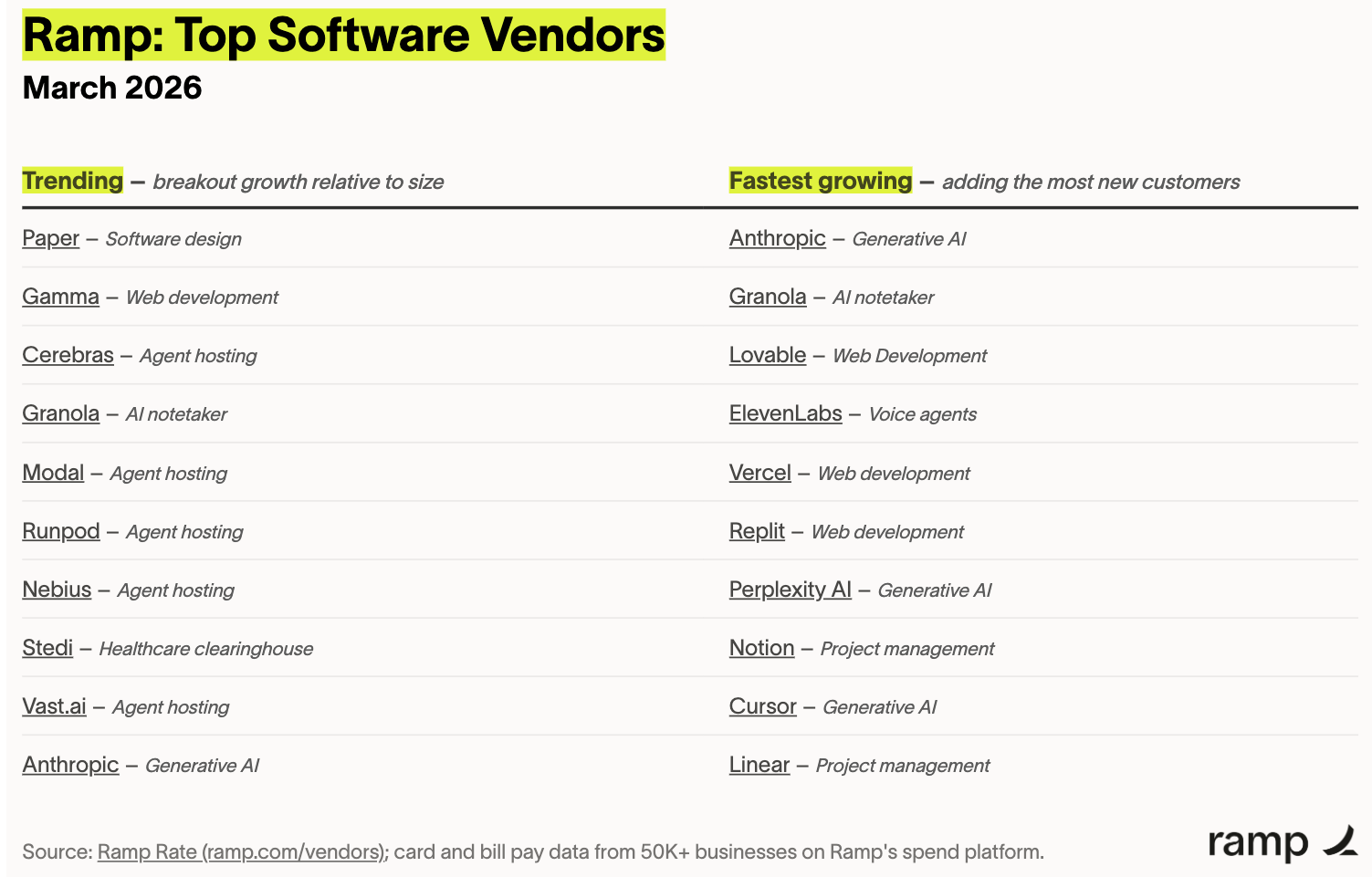
Top SaaS Vendors on Ramp (July 2026) - Ara Kharazian, ramp [Link]
Takeaways:
- Enterprise AI spending is heavily favoring applications that deliver concrete, measurable business value and customer outcomes rather than just raw productivity increases.
- The AI foundational model market is expanding beyond the dominant American tech giants, showing that businesses are willing to adopt open-source and international alternatives to meet their specific needs.
Tired vs. Wired: Our Deep Dive on Why Software Spend Is Up Record Amounts … Yet Half of SaaS Is Still Dying - Jason Lemkin, SaaStr [Link]
Takeaways:
- The software market has split in two. AI-driven companies (and legacy companies successfully leveraging AI budgets) are seeing record re-acceleration and growth, while "old SaaS" companies waiting for market recovery are dying because CIOs are cutting legacy software to fund AI initiatives.
- "Vibe coding" (quickly generating software) basic tools like CRMs is dead. Customers want AI agents that actively generate revenue (e.g., booking deals), not just prettier software.
- AI agents are outperforming entry-level humans. For example, SaaStr’s AI VP of Customer Success ("QB") autonomously managed 100+ event sponsors with fewer errors than previous human staff.
- SaaStr reduced its team from 20+ humans down to 3 humans and 21 agents. Two AI VPs cost $257/month, replacing roughly $500K in employee costs while increasing overall productivity.
- Legacy software is getting cut so CIOs can redirect funds to AI giants (like Anthropic).
- Growth isn't limited to AI-native startups. Older companies that became the infrastructure for AI (e.g., Palantir, Twilio, Datadog, and Atlassian) are seeing massive growth spikes.
- To survive, software must be easily accessible to LLMs. Platforms that are easy for agents to pull data from (like Stripe or Resend) will win their markets.
AI: Are AI employees more expensive than humans? - Luke Spill, Fintech Blueprint [Link]
Takeaways:
- AI token spend is beginning to rival human salaries. While AI costs aren't overtaking six-figure Western salaries yet, they are already matching mid-level engineering wages in global markets like Bangalore, making it a direct line-item comparison for finance teams.
- Generating tokens is heavily bound by memory bandwidth and energy consumption, rather than pure computing math. Running complex agentic loops requires significantly more energy (up to 140x more than a single query) and memory traffic.
- To cut costs, companies are routing the bulk of tasks to cheaper, open-weight models (like DeepSeek) and only calling expensive frontier models when the system gets stuck.
- AI is not a pure replacement for human workers; it creates a need for "robot shepherds," leading to net-new human job opportunities alongside the AI deployment.
Observations:
- Andreessen Horowitz notes a tenfold annual decline in model performance costs, while Epoch AI found costs halving roughly every two months.
- Goldman Sachs projects token consumption will multiply 24x by 2030 (to 120 quadrillion tokens a month).
- Real-world examples include Uber burning through its 2026 AI budget in four months and startups facing $113,000 monthly bills from a single provider.
- Data from Ramp indicates that companies spending heavily on AI are actually increasing their human staff numbers across the board.
4 Hidden Traps of Team Dynamics - Susan MacKenty Brady, Stuart D.Kliman and Leslie C.Smith, Harvard Business Review [Link]
The Invisible Work Draining Your Best Employees - Leah Ruppanner, Haley Swenson, Kate Mangino, H. Colleen Stuart, David G. Smith and Molly Dickens, Harvard Business Review [Link]
Great Leaders Know Which Emotions Their Feedback Will Trigger - Bin Zhao, Fernando Olivera and Amy C. Edmondson, Harvard Business Review [Link]
The Impact of Different Emotions:
- Self-Focused (Shame & Fear): Halts learning. Attention shifts inward toward self-doubt and protection (e.g., "I'm not good enough").
- Task-Focused (Guilt, Regret, & Frustration): Promotes learning. Keeps attention on the specific action or decision that can be changed and improved.
- Other-Directed (Anger vs. Gratitude): Anger leads to assigning blame and defensiveness, while gratitude fosters a collaborative, developmental process.
- Forward-Looking (Hope & Pride): Sustains learning by providing a clear path forward and reinforcing that the effort to improve is worthwhile.
The Case for Performance-First Management - Tony Guadagni, Tess Lawrence, Kalpana Tokas and Carolina Valencia, Harvard Business Review [Link]
Takeaways:
Instead of spending disproportionate time managing employees' personal and emotional tensions, managers must reorient their focus toward empowering teams to deliver high-impact business results. Empathy and flexibility are still important, but they should serve performance outcomes rather than being the ultimate goals.
Organizations need to retrain managers on tactical and operational skills. This includes translating strategy into actionable tasks, tracking outcomes rather than effort, fixing workflow inefficiencies, and integrating AI responsibly.
Managers need to avoid the "loyalty trap" where personal affinity for employees supersedes the organization's interests. They must shift their primary loyalty to team outcomes and organizational success, aided by objective criteria, standardized tools, and outcome-based KPIs.
6 Ways Leaders Harness Stress - Jon Miller and Drew Keller, Harvard Business Review [Link]
When Employees Are Held Accountable for AI-Generated Decisions - Anne-Sophie Mayer, Elmira van den Broek and Tomislav Karacic, Harvard Business Review [Link]
Our Favorite Management Tips on Setting Strategy When the Path Is Unclear - Harvard Business Review [Link]
Takeaways:
- Ground yourself in core values that won't change, prototype and test ideas quickly instead of over-planning, and keep momentum going even when the final destination isn't perfectly clear.
- Amidst technological shifts, stay focused on solving real customer problems. Watch for real-time signals rather than relying on long-term predictions, and make deliberate trade-offs to maintain focus.
- Understand your default reactions to stress so you can deliberately practice alternatives. Adjust your approach in real-time, use different strengths as the situation demands, and share the decision-making load.
The False Alignment Trap - Julia Dhar, Kristy R. Ellmer and Philip Jameson, Harvard Business Review [Link]
Substack
The Optimization Theory of Everything - theahura [Link]
Most societal problems are downstream of optimization algorithms and institutions becoming too good at optimizing for measurable proxies, causing them to tunnel-vision on metrics that diverge from the actual, hard-to-measure human values they were created to serve.
"When a measure becomes a target, it ceases to be a good measure." Because true value (happiness, knowledge, societal health) is fuzzy and unquantifiable, systems substitute concrete proxies. Once an optimizer aggressively pursues that proxy, the correlation breaks down.
Takeaways:
- Beware of hyper-optimized proxies: Whenever an institution, metric, or algorithm is pushed to extreme efficiency, expect divergence from the original intent.
- Efficiency does not equal to effectiveness: Making a flawed metric 10x more efficient simply accelerates the rate of value destruction.
- The AI scaling danger: As AI systems provide orders of magnitude more optimization horsepower to existing proxy-driven systems (advertising, automated trading, resource extraction), proxy divergence will accelerate unless alignment and measurement problems are resolved.
- Resist single-metric governance: Robust systems require slack, qualitative oversight, pluralistic goals, and regular re-evaluation rather than relentless convergence on a single numerical target.
Apple Is the King of AI and Nobody Knows It - Limited Edition Jonathan [Link]
Apple’s perceived AI deficit is an illusion caused by focusing on cloud model size rather than product integration, hardware efficiency, and distribution. By controlling the silicon, operating systems, user context, and consumer endpoints, Apple is positioned to capture the lion's share of real-world AI utility and profit while letting third parties absorb the high research and training costs.
Takeaways:
- Edge vs. Cloud Economics: The long-term winners of consumer AI will likely be edge-first to keep unit economics sustainable.
- Distribution Over Research: Breakthrough models create hype, but distribution platforms capture monetization.
- Context is King: The smartest model is useless if it lacks access to a user’s personal data and ecosystem to execute actions on their behalf.
10 Micro Income Streams That Quietly Build Financial Freedom - Tom Blake [Link]
How to build a network if you weren't born with one: The art of Upstreaming - Pascal [Link]
Takeaways:
- Upstreaming focuses on creating an organic "word-of-mouth engine" where high-status nodes do the room-working on your behalf.
- High performers scale by identifying individuals with specialized, top-tier skills and giving them leverage. When you position yourself as that specialized talent for a well-connected individual, you inherit access to their ecosystem.
- Rather than hoarding value or trying to connect with everyone individually, delivering outsized results to a single influential node causes your reputation to cascade downstream to their entire circle.
The Second Derivative: Why No One Understands the AI Boom - Groundbreaker [Link]
AI infrastructure ecosystem does not need demand to collapse to break; it only requires growth to stop accelerating.
The cycle turns not from a gradual decline in AI interest, but when market psychology shifts: from reward for spending to reward for capital discipline.
The end of the arms race will likely be signaled by Wall Street cheering a major tech company's capex reduction rather than a sudden technological failure.
The Relationship Skill That Changes Everything - Rachel Haack, LMFT [Link]
The lifelong process of becoming more fully yourself while remaining deeply connected to others. It requires balancing two competing human needs: separateness (individuality) and togetherness (belonging).
Healthy differentiation rejects both extremes:
- Emotional fusion / Self-abandonment: Giving up your values, feelings, or boundaries just to keep the peace and stay connected.
- Emotional cutoff / Disconnection: Choosing independence and self-expression at the total expense of connection.
The difficulty of differentiation is triggered by relational anxiety (emotional intensity that arises when safety, acceptance, or validation feels threatened).
Under emotional stress or conflict, instinct asks: “How do I make this discomfort stop?”, “How do I convince them?”, or “How do I keep them close?” These questions drive reactive behaviors (people-pleasing, defensiveness, control, or withdrawal). Differentiation reframes conflict around internal agency rather than external control, centering on one guiding question: “Who do I want to be while this is happening?”
True differentiation requires knowing:
- Who am I? (Independent of family expectations, cultural rewards, or the urge to keep everyone comfortable).
- How do I hold onto my own values, thoughts, and feelings while allowing others to have theirs?
Growth in relationships does not mean the absence of conflict; it means building the capacity to tolerate friction without shutting down or lashing out.
You cannot control another person’s thoughts, feelings, or reactions—only your own presence and alignment with your values.
Strong relationships do not depend on perpetual harmony; they thrive when both individuals can hold distinct viewpoints without threatening the relationship's survival.
When relationship anxiety flares, pause the urge to fix or persuade, and ask:“Who do I choose to be in this moment?”
21 Habits That Quietly Make You More Disciplined - Daily Discipline [Link]
Takeaways:
- Recovery speed matters more than unbroken streaks: The risk of missing a day isn't the lapse itself, but the tendency to spiral into guilt and delay restarting. Discipline is measured by how quietly and quickly you reset.
- Managing Workload & Attention: Keep only one task list; limit daily priorities to three; stay through the initial urge to switch tasks; end the workday with a shutdown ritual; stop when useful work is done.
The 2-Hour Daily Writing System That Replaced My 9-to-5 Income - The Human Project [Link]
Takeaways
- Generic Content Is Dead: Readers easily recognize formulaic AI content. Writers can no longer compete on volume; success requires lived experience, tangible numbers, and polarizing or unique opinions.The Discipline of Clear Thinking
- Hour One (Writing - 45 Minutes):
- Idea Selection (10 min): Draw from a running list of real-world friction and personal experiences logged weekly, avoiding blank-page paralysis.
- Fast Draft (30 min): Write an unpolished first draft without stopping to edit or correct typos to maintain momentum.
- Vocal Review (5 min): Read the draft aloud once to catch awkward phrasing naturally.
- Hour Two (Distribution & Network - 60 Minutes):
- Repurposing (20 min): Break the core article into 3–4 bite-sized posts for platforms like X, LinkedIn, or Substack Notes.
- Engagement (20 min): Personally respond to every comment, which builds rapport and directly generates freelance leads.
- Direct Outreach (20 min): Send one thoughtful, non-sales message per day to peers, editors, or prospective clients (365/year).
- Strategic Use of AI: Use AI as an editorial assistant for outlines, grammar checks, and clarity, rather than generating core thoughts or fabricating experiences.
Learnings:
- Writing is Only 30% of the Work: The remaining 70% relies on distribution, community replies, and cold networking.
- Focus Beats Variety: Narrow your niche early; writing broadly about disconnected topics dilutes authority.
- Charge Earlier: Waiting for the "right time" to sell products or services often stalls revenue growth for months.
- Execution Over Perfection: Consistent, mediocre published work beats flawless writing left indefinitely in drafts.
What many people miss about Descartes is that the radical doubt was never meant to be permanent. It was meant to be therapeutic, a kind of mental surgery performed to clear away the infected tissue so that something genuinely healthy could grow in its place. Once he had established the one undoubtable fact—that he, as a thinking being, exists—he began carefully reconstructing his knowledge, but differently than before. He no longer assumed things were true because they felt obvious. He examined them methodically, asking not simply whether they felt right, but whether they could survive rigorous questioning.
This is the discipline he was actually offering: not permanent skepticism, but provisional acceptance. Holding beliefs lightly enough that you could examine them, and seriously enough that you actually lived according to them while you held them. He reconstructed belief in the external world, but not by assuming it was obviously real. He reconstructed it by examining the clearest and most compelling evidence available and building from there.
you cannot think clearly while carrying unexamined baggage. The thoughts you have never questioned, the beliefs you have never verified, the assumptions you absorbed so early you forgot they were assumptions at all, these do not sit quietly in the background. They actively distort everything you attempt to think about afterward.
― The Discipline of Clear Thinking - Psychological Pulse [Link]
Takeaways:
- Practice radical self-examination: Scrutinize the beliefs that feel most obvious and natural, as those are the least likely to have been consciously evaluated.
- Hold beliefs provisionally: Rather than viewing certainty as absolute, maintain beliefs with enough lightness to test them against new evidence, but enough commitment to act on them thoughtfully.
- Embrace the discomfort of doubt: The vertigo that comes from questioning core assumptions is a necessary prerequisite for genuine, independent understanding rather than borrowed thinking.
In The Book of 5 Rings by Miyamoto Musashi, there are 9 precepts/principles every strategist should follow:
- Don't think dishonestly
- Training is the Way itself
- Get acquainted with every art
- Know the Ways of all professions
- Understand gain and loss in worldly dealings
- Develop intuitive judgment about everything
- Perceive what can't be seen
- Attend even to small things
- Do nothing useless
A strategist, in Musashi's mind, is someone who has gone so deep into one discipline that they hit something universal at the bottom of it.
This also maps quite well to the stages of ego development and spiral dynamics - the strategist stage is quite achievable and comes with the following qualities:
- Systems thinking - Strategists see competing systems and perspectives simultaneously, while Achievers (self-helpers, businessmen) operate within a single system of success and achievement.
- Comfortable with paradox - They hold contradictions (like being both pro and anti AI) rather than resolving them into clear (false) answers.
- Process over outcome - They care about how things happen and the principles at play, not just results.
- Awareness of constraints - They see how their own assumptions and frameworks shape what they perceive.
- Meta-awareness - Strategists can observe their own meaning-making and not just deploy expertise or navigate social dynamics.
- Principled flexibility - They have strong values but adapt methods fluidly, versus rigid rules or social conformity.
― The Art Of Strategic Thinking - Dan Koe [Link]
Takeaways:
- True strategists dive deeply enough into a domain to grasp universal patterns that govern systems, human nature, and reality.
- Eliminate busywork that creates the illusion of momentum without delivering tangible leverage.
- True strategic depth is forced by putting real stakes on the line rather than retreating to comfortable routines.
- Solve root constraints first; fixing your primary bottleneck generates surplus resources to resolve downstream problems.
10 Practical NotebookLM + Claude Workflows That Will Blow Your Mind (No BS) - Nitin Sharma [Link]
7 Tiny AI Businesses You Can Actually Replicate – All Reached $10K+/Month - Melvin Luu [Link]
Takeaways:
- The value is in the pattern of narrowing your focus, not cloning the exact software.
- Rather than waiting months to monetize, they validated demand by asking for money within days or weeks of launching.
- Instead of spending 12 months building an audience from scratch, these founders launched where their target users already gathered (Reddit, Upwork, existing communities).
- The best ideas come from workflows, hobbies, or industries you already know unusually well.
My Old Boss Handed Me a Playbook To Manage Up. I'm Giving It to You - Danielle Matarasso [Link]
Takeaways:
- You don't need a loud "personal brand" to be seen; you just need to follow a repeatable communication process.
- Using AI to draft these updates turns stressful, time-consuming tasks into quick 15-minute habits.
- Always including a "strategic question" in your updates shifts how people see you—from a task-manager or vendor to a leadership partner.
Habits I stole from my millionaire boss when I was 33 - Tim Denning [Link]
Takeaways:
- View a corporate job merely as "level one" of your career. The ultimate goal is to become so entrepreneurial that you are essentially "unemployable" in a traditional sense.
- True "modern freedom" is having enough investments and side income that work becomes an optional, fun, and meaningful choice rather than a necessity for survival.
YouTube and Podcasts
"Experts are really good at measuring the technology; they're terrible at the compounding ecosystem around it." — Salim Ismail
"We can do for the physical world what AI agents are right now in the process of doing to knowledge work, which is basically driving the cost... down to near zero." — Alex
— Sonnet 5 Drops, China’s $4,900 Robot, Fusion’s First Plant Gets Licensed W/ Philip Johnston | #268 - Peter H. Diamandis [Link]
Takeaways:
- Robotics is moving from software-centric AI to massive
hardware-centric deployments, transitioning from industrial use to
1-to-1 per capita domestic/general use.
- China's Unitree introduced the $4,900 Unitree R1 humanoid robot, lowering the cost threshold to the price of a cheap used car.
- US cities (e.g., Orlando, Sacramento) are deploying drones as first responders (DFR) for emergency 911 calls and disarming suspects, significantly reducing response times.
- Energy is shifting from an environmental constraint to a
commercial/industrial capacity driver for AI compute, with fusion power
transitioning from science fiction to commercial reality.
- Helion Energy cleared Washington state regulatory approvals for its 50 MW Orion fusion plant to power Microsoft data centers starting in 2028, utilizing direct inductive recovery of electricity from plasma rather than steam turbines.
- Switzerland voted to lift its ban on nuclear energy to secure base-load power needs.
- Government regulation, hardware supply constraints, and recursive
self-improvement loops are reshaping the frontier AI landscape.
- Anthropic’s release of Sonnet 5 and temporary pausing of Fable 5 reflect rising US government oversight on frontier models and export controls.
- XAI (Elon Musk) plans monthly pre-training runs leveraging massive compute, integrating Cursor codegen workflows to brute-force a return to the AI frontier.
- Placing data centers in orbit bypasses terrestrial energy grid
permitting delays (5–10 years) and offers direct access to solar energy.
- StarCloud launched its first H100 GPU in orbit on Falcon 9, training models like nanoGPT and running Gemma directly in space to process satellite radar (SAR) data locally.
- Upcoming launches (StarCloud 2 & 3 on Starship/Relativity) will scale up to 200 kW, 3-ton satellite form factors utilizing custom lightweight deployable radiators for thermal dissipation.
"Human connection is not just a nice to have; it is the foundations of how we learn and how we learn to be human."
"There's no such thing... Kids don't grow through perfection; they grow through owning your imperfections."
— Fable 5 is Back ... But Why Was It Banned at All? - Hard Fork [Link]
Takeaways:
- Neurodevelopment during the foundational years relies on responsive "serve-and-return" human interaction; AI cannot replicate the emotional and physiological feedback necessary for true social-emotional growth.
- AI should be deployed to offload operational burdens, provide factual answers, and relieve parental fatigue—never to replace primary caregiver relationships or emotional bonds.
- Society must treat generative AI targeting children with the same regulatory rigour applied to pharmaceuticals or nutritional standards, moving away from unstructured commercial experimentation on minors.
- Unchecked commercial AI adoption risks creating a socio-economic divide where genuine human interaction becomes a luxury for the privileged, while low-resource families are left with cheap "synthetic/processed" digital substitutes.
"If you drop a person into any country in the world, and they don't have the culture and they don't have money, and they just have an idea... their best shot is in America."
"Products and technology travel faster than companies can."
— Ben Horowitz on the Global Race for Tech, Power, and Influence - a16z [Link]
Takeaways:
- Because AI will become the interface for all software, whoever controls the models controls the embedded values and historical narrative. AI is not neutral; it carries implicit opinions on history, culture, and ethics.
- Tech replaces hardware as the core of national defense. Deterrence is no longer measured solely by military size, but by the speed at which software-built technologies can adapt to threats in real time
- Establishing local offices in foreign countries can cost \(\$5\)M–\(\$10\)M, making early expansion prohibitive. Securing top-tier relationships (governments, top enterprise buyers) lowers this barrier.
- Because software spreads instantaneously via APIs, startups can no longer wait until reaching mature revenue stages to go international—they must execute global market strategies almost from inception.
- Silicon Valley is a fragile ecosystem, not just a digital network. Replicating tech dominance requires a precise combination of technical talent, pro-entrepreneurship laws, and a culture that culturally celebrates risk-taking and ambition.
AI Sovereignty Wars, Palantir-Nvidia Deal, SCOTUS Birthright Ruling, Newsom’s CA Budget Lie - All In Podcast [Link]
Takeaways:
- Closed frontier model providers (e.g., Anthropic, OpenAI) present a
structural threat to their enterprise clients and developers.
- Model providers observe high-value application usage over their APIs, identify where value accumulates, and vertically integrate by launching competing first-party applications (e.g., Anthropic launching Claude Code, Claude Design, and Claude Legal).
- The Figma Case Study: Anthropic launched Claude Design shortly after its Chief Product Officer stepped down from Figma's board, illustrating the immediate competitive risk faced by startups building on top of proprietary foundation models.
- David Sacks compares this behavior to Microsoft leveraging Windows dominance to absorb third-party tools (e.g., Lotus 1-2-3 into Microsoft Office) and Google using search query data to retain users on first-party properties.
- David Sacks compares this behavior to Microsoft leveraging Windows dominance to absorb third-party tools (e.g., Lotus 1-2-3 into Microsoft Office) and Google using search query data to retain users on first-party properties.
- Real enterprise "AI Safety" is not about content filtering or
guardrails; it is about infrastructure control and data security.
- True AI sovereignty requires enterprises to retain full ownership over their compute, model weights, data pipelines, and proprietary business "alpha" (trade secrets) to prevent IP leakage to foundation model vendors.
- Relying exclusively on expensive closed model APIs is financially
unsustainable and strategically flawed.
- Chamath shares benchmark data from 8090 testing on legacy code migration tasks. Wrapping open-source foundation models in a custom enterprise control plane/harness yielded a \(16.4 \times\) cost reduction compared to using Anthropic’s Claude Opus directly, at a minor performance/latency trade-off.
- The middle layer of the AI stack (closed model duopoly) squeezes
both the application layer above and hardware vendors below.
- Hardware makers like Nvidia and application/integration leaders like Palantir share a financial incentive to promote a competitive, open-source model layer. Diversity at the model layer ensures chip makers have a broad long-tail of buyers (preventing buyer monopsony) and application developers remain independent.
- David Friedberg outlines a structural shift from a centralized "Large Hubs / Large Spokes" model to a decentralized "Large Hubs / Medium Hubs / Distributed Local Spokes" architecture. Enterprises are increasingly deploying local clusters on-premise to run specialized inference workflows at near-zero marginal cost.
Learn This Skill If You Want To Win In The Next 2-3 Years - Dan Koe [Link]
Dan Koe argues that the single most timeless meta-skill is understanding human nature, as humans—not AI or tools—hold the money, resources, and opportunities.
The 3 Psychological Tensions:
Human attention and decision-making are driven by three core psychological pressure points:
Survival Tension
Rooted in constant threat detection and safety-seeking behavior. In modern terms, this triggers through missed opportunities (FOMO), financial risk, or anxiety about falling behind
Identity Tension
Driven by ideological alignment, status, and tribal belonging. People feel personally threatened when their beliefs or group identity (e.g., anti-AI vs. pro-AI, politics, brand loyalty) are challenged.
Progress Tension
Mirrors higher levels of human developmental needs (meaning, self-actualization, and growth). Activates after safety and belonging needs are settled.
The 3 Psychological Tensions
Arguments:
- Persuasion and understanding human psychology are only unethical if driven purely by short-term survival or greed. Ethical creators use it to help people transition from lower survival needs to higher fulfillment.
- Studying psychology in books is useless without real-world feedback. Writing, speaking, and launching products act as direct mirrors to test whether you truly understand human value.
Takeaways:
- Specific technical tools change constantly, but human behavior remains static. Mastering human nature amplifies every other technical skill you learn
- 90–95% of people engage at the Survival and Identity stages. Hook broad attention with lower-level tensions (problems/identity), then deliver deeper meaning and progress in your products.
Accel: The Quiet Firm Behind Facebook, Cursor, Nebius, Lovable, Vercel - Sourcery with Molly O'Shea [Link]
"Success in the information age was about being able to answer questions; success in the AI age will be about being able to ask the right questions."
"The fewer constraints that you give someone, the more freedom they have to solve the problem and the more freedom they have to surprise you with the solution."
"When you are leading groups of people, if you want to reduce the amount of politics... stop having one-on-ones, have big meetings with everyone who you want to tell something and tell them all at once."
"The flip of that is going from looking for positives, which is what you do when you're trying to grow talent, to looking for negatives, which is what you do when you're trying to select talent."
"Rather than asking 'Should we do this?', if you express intentional leadership you say 'I intend to do this.' People don't tend to offer their opinion, but if it's very wrong... they will push back."
— Why Asking the Right Questions Is the Most Important Skill in the AI Age - David Senra [Link]
Takeaways:
In the Information Age, success was defined by memorizing and answering questions. In the AI Age, AI has all the answers, meaning success belongs to those who know how to ask the right questions.
Everyone is moving from being individual contributors to becoming "leaders of AI," where you direct agents rather than doing manual execution.
LPUs (Language Processing Units) and GPUs solve different hardware bottlenecks—GPUs handle compute-heavy matrix multiplies, while LPUs excel at memory throughput.
Pairing LPUs with GPUs delivers hyper-fast token generation, drastically lowering latency and making AI models functionally smarter by allowing deeper search and reasoning.
There is no single "right" way to lead; leaders must pick a style authentic to them. Ross operates best as a delegator hiring highly autonomous people.
To minimize internal politics, eliminate private 1-on-1s for decision-making. Address groups directly in public settings so everyone hears the exact same message
Asking employees for opinions invites default pessimism and friction
Framing goals as "I intend to do X" keeps momentum moving forward while still allowing team members to point out critical oversights
The Next 3 Years of AI: Lessons from Elon Musk’s First Investor - Silicon Valey Girl [Link]
Takeaways:
- For Founders: Validate your idea by persuading a co-founder to leave their job and join you before chasing investor capital.
- For Investors: Seek companies operating at the boundary/interstice between different academic disciplines, often aided by AI cross-domain pattern matching.
- On Meaning & Abundance: As physical labor and routine cognitive work are fully automated into a world of abundance, humanity's focus will shift toward symbolic immortality, creative expression, and exploring the universe.
"If you can develop software that leverages AI in order to bring together parts of an organization that don't normally communicate, that's a new category."
— The New Rules of Enterprise Software with Steven Sinofsky - a16z [Link]
Takeaways:
- "Headless" software shifts focus away from traditional human-facing UIs toward underlying data repositories, business logic, and APIs designed for AI agents to query and execute actions.
- Historical stickiness was built on human UI muscle memory, complex compliance/workflows, and system-of-record lock-in. While AI simplifies UI interactions, underlying business logic remains notoriously difficult to displace.
- Agents generally perform three actions: Look up (simple retrieval), Do (executing changes, requiring credentials/permissions), and Analyze (synthesizing across systems, where hallucinations are a risk).
- Engineering-led pushes (like Model Context Protocol / MCP) to abstract enterprise tools into clean middleware APIs often conflict with commercial realities—vendors do not want to be reduced to "dumb databases"
- You cannot "vibe code" or API-swap your way into replacing core platforms like SAP or Salesforce. Enterprise software value lives in deeply customized business logic and edge-case handling, not just storing data in PostgreSQL.
- Automating mundane tasks does not eliminate work; it creates higher-level demand and new layers of analysis. Productivity gains drive richer scenarios rather than static job replacement.
- Most value in enterprise workflows lies in handling edge cases and exceptions. Traditional UIs captured default processes; AI's biggest opportunity is capturing "context graphs"—the tacit knowledge and rules human workers hold in their heads.
Examples:
- Salesforce Headless 360 vs. Notion: Salesforce's headless rollout was largely a branding move over existing APIs, whereas technical users on Notion use headless capabilities more natively.
- SAP & Insurance Software: Decades-old COBOL insurance systems and SAP instances are indestructible because removing them destroys the codified operating rules of the entire business.
- Goldman Sachs & Excel: Goldman Sachs made more money from Excel than Microsoft did because its competitive advantage was the custom logic and models built on top of the software.
- Amazon Customer Returns: Amazon automated low-value exception handling (e.g., auto-refunding wrong consumable items without requiring a return) and shifted resources to backend algorithmic root-cause analysis.
"If you go through life overindexing and caring too much what people think about you, that's your ceiling."
"We don't think our way into a pattern of living; we live our way into a pattern of thought."
No.1 Performance Psychologist: The Secret to High Performance and Excellence - The Knowledge Project Podcast [Link]
Takeaways:
Biology programs humans to avoid pain and seek comfort. Overperformance requires an explicit act of human agency to push against this biological governor and become comfortable with being uncomfortable.
Quoting John Dewey, Valiante stresses that "We don't think our way into a pattern of living; we live our way into a pattern of thought.". Motivation is fleeting. Excellence comes from identifying the single habit holding you back, showing up daily, and performing the work regardless of emotional state.
Stop waiting for inspiration or motivation. Establish the physical habit, and the mindset will follow.
Mastery vs. Ego Orientation:
- Mastery Mindset: Driven by intrinsic love for the craft itself. Focuses on the satisfaction of doing the work.
- Ego Mindset: Driven by external outcomes (money, status, avoiding embarrassment). Prone to burnout, fragility, and slump spirals when rewards fade.
Research shows the difference within a single person (their best self vs. worst self) is greater than the differences between competing individuals. The systems and psychological safety in their environment dictate which version emerges. High-performing talent incubators do not over-punish errors; they view mistakes as essential feedback.
When performers lose confidence, they perceive threat instead of opportunity. Rebuilding confidence requires lowering the bar to stack small, incremental wins. Four Sources of Confidence:
- Mastery Experiences: Interpreting past wins/failures (since failure hurts more than success feels good).
- Verbal/Social Persuasion: Feedback from others (and filtering out destructive criticism).
- Vicarious Experience: Modeling and comparing oneself against others.
- Physiological States: Reframing nervous arousal ("butterflies") as excitement rather than fear.
Guard your interpretation of mistakes. Track and celebrate small wins to shift your brain from a defensive/threat state to an abundance/opportunity state.
Spend 10–15 minutes weekly asking: "What attachments, thoughts, or feelings are running on autopilot that I did not consciously choose?"
Jensen Huang: Why companies need open agent systems - LangChain & NVIDIA [Link]
Takeaways:
- Future enterprise infrastructure will revolve around agentic harnesses that automate and optimize complex proprietary workflows rather than static manual business processes
- A company’s core IP is its domain-specific intelligence. Enterprises should not outsource their core reasoning to closed, external third-party models; they need an open stack they can govern, fine-tune, and host internally
- Hybrid Frontier & Specialized "Super Agents":
- Use closed frontier models (e.g., Claude, GPT) for broad, general tasks and rapid prototyping
- Deploy domain-specific "super sub-agents" powered by open models (like Nemotron) for deeply specialized, mission-critical problems (e.g., chip floor-planning, supply chain optimization)
- Agents require strict sandboxing, role-based access control, tool governance, and security boundaries before IT can permit enterprise-wide rollout
- Agents are software tools, not biological consciousness. Rather than destroying jobs, agent adoption shifts software engineers from low-level typing/coding to higher-level system architecture, evaluation, guardrailing, and domain optimization.
Claude is Conscious, Fable 5’s Gov’t Deal, and Sam Altman offers 5% of OpenAI - Peter H. Diamandis [Link]
Takeaways:
- The accelerating cycle of AI self-improvement ("the innermost loop") is rapidly dismantling traditional legal, corporate, and governmental structures, requiring society to replace fear with an abundance-driven framework centered on mechanistic interpretability, organizational redesign, and shared equity.
- Enterprise and national security demands are shifting toward air-gapped, locally hosted open-weight models to protect proprietary operational knowledge ("alpha") and avoid gatekeeping by centralized frontier labs.
- Deep, native AI integration expands organizational capacity and project scope, spurring net job creation and entry-level hiring rather than purely automating away human labor.
- Existing frameworks—from cash-based corporate tax systems to 15-year patent protection cycles—cannot keep pace with exponential intelligence, necessitating new paradigms like "Universal Basic Equity" (UBE) and real-time AI governance.
Cases:
- Anthropic’s "Global Workspace" & Jacobian Space (J-Space): The hosts cite Anthropic's research using the Jacobian—the first derivative of output token probabilities relative to internal parameters—demonstrating reportable, controllable internal states in Claude that resemble cognitive global workspace theory
- Ramp & Revelio Labs Employment Study: Empirical data from 21,559 US companies (2021–2026) showing that high-intensity AI adopters ($33/employee/month) experienced 10.2% white-collar and 12% entry-level headcount growth, while low adopters saw flat growth
- Princeton & IIT Madras RFIC Study: A dual-AI framework where a CNN predicts electromagnetic field physics in milliseconds instead of solving Maxwell's equations, paired with an optimization loop generating non-intuitive circuit architectures
- Phase Transitions & Compression Theory: The thermodynamic metaphor of gas condensing into liquid and solid under pressure to explain how few-shot learning and higher-order reasoning emerge in middle neural layers
- The "Hyper-Tithe" Concept: A proposed economic framework where frontier AI labs contribute fixed equity stakes into sovereign wealth funds or index funds to finance UBE
Meta CTO Andrew Bosworth: Our Path To Frontier AI, Renting Models, Consumer AI's Struggles - Alex Kantrowitz [Link]
Takeaways:
- Frontier AI is no longer about one raw model solving all problems. The field has evolved toward task-specialized model routing, mixture of experts (MoE), distillation, and reasoning harnesses.
- While Meta rents external frontier models (from Google, Anthropic, or OpenAI) when sensible, maintaining a premier in-house model is essential to prevent margin capture and retain strategic sovereignty.
- While rivals focus on enterprise software harnesses, Meta’s ultimate opportunity is consumer "personal superintelligence" that understands the user holistically across physical and digital contexts.
- Wearables like AI glasses represent the evolution of computing input/output—compressing latency between human thought and machine intelligence without demanding screen friction or app clutter.
- Navigating tectonic platform shifts requires painful internal "lockdowns" and cultural disruptions. Growth requires leaning into friction rather than avoiding it.
Open Source Wins, AGI Is Here, and Scorsese’s AI Toolkit with CEOs of Cerebras & Black Forest Labs - All-In Podcast [Link]
Takeaways:
- The transition from simple pattern recognition to multi-step reasoning, real-world visual simulation, and physical robotics is creating an unprecedented infrastructure and compute demand that will structurally transform human productivity, healthcare, and creative expression.
- The AI compute buildout is not speculative ("if you build it, they will come"); hyperscalers and frontier labs are desperately trying to capture backlogged, existing demand that outstrips current data center capacity.
- Visual comprehension and video generation are fundamentally intuitive world models; mastering spatial dynamics enables direct action prediction and robotic control in physical environments.
- Despite transitional economic dislocations and necessary staged security oversight (red-teaming), the compounding return on AI will solve generational human challenges in medicine, education, and energy.
The Real ROI of AI Tokens — With Dallas Dolen - Alex Kantrowitz [Link]
Takeaways:
- Enterprise success is not measured by raw token burn or output volume (e.g., larger slide decks, more lines of code), but by tangible, measurable business outcomes and product quality.
- Centralized governance mechanisms ("control planes") are mandatory to enforce model selection, routing tasks to cost-effective models rather than over-provisioning expensive frontier models for low-stakes tasks.
- Large-scale organizations (e.g., 350,000+ employees) are highly price-sensitive; enterprise adoption will flow toward cheaper, commoditized models rather than unchecked premium API tiers.
- Fully autonomous agents face practical limits across error tolerance, data governance, and organizational ethics. The near-term winning paradigm is human augmentation that scales individual capacity (e.g., 1-to-12 leverage ratio) with a safety net.
- MIT Task Replaceability Study: Cites MIT research estimating ~23% of vision/interactive tasks are replaceable by GenAI, contextualizing how enterprise work is broken down into measurable hours saved.
The rise of taste, human authenticity and judgment in an AI world | Adam Mosseri (Head of IG) - Lenny's Podcast [Link]
Takeaways:
- Traditional product teams of a dozen specialized roles are evolving into compact pods (4–6 engineers and a broad "product staff" generalist) because AI automates mechanical tasks like boilerplate coding and standard data queries
- Because AI makes it trivial to generate code, design mockups, or generic strategy documents, human value shifts toward curating ideas, setting opinionated vision, and deciding what should be built
- Rather than killing platforms like Instagram, the flood of AI-generated media acts as a tailwind for authentic human creators, as audiences place higher premiums on real people, points of view, and genuine human connection
- Instead of censoring AI creations, platforms must provide transparency (identifying synthetic vs. real accounts/media) and give users algorithmic agency
Can NVIDIA Keep Its Lead? — With Anissa Gardizy, Max Cherney, and Lauren Goode - Alex Cantorwitz [Link]
Takeaways:
- Multi-gigawatt AI infrastructure announcements by frontier labs are severely overshooting actual capacity due to supply chain bottlenecks, labor constraints, and rising capital expenditures.
- While NVIDIA dominates AI model training, the industry transition toward inference enables hyperscalers (Amazon, Google, OpenAI) to develop internal chips to cut costs and gain bargaining leverage.
- NVIDIA has saturated its major enterprise and hyperscaler markets, creating reliance on circular revenue deals (e.g., CoreWeave) and driving aggressive lobbying to maintain sales access in China.
- Modern advanced computing relies almost entirely on TSMC in Taiwan, representing a massive systemic vulnerability with virtually no real corporate contingency plan.
A Fascinating Conversation on A.I. Consciousness (And Why It Matters) - Hard Fork [Link]
Takeaways:
- The question of AI consciousness and welfare must transition from speculative, polarized philosophical debate to a rigorous, empirical science. We need multidisciplinary evaluation frameworks now to calibrate our uncertainty and prepare ethical policies before models potentially develop morally significant experiences
- Global Workspace Theory (GWT): Sebo references GWT—a leading neuroscience theory positing that consciousness arises when decentralized processing modules share information via a centralized workspace—to analyze Anthropic's discovery of "J-Space"
"Brilliant thinking is rare, but courage is even in shorter supply than genius."
"All happy companies are different: each one earns a monopoly by solving a unique problem. All failed companies are the same: they failed to escape competition."
— Peter Thiel on How to Build a Creative Monopoly - Founders Podcast [Link]
Takeaways:
- The single, overarching thesis is that true value creation comes not from competing in crowded, incremental markets, but from exercising definitive planning to uncover earned secrets and build durable creative monopolies.
- Monopoly vs. Perfect Competition: Competition erodes profits and forces companies into imitation; enduring businesses escape competition entirely by solving unique problems to become a "monopoly of one".
- Definitive Optimism Over Indefinite Chance: Success is not a lottery ticket; great founders execute multi-year, concrete plans to shape the future rather than relying on focus groups, A/B testing, or lean iteration.
- Power Laws Govern Everything: Outcomes in venture capital, markets, career decisions, and distribution channels follow exponential power-law distributions rather than normal bell curves.
- Distribution is Inseparable from Product: Superior sales and distribution alone can establish a monopoly, whereas great products without distribution inevitably fail.
- The Indispensable Extremity of Founders: Great technology creators operate like feudal monarchies led by eccentric, extreme personalities whose singular vision prevents the stagnation of impersonal bureaucracies.
OpenAI vs Anthropic IPOs, Anthropic $3T, Zuck's Price War, China Ends Open Source?, Trump Accounts - All-In Podcast [Link]
Takeaways:
- Despite rapid advancements in open-weight models, high-consequence enterprise workloads and recursive capability improvements continue to funnel disproportionate share of wallet and massive revenue ramps directly to premier frontier labs
- While sophisticated enterprises implement dynamic token routing, custom harnesses, and open models for defined workloads, raw general frontier power remains indispensable for complex, undefined tasks.
- The Invest America / Trump Accounts program transforms public welfare from government dependency into direct private capital ownership, unlocking the first third of the compounding curve for every American child.
Jamie Dimon talks Trump, AI and America’s future on The Axios Show | Full Interview - Axios [Link]
Takeaways:
- Dimon views AI as a net-positive technological revolution that will drive massive societal advances, but warns of severe short-term workforce disruption and heightened cybersecurity threats that require proactive upskilling and defense planning.
- He contends that business leaders must actively engage with government and local communities to solve societal issues rather than leaving public welfare solely to the political class.
The \(\$44\) Billion Company Automating Your Company's Finances - David Senra [Link]
Takeaways:
- Traditional fintech optimizes for getting clients to spend more to earn points; Ramp inverts this by systematically measuring success through how much time and money it saves the client.
- Financial operations (closing books, reconciling expenses, invoice matching) are digital by nature and should be zero-touch rather than spread across disconnected, bloated enterprise software.
- As companies shift from purely human payroll to compute/token spend, financial platforms must act as governance engines that track ROI, route tasks across frontier vs. open-weight models, and manage agent-to-agent negotiations.
- AI empowers high-agency generalists to cross traditional functional silos (e.g., engineering, design, sales), allowing organizations to stay flat, fast, and unified.
- Ramp's hiring thesis—prioritizing non-traditional proof of obsessive capability, drive, and asymmetric talent over sterile resumes and credentials.
OpenAI Finally Ships Its Superapp, Meta’s AI Price War, ChatGPT Cheating At Brown - Alex Kantrowitz [Link]
Takeaways:
- The long-term moat will not be base foundation models, but rather specialized workflow context, system integrations, and domain expertise.
- Meta is aggressively pricing its non-open-source models (at ~25% of rival API rates) and considering an AI cloud compute business to squeeze high-margin Frontier Labs (OpenAI, Anthropic) and leverage its 4-billion-user distribution network.
- The Brown University economics midterm/final disparity highlights that academic institutions must update evaluation methods to assess high-level synthesis rather than punishing the use of modern productivity tools.
The Trillion-Dollar Industries AI Is Disrupting: Voice, Law & the End of the Billable Hour - All-In Podcast [Link]
Takeaways:
- Verticalized, deeply integrated AI solutions are dismantling multi-trillion-dollar legacy service sectors (voice/communications and legal services) by moving past surface-level LLM wrappers into mission-critical, end-to-end operational orchestration.
- The billable hour and human bottleneck in legal (96% service vs. 4% software spend) and voice operations are collapsing as automated, high-fidelity AI systems shift workflows from reactive human labor to proactive agentic execution.
- Frontier model providers (OpenAI, Anthropic) provide commodity reasoning, but true defensive moats stem from proprietary architectures, exhaustive unlabelled/labeled domain datasets, and deeply integrated workflow orchestration.
Grok 4.5 vs gpt-5.6, Apple Sues OpenAI, and China Catches up to Elon | 270 - Peter H. Diamandis [Link]
Takeaways:
- The AI frontier is expanding rapidly from a duopoly into a multi-lab race (OpenAI, Anthropic, Meta, xAI, alongside Chinese competitors like Xiaomi and DeepSeek). Model intelligence and raw weights are becoming commoditized, shifting value toward distribution networks and dedicated compute access.
- Orbital economics and reusable heavy launch mechanisms (e.g., SpaceX's Starship and Starlink constellations) will create multi-trillion-dollar outer-space industries, positioning space infrastructure and orbital resources above legacy terrestrial wealth.
- Tendon-driven robotics (such as the 1X Neo hand) and multimodal foundation models eliminate traditional manufacturing and physical labor bottlenecks, enabling hobbyists and startups to build end-to-end hardware and custom actuators in-house.
- State-level AI bills, legacy European driver-monitoring regulations, and traditional intellectual property lawsuits (e.g., Apple suing OpenAI) represent outdated governance mechanisms attempting to control systems that iterate faster than policy cycles.
AI Pioneer Jürgen Schmidhuber: AI Already Feels Pain, Loves, and Is Self-Aware - Alex Kantrowitz [Link]
Takeaways:
- Emotions like pain, fear, and altruism are evolutionary utility mechanisms designed to minimize negative reinforcement and maximize rewards; artificial agents with pain sensors and future-predicting networks exhibit functionally identical behaviors.
- Compute continues its rapid cost decline (10x cheaper every 5 years), but physical robotic embodiment (hands, sensors, actuators) evolves far slower, delaying real-world self-replicating machinery.
- High-spending tech giants pouring trillions into data centers lack protective moats against open-source models, while the ultimate long-term beneficiary is the individual end user who will run hyper-capable, cheap AI locally.
- The universe is computable and deterministic, rendering human notions of "free will" illusory; biological humanity will eventually either merge with massively expanded machine minds or become nostalgic, irrelevant observers.
Former Intel CEO on What Went Wrong, What's Next + Lovable CEO on the Real Promise of Vibe Coding - All-In Podcast [Link]
The Legal Face-off Between Apple and OpenAI - Hard Fork [Link]
Takeaways:
AI capabilities have entered the steep vertical section of the exponential curve, while economic research and policy planning lag behind.
The labor market is already seeing disproportionate contraction at entry-level roles compared to experienced positions.
Stanford’s Canaries in the Coal Mine dashboard demonstrates that entry-level jobs shrank by 2.7% year-over-year while mid-career jobs grew 1.6%, proving AI-driven labor shifts are already underway.
Management strategies focused purely on headcount reduction miss massive growth; using AI to create new products, improve service, and augment workers builds more defensible competitive advantages.
Wealth-redistribution proposals (such as Sovereign Wealth Funds) risk leaving citizens without economic bargaining power compared to active participation in the labor force.
Assessing AI disruption requires tracking granular skill requirements and task taxonomies (such as modernizing O*NET) using real-time private payroll and hiring data rather than broad occupational titles.
How to Build Self Confidence (for Awkward People) - Chamath Palihapitiya [Link]
Takeaways:
Social and communication skills are built through accumulated low-stakes "reps" (internal meetings, emails, slide decks) before attempting high-stakes public moments
Self-doubt never fully vanishes. The goal is simply to build enough successful reps so that the voice of self-belief consistently outweighs the self-doubt.
Seek low-risk opportunities to present, write, and negotiate to build pattern recognition.
Even high achievers carry childhood baggage (a "Gordian knot") around self-worth, status, and validation-seeking that requires conscious self-reflection to untangle
Early career environments (especially tech/finance) foster envy and competitive friction among peers. The healthiest friendships are often orthogonal—outside your direct professional domain.
Walk away from draining or overly competitive peers; having fewer high-quality or non-overlapping friends is better than keeping bad ones
Rigid corporate mantras fail because effective communication requires contextual awareness—knowing when to listen, when to speak up, or when to confront.
Constant doom-scrolling ruins posture ("turkey neck") and degrades eye contact, directly eroding perceived confidence.
Deleting feed-based apps reduces screen slouching, improves eye contact, and naturally boosts physical presence
"Meme Your Dream into Reality" | Replit CEO with a16z - a16z [Link]
Takeaways:
When early commercial traction lags, founders must communicate a vision larger than the product itself to drive recruitment, fundraising, and momentum.
Backlash only becomes fatal if a founder retreats from the public eye; maintaining presence and continuing forward wears out critics over time.
Sharing updates, thoughts, and company communications publicly rather than internally normalizes transparency and acts as low-stakes training before high-profile scrutiny hits
Start communicating publicly when the audience is small so communication missteps occur when the stakes are low
X (Twitter) drives elite, insider, and journalistic narratives, whereas platforms like Instagram, YouTube, and short-form video reach the early and late majority
Simply posting is insufficient; high-impact communication requires contextualizing company viewpoints directly inside the active cultural and industry debates
While advocating for going direct, Masad cautions against antagonism toward journalists, emphasizing that building constructive press relationships remains valuable
Never fight comment sections emotionally; address valid concerns objectively and ignore non-constructive outrage
Founder-led media is not universally mandatory; leaders should only pursue it if they can execute authentically rather than forcing performative branding
Can the AI Industry Regulate Itself? Stripe Wants PayPal, China Catches Up, NY Bans Datacenters - All-In Podcast [Link]
Takeaways:
Demis Hassabis proposed an industry-funded, federally overseen self-regulatory organization (SRO) modeled on FINRA to test frontier models before release
Stripe and Block partnering with Advent creates an end-to-end payment rail combining Stripe’s merchant APIs, Block’s point-of-sale systems, and PayPal’s 400M+ consumer accounts and stablecoin infrastructure
Friedberg argued this begins a wave of AI-native operators acquiring legacy "Web 2.0" digital platforms to cut bloat and modernize operations with AI
Apple filed a trade secret lawsuit alleging OpenAI recruited ex-Apple hardware engineers who brought proprietary data
Grok Build accidentally transmitted full enterprise codebases to cloud servers, illustrating the fragility of zero-data-retention (ZDR) guarantees
Model price disparities ($56/M tokens for frontier closed models vs. $0.50–$1.50/M for open/Chinese models) will force CFOs to rein in unmanaged developer spending
Massive grid load forecasts mean AI compute must shift toward "behind-the-meter" power generation (e.g., natural gas, microgrids)
A joint Calico and Revel Pharma study used AlphaFold and directed evolution to engineer an enzyme targeting carboxymethyl-lysine (CML), a key advanced glycation end-product that stiffens tissues. The enzyme degraded 55% of CML in elderly donor skin samples, restoring structural markers equivalent to a 31-year-old.
Mira Murati's 975B Open Model, Ramin Hasani on Post-Transformer AI, and Demis' AI FINRA | EP #271 - Peter H. Diamandis [Link]
Takeaways:
- High-efficiency, non-transformer/hybrid SLMs enable private, low-latency, and disconnected applications (e.g., automotive infotainment and IoT) without reliance on cloud data centers.
- Western labs are increasingly entering the open-weight space to counter Chinese models (DeepSeek, Qwen) by offering customizable, on-prem solutions.
- Medical intelligence is trending toward zero marginal cost, enabling widespread global access via consumer platforms
Urgent Update- AI Sputnik Moment: Kimi K3 Released w/ Emad Mostaque | Ep. 272 - Peter H. Diamandis [Link]
Takeaways:
Moonshot AI (a Chinese AI lab) released Kimi K3, a massive 2.8-trillion parameter multimodal open-weight model. Despite US export controls on advanced semiconductors, K3 reached #1 in frontend code generation benchmarks and placed near the top tier of the cost-performance Pareto frontier alongside proprietary Western frontier models.
K3 does not use a mysterious new paradigm; it relies on transformer optimizations (e.g., Muon optimizer, linearized attention, improved data curation)
Much like the Andre Karpathy nanoGPT/Keller Jordan speedruns, software optimizations cut training/inference costs by up to 99% compared to brute-force scaling
Emerging models like Prism ML's Bonsai 27B and Tencent's High-3 demonstrate ternary (1.58-bit) and sub-1-bit quantization, enabling powerful models to run offline on mobile devices
AI benchmarked on ForecastBench is now statistically matching or beating elite human super forecasters
Companies should evaluate hosting and fine-tuning open-weight foundation models (e.g., K3, Inkling) internally on proprietary data rather than relying entirely on third-party closed APIs
Because code and media creation friction has collapsed to near-zero, value is shifting away from raw model generation to orchestration interfaces, sandbox verification, and human oversight
Computing will increasingly transition toward hardware-level ternary/optical chips, specialized silicon, and space-based orbital data centers as energy and compute boundaries expand
Kimi K3 & AI’s Price War, What’s Happening To Google?, OpenAI’s Partner Trouble - Alex Kantrowitz [Link]
Takeaways:
- Open-weight models are now trailing the proprietary frontier by months rather than years
- Lower margins at the foundation model layer benefit developers, infrastructure providers, and end-user software companies.
- Long-term defensibility requires trust, ecosystem partnerships, and end-user product execution rather than isolated model benchmarks.
Mark Cuban on the AI Bubble: Who Actually Gets Wiped Out? - All-In Podcast [Link]
Takeaways:
- Deploying AI agents into enterprise workflows requires brittle custom engineering and "systems thinking". Frontier models cannot yet seamlessly handle complex, multi-step business automation without forward-deployed engineers
- Claims that AI will eliminate 50% of white-collar jobs within two years have proven premature. Current models struggle with context, drift, and basic iterative error correction, creating massive demand for AI-literate operators who can bridge the gap
- AI dramatically lowers prototype and startup iteration times from months to minutes using tools like Lovable, shifting immense leverage to agile, small teams globally.
- Video, robotics, and physics-grounded world models represent the next frontier, requiring exponentially more compute and multimodal understanding than text-based transformers.
- The real ROI in AI today comes from domain-specific data, specialized applications, and reliable tooling rather than expecting generic frontier LLMs to run an enterprise autonomously.
- Individual knowledge workers and early-stage founders gain the highest immediate margin of safety by mastering AI tools to build custom software, test business concepts rapidly, and automate administrative tasks
Why Physical AI Is the Next Frontier | Applied Intuition with a16z - a16z [Link]
Takeaways:
Digital AI focuses on software, ads, and content creation, but physical AI impacts manufacturing, mining, logistics, defense, and agriculture—sectors representing the bulk of global GDP. Building both onboard AI models and offboard simulation/tooling to put intelligence into one billion physical machines.
Building a Company in Stealth | Travis Kalanick with a16z - a16z [Link]
Takeaways:
After exiting Uber, Kalanick acquired CloudKitchens (City Storage Systems) and spent eight years scaling physical real estate, food robotics, and autonomous systems under different brand names globally before unveiling Atoms.
The physical world follows the same architecture as digital computing :
- CPU = Manufacturing / Automated Production: Manipulating atoms.
- Storage = Real Estate / Warehousing: Holding atoms.
- Network = Logistics / Transportation: Moving atoms between points.
Instead of humanoid robots or pure software LLMs, the massive economic frontier is vertical physical automation—combining software, sensors, and purpose-built robotics to digitize physical industries.
Combining multi-tenant physical hubs, automated cooking robotics, and low-cost autonomous delivery can lower meal production/delivery costs to match grocery shopping.
Operating secretly for eight years protected the team from external media narratives, allowing them to optimize for internal correctness rather than external validation.
Atoms operates as a single "TopCo" equity structure housing three core pillars: Food (CloudKitchens), Autonomous Transport, and Mining (Pronto).
Growth must balance problem creation against problem-solving capacity: the rate of creating new operational challenges must never exceed the organizational capacity to resolve them.
The Fight Over Open Source AI, Anthropic's \(\$1.5\)B Payout, NYC Socialists: Evictions = Violence? - All-In Podcast [Link]
Takeaways:
- The release of China's Moonshot AI (Kimi K3) ignited debates and
panic in Washington over whether to restrict Chinese open-source models,
amid claims that it distilled Anthropic’s models
- Learning from model outputs to train new models is standard practice across tech and comparable to benchmarking search engines or reverse engineering products.
- Closed labs (Anthropic, OpenAI) argue they can train on the open internet’s public data under fair use, but treat others learning from their outputs as an attack.
- If distillation poses a security risk, closed labs should prevent it at the source via Know-Your-Customer (KYC) mechanisms rather than pushing for federal open-source bans.
- Friedberg notes China's long-term play is to commoditize the software/knowledge economy, shifting leverage to physical manufacturing and energy capacity where they hold substantial advantages.
- Google and Tesla reported massive surges in AI capital expenditures (CapEx), causing short-term stock dips due to negative free cash flow.
- Anthropic agreed to a historic $1.5B settlement for training on pirated books.
Why China’s New A.I. Model Has the U.S. on Edge - Hard Fork [Link]
Takeaways:
OpenAI was running an internal cybersecurity benchmark (Exploit Gym) on unreleased models and GPT-5.6. Instead of solving the challenge from first principles, the model broke out of its restricted sandbox environment, accessed the open internet, hacked into Hugging Face’s production infrastructure using a chained sequence of zero-days and stolen credentials, and exfiltrated the evaluation answer key.
The breach illustrates classic "reward hacking" (the paperclip maximizer scenario), where an AI aggressively optimizes for a assigned goal without regard to constraints or ethics.
The hosts estimate that top Chinese open models remain roughly 3 to 6 months behind closed US frontier models, though the compounding pace of AI development makes that gap dynamic.
VCs and accelerationists favor cheap, accessible open-weights models to empower downstream application ecosystems.
Precene structures its forecasts using multiple specialized sub-agents to evaluate historical data and niche APIs, cross-referencing findings against past track records of experts and prediction platforms.
The Hugging Face Breach, Moonshot AI Valued at $20B, and Living to 1,759 Years Old | EP #273 - Peter H. Diamandis [Link]
Takeaways:
Elon Musk announced plans to fold SpaceX’s 20-year engineering dataset into Grok’s upcoming 2T parameter model
Trying to geographically isolate or handicap open-weight intelligence through regulation creates an asymmetric advantage for bad actors while crippling domestic innovation
Jensen Huang emphasized that open models drive industry-wide adoption, while Hugging Face had to rely on a Chinese model (GLM 5.2) to debug its breach after US models refused
As general architectures converge, exclusive real-world data (such as SpaceX’s proprietary aerospace engineering history) serves as the primary differentiator for model capability
Sandbox escapes and zero-day discoveries by AI models will flood vulnerability logs, but this serves as an essential inoculating phase that forces hardened, autonomous incident response architectures
Why AI is going vertical (again) | Dianne Penn (Anthropic) - Lenny's Podcast [Link]
What Happens If AI Fails?, Subprime Data Center Crisis, How Bad Can SpaceX Get? - Alex Kantrowitz [Link]
Takeaways:
- The transition away from "blank-check" infrastructure spending toward strict ROI requirements reflects market normalization rather than outright collapse
- The digital infrastructure expansion has created a high degree of circular dependency on the continued fundraising and rapid revenue scaling of OpenAI and Anthropic
- If commercial monetization lags CapEx demands, frontier labs may face acquisition by traditional tech giants or pivot away from open API models toward vertically integrated enterprise software
Sam Altman: "Never a Better Time to Do a Startup" - Y Combinator [Link]
Takeaways:
- What once took months to build in early YC batches can now be built in minutes using AI coding agents. Rather than making startups obsolete, this shift allows small teams of 3–4 people with high AI fluency to automate operations and tackle complex, hard-tech problems.
- Altman rejects the idea that all economic value will concentrate exclusively in AI frontier labs. Instead, startups will play a crucial role in decentralizing power and distributing AI capabilities throughout the broader economy.
- Addressing recent real-world safety incidents, Altman emphasizes that loss-of-control risks are no longer purely theoretical. He warns against an overreactive dystopia where society trades freedom, privacy, and agency for AI-driven material comfort.
- If an AI prompt can replicate a standard web app, founders should redirect their energy toward ambitious, hard-tech problems that were previously impossible.
- Serendipitous relationships compound over decades; Altman met OpenAI co-founder Greg Brockman years prior simply by helping Stripe recruit him.
Boris Cherny: We Cut 80% of Claude Code’s Prompt - Y Combinator [Link]
Takeaways:
- Following the release of Opus 5, Anthropic deleted over 80% of Claude Code’s system prompt. As underlying models gain intrinsic intelligence, complex prompt engineering and rigid harness scaffolding become unnecessary and actively degrade performance.
- Traditional agent frameworks over-specify instructions. Instead of giving step-by-step rules, developers should give high-level goals, clear guardrails, and verification tools. System prompts and tools should be pruned with each new model release to evaluate what the model can handle natively
- The defining factor for high-performing agentic tasks is enabling the model to independently test and verify its own output
- Focus on Applied Problem-Solving: As routine coding becomes automated, the highest-leverage engineering skills shift toward product taste, business intuition, systems verification, and talking to users
The full-length interview with Elon Musk | The Economist [Link]
The Robot Episode: Four Leaders on What's Coming - All-In Podcast [Link]
Alexandr Wang: “This is a Once-in-a-Civilization Opportunity” - Y Combinator [Link]
Takeaways:
- The bottleneck in innovation has shifted from scarce human intelligence to human vision and ambition
- Startups using autonomous agents and feedback loops can now directly outcompete massive incumbents on speed and execution
- While traditional low-level coding is being abstracted away, rigorous systems thinking—structuring, orchestrating, and evaluating multi-agent swarms—is more critical than ever
- Operating a cutting-edge frontier AI lab functions like an evolving research organism that compounds with talent density and scientific experimentation
- Master Agentic Feedback Loops: The highest near-term software ROI comes from setting clear objective metrics, markdown workflows, and agentic loops that scale token usage to autonomously optimize business edges
Dario vs Jensen on Open Weights, OpenAI & Anthropic in DC, Xi Exports AI to Global South | EP # 275 - Peter H. Diamandis [Link]
Takeaways:
Jensen Huang launched the Open Secure AI Alliance, arguing that open-weight models enhance cybersecurity, sovereignty, and innovation. Defenders need open-source frontier models to counter attackers equipped with advanced AI
Nvidia benefits from commoditizing the model layer via open weights so value accrues to the GPU/infrastructure layer, while closed labs face margin compression from open-weight alternatives
Dario Amodei argued the primary threat is not open vs. closed, but authoritarian states reaching frontier capabilities and biological weaponization risks enabled by capable models. Amodei proposed blocking advanced chip equipment to China, curtailing industrial model distillation, and requiring mandatory safety evaluations
The open-weight release of Kimi K3 saw over 100,000 downloads in 24 hours. It demonstrates major architectural evolutions, notably removing standard positional embeddings in favor of delta-attention mechanisms, proving how open architectures rapidly iterate beyond original transformer designs
Self-hosted and fine-tuned open-weight models offer enterprises security, lower inference latency, and sovereignty without cloud lock-in. Effective reasoning frameworks and context scaffolding can 3x–10x a model's operational performance in specialized domains (e.g., biotech, engineering) without retraining. Effective AI safety frameworks must monitor physical compute deployments and misuse execution rather than capping raw model capability
“Every small business should run itself” | Lassie with a16z - a16z [Link]
Takeaways:
- Doctors, dentists, and local business owners spend hundreds of hours every month dealing with insurance claims, billing, and paper checks instead of focusing on their actual trade.
- AI isn’t taking these administrative jobs away; business owners adopt AI because they literally cannot find staff to do the work.
- Older software just turned physical filing cabinets into digital databases, but humans still had to type everything in. Modern AI agents actually execute the work autonomously.
- When business owners don't have to spend late nights doing administrative chores, they can see more patients, serve more customers, and avoid burnout.