2026 June - What I Have Learned
Substack
Cybersecurity's AI Moment - App Economy Insights [Link]
Takeaways:
- Anthropic’s Mythos model (deemed too dangerous for wide public release) has accelerated enterprise demand, forcing companies to immediately secure their AI agents and internal data systems.
- Palo Alto Networks (PANW): Launched Unit 42 Frontier AI Defense and Prisma AIRS to target runtime security for AI agents. They are using internal frontier AI models to compress a year's worth of penetration testing into less than three weeks.
- CrowdStrike: Created a Chief AI and Autonomous Systems Officer role (poaching from NVIDIA) and launched AIDR (AI Detection and Response), which saw ending ARR grow +250% sequentially.
Cerebras: Demand Is Not the Problem - App Economy Insights [Link]
Technical and Strategic Moats
- Speed premium: Cerebras' massive "dinner-plate" Wafer-Scale Engine (CS-3) runs frontier models at over 1,000 tokens per second by avoiding the slow data transfer required between thousands of traditional GPUs.
- Supply chain insulation: By utilizing mature 5nm processes and SRAM, Cerebras completely sidesteps the industry's fiercest bottlenecks—namely TSMC's CoWoS packaging and high-bandwidth memory (HBM) shortages.
Every company racing to build compute now stands in front of three doors:
- Pay with the cash you already generate.
- Borrow it (issue debt).
- Sell a piece of the company (issue equity).
Each door sends a different signal about how confident you are and how much risk you are willing to take
― Why Google is Selling $85B of Itself - App Economy Insights [Link]
Takeaways:
Self-Funding (Free Cash Flow):
- Free cash flow is the ultimate financial position of strength and independence because it proves a company's core business can fully fund its own growth without needing anyone else's permission.
- Companies like Amazon utilize their own operating cash flow to pay for land, power, and chips directly. While this avoids interest and dilution, the massive scale of AI CapEx is pushing free cash flow down to near zero for some tech giants.
Debt Issuance:
- Debt is a highly effective leverage tool because it allows a tech giant to build much bigger infrastructure than its current cash flow allows while letting shareholders keep all the financial upside if the bet pays off.
- The Downside is it transforms a flexible bet on market demand into a rigid, inescapable financial obligation. As more AI loans move off public balance sheets into opaque special-purpose vehicles (SPVs) and private credit, the true systemic risk becomes harder to track. If AI demand drops, this extreme leverage could quickly bankrupt companies—similar to how dot-com era telecom firms collapsed after taking out 20-year loans for tech that became obsolete in just five years.
- Companies like Oracle and Meta leverage the bond market, equity-linked debt, or Special-Purpose Vehicles (SPVs) for project finance. This keeps massive liabilities off their main balance sheets and avoids immediate shareholder dilution, but it introduces substantial solvency risk if the expected AI revenue stalls.
Selling Stock (Equity):
A company’s ownership is divided into shares, with each share representing a tiny claim on the business and its future profits. When a company issues equity, it creates brand-new slices of the pie and sells them to investors for cash.
Unlike taking out a loan, the cash a company raises by selling stock is money it never has to pay back to lenders.
Because the total "pie" is now cut into more pieces, existing shareholders automatically own a slightly smaller percentage of the company than they did before. This shrinking of ownership is permanent and is known as dilution, making equity the most expensive way for a company to raise capital.
Alphabet notably chose to issue brand-new shares to raise capital while the market sits near record highs. While equity is permanently dilutive to existing shareholders, it provides non-repayable cash and signals that customer demand is outstripping what current cash reserves can build.
The Bullish View (Market Strength): Customer and infrastructure demand is so massive that any minor shareholder dilution is irrelevant compared to the massive market opportunity and ultimate prize.
The Bearish View (Risk Management): The sheer scale of the AI bet is so enormous and risky that even a cash-rich giant like Alphabet wants external partners to help share the financial downside, taking advantage of its stock sitting near an all-time high to raise cheap equity.
How FIFA Makes Money - App Economy Insights [Link]
Takeaways:
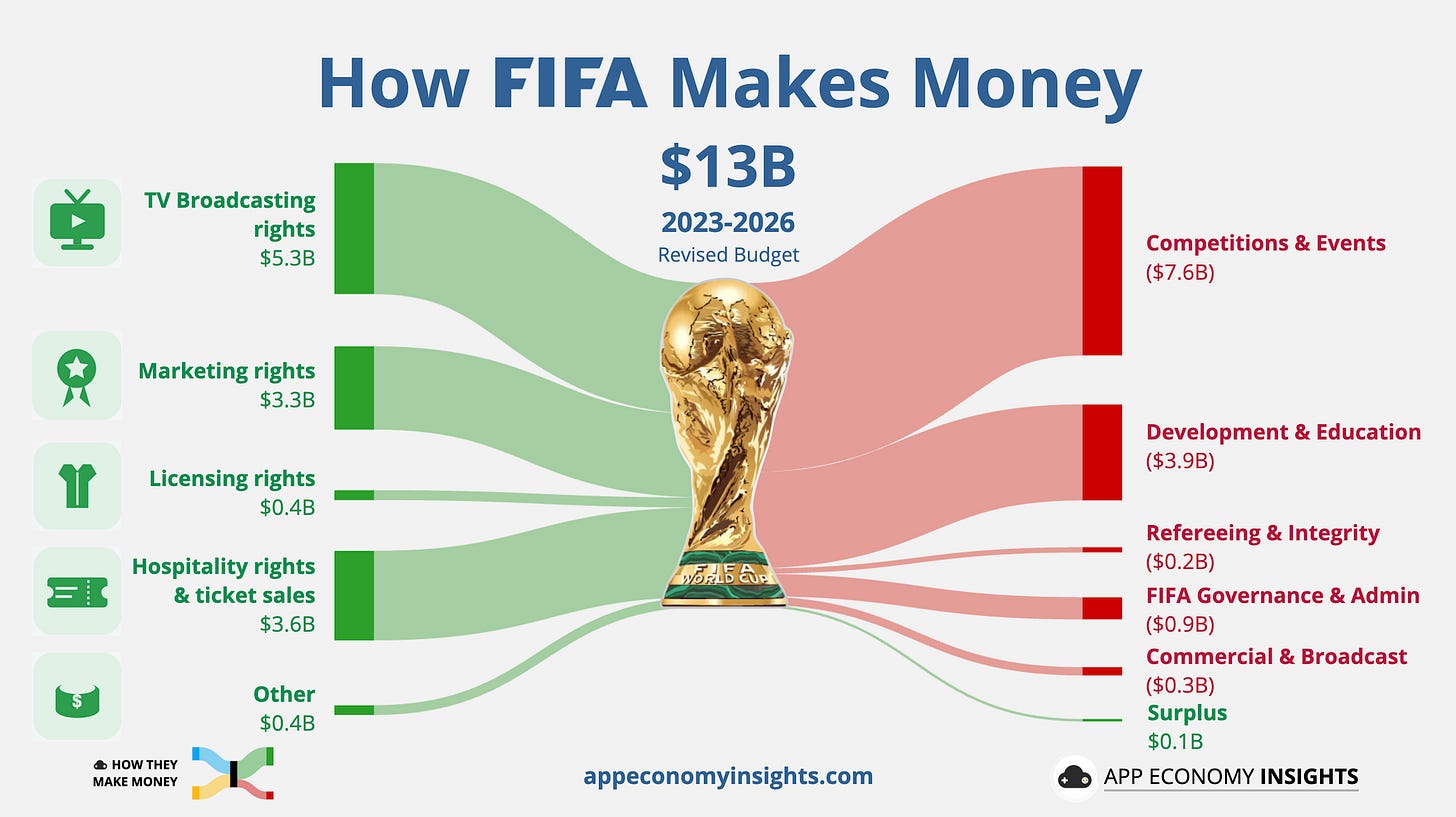
Revenue Generation (The \(\$13\) Billion Machine)
IFA expects to bring in \(\$13\) billion for the 2023-2026 cycle.
Core Revenue Streams (see the screenshot):
- TV Broadcasting (~40%): Remains the single largest revenue driver.
- Hospitality & Ticketing (~28%): Seeing a massive spike due to the introduction of dynamic pricing (causing top-tier tickets to climb past \(\$32,000\)).
- Marketing & Sponsorship (~25%): Major global brand partnerships.
Where the Money Goes (see the screenshot):
Asset-Light Execution: The 2026 World Cup relies entirely on existing stadiums (mostly NFL venues), meaning significantly fewer infrastructure costs compared to Qatar's \(\$200\) billion buildout.
Redistribution Moat:
~58% goes to staging tournaments and events, including a record \(\$871\) million prize pool (the champion takes home \(\$50\) million).
~30% goes to development and education, which directly funds all 211 member federations. Critics view this massive financial backing as a highly durable patronage machine that secures votes for leadership.
When revenue beats expectations, the surplus flows into a reserve that is now approaching \(\$2.7\) billion.
Key Risks & Controversies
- While the base ticket price remained at $60 to account for inflation, the average ticket price is estimated at \(\$1,300\)—a 1,000% inflation-adjusted increase since 1994, threatening the "universal" appeal of the sport
- Local governments (like Boston and Kansas City) are on the hook for tens of millions in transportation and security costs, while FIFA retains the upside from ticket sales.
- FIFA is actively trying to smooth out its volatile 4-year cycle and reduce dependency on a single tournament by introducing new properties, such as the expanded 2025 Club World Cup and targeting a $1 billion revenue mark for the 2027 Women's World Cup.
The Trillion-Dollar Off Switch - App Economy Insights [Link]
Takeaways:
- Regulatory Shock: Because Anthropic could not screen users by nationality in real time, it had to disable Fable 5 and Mythos 5 worldwide. This sets a major precedent showing that a company's single most valuable frontier asset can be turned off overnight by the government.
- The New Risk Variable: Choosing whether to build or rent an AI model
is no longer just about cost and control; it is now about regulatory
shutdown risk.
- Companies like Anthropic and OpenAI have their entire business riding on their frontier models, making them highly vulnerable to sudden regulatory shocks right as they head toward massive IPOs. Diversified companies (like Google) have other revenue streams to absorb the blow.
- Apple Strategy: Instead of building a massive frontier model, Apple
opted to rent a custom, 1.2-trillion-parameter version of Google’s
Gemini for its new Siri AI, paying Alphabet a reported \(\$1\) billion a year.
- By renting, Apple avoids the massive capital expenditure (CapEx) arms race and limits its direct exposure to model commoditization. It focuses instead on what it owns: the user's personal context and privacy.
- Apple yields control of its flagship intelligence product's roadmap and pricing to a direct competitor. Furthermore, it is only partially hedged; if Google's models get targeted by a government directive, Siri goes dark too.
Bottom Line: The core metric for AI investors is no longer just who has the most powerful model, but who can reliably keep it online within an increasingly complex regulatory perimeter.
How to Invest in IPOs - App Economy Insights [Link]
To beat the unfavorable base rates of a hot listing (like SpaceX, OpenAI, or Anthropic), follow a deliberate, patient strategy:
- Let the Volatility Pass: Never rush to buy on Day 1 at peak-euphoria valuations.
- Wait for the Second Earnings Call: Give the company two quarters as a public entity. This establishes a trendline, proves whether management can accurately forecast, and lets early lock-ups expire.
- Size Exceptionally Small: Start with a tiny "nibble" in year one so that an early 50% drawdown won't disrupt your portfolio or peace of mind.
- Anchor to Fundamentals: Base your investment on whether the valuation leaves a margin for error, not on the excitement of the narrative.
The M&A Land Grab - App Economy Insights [Link]
In the framework of the technology "land grab," companies are aggressively acquiring businesses to control specific control points before the market architecture hardens.
There are four critical layers of technology to control in a strategic race before the market structure hardens.
The Workflow Layer
- What it is: The digital environment or application where a user spends their time actually doing their primary job or task (e.g., writing code, managing a pipeline, creating a design).
- Why it matters: Sitting inside the workflow is the ultimate defensive moat because it captures the user’s active attention and creates high switching costs. If you own the workflow, you own the initial point of entry.
- The M&A Example: SpaceX’s acquisition of Cursor. Software developers live inside their IDE (Integrated Development Environment). By controlling Cursor, SpaceX/xAI captures the exact interface where developers are "vibe coding," giving them immediate influence over the tools and infrastructure developers use to build applications.
The Interface / Agent Layer
What it is: The layer that translates user intent into execution. In the AI era, this is shifting from static buttons and menus to autonomous AI agents that can execute multi-step tasks natively on behalf of the user.
Why it matters: The interface layer is where choices are made. If an AI agent can successfully handle a task (like resolving a customer issue or booking a flight), the user no longer needs to navigate downstream software. The agent becomes the gatekeeper to all other services.
The M&A Example: Salesforce’s acquisition of Fin. Salesforce already owns the enterprise customer records (system of record), but by adding Fin, they gain a highly specialized, conversational AI agent layer (system of action) that can actively solve customer support issues across email, chat, and Slack without human intervention.
The Distribution Layer
What it is: The gateway or platform that aggregates and controls audience attention, acting as the primary pipeline through which products, media, or services reach the end consumer.
Why it matters: Without distribution, even the best content or product can be buried and rendered invisible by competing algorithms or operating systems. Whoever owns the distribution layer dictates the monetization terms, owns the first-party viewer data, and controls the ad load.
The M&A Example: Fox’s acquisition of Roku. Fox is an expert content creator (sports, news, Tubi), but content providers are at the mercy of the hardware and operating systems people use to watch TV. By buying Roku, Fox graduates from a mere content supplier to the owner of the physical living room gateway—allowing them to control home-screen placements and monetization for over 100 million households.
The Data Loop
What it is: A continuous feedback mechanism where product usage generates data, that data is used to improve the underlying models or product, and the improved product attracts more users.
Why it matters: This creates a powerful flywheel effect. The company with the most active workflow or interface captures the most high-quality, real-world data, making their AI or system smarter than competitors who are relying on static or scraped datasets.
The M&A Example: This layer underpins both tech deals (Cursor and Fin). For instance, as thousands of enterprises route customer interactions through Fin, the system maps out successful resolutions, continuously training Salesforce’s broader Agentforce platform to be more accurate and efficient over time.
Micron: Locking In the Boom - App Economy Insights [Link]
Takeaways:
Micron Technology is one of the world's largest semiconductor companies, specializing in memory and data storage technologies. Unlike tech companies that design software or processing chips (like CPUs or GPUs), Micron manufactures the physical hardware that allows computers, servers, and smartphones to hold and access data.
- Revenue surged +346% year-over-year to \(\$41.5\) billion, driven by skyrocketing demand for AI infrastructure. Micron’s data center business alone has cleared a \(\$100\) billion annualized run rate.
- Almost none of the growth came from selling more chips. Instead, due to severe capacity constraints, DRAM prices jumped over 60% and NAND prices rose in the mid-80s% in a single quarter, resulting in a staggering 85% gross margin.
- To combat memory's historical cyclicality, Micron is leveraging Strategic Customer Agreements (SCAs). These are 5-year, take-or-pay contracts that lock in volumes and price floors through 2030, backed by ~\(\$22\) billion in customer deposits and guarantees.
- Micron’s massive margins represent a severe cost line for everyone else. Hardware giants like Apple and HP are raising device prices to absorb the memory crunch, and Micron's CEO expects supply shortages to stretch past 2027.
Narrative Violation: In B2B customer support, AI is a Copilot, Not a Replacement - a16z New Media [Link]
Takeaways:
- In the business-to-business (B2B) world, AI is only resolving about 15% of tickets entirely on its own (compared to 35% in B2C, where stakes are lower). Instead of replacing humans, AI is doing the background work to make humans faster and better at their jobs.
- If AI isn't closing every ticket, what is it doing? The data shows
it excels at two things:
- Filtering out the noise: About 33% of all incoming support emails/messages are just "garbage" (marketing spam, automated system notifications, or accidental emails). AI quietly filters these out so humans don't waste time on them.
- Silent Triage: Two-thirds of the time, the AI reviews an incoming question, realizes it's too complex for a bot, and quietly hands it off to a human specialist with the right context attached.
- When AI actively helps on a ticket—even if a human ultimately has to step in and finish it—it cuts the human's workload by about a third. Because the AI does the initial reading, sorting, and basic troubleshooting, the human support agent takes fewer messages to solve the problem than they normally would. Furthermore, customer satisfaction (CSAT) remains just as high in these hybrid human-AI setups as it does with purely human support.
- The article points out that AI support gets dramatically more
successful under two conditions:
- If you give the AI access to account data (knowing who the customer is, what they bought, and their history), it resolves more tickets and gets higher ratings.
- Companies that build their workflows around AI from the ground up have much better success rates.
Why Japanese companies do so many different things - David Oks [Link]
Takeaways:
What it is: The phenomenon of extreme corporate diversification in Japan (the "J-Firm"), where companies like Toto (toilets) or Kyocera (ceramics) successfully operate across completely unrelated, high-precision industries (such as semiconductor components).
How it works: It operates as a self-reinforcing "bundle" of horizontal practices. Instead of top-down vertical hierarchies, information flows laterally. It relies on lifetime employment, intensive generalist training, seniority-based pay, and insulation from outside shareholder pressure through insider boards and bank financing.
Why it works: Because employees cannot easily be fired and are deeply invested in the company, the primary corporate motive shifts from maximizing short-term investor profit to ensuring long-term survival. Diversification allows firms to hedge risks, reinvest earnings, and pivot to protect jobs when core markets decline.
Historical roots: The system originates from the "1940 system"—a planned, production-at-all-costs economy established by Japan during WWII mobilization. This state-controlled, employee-centric economic structure survived the war and became entrenched during the postwar era.
Strengths: Uniquely optimized for "moderate volatility" and catch-up growth. It excels at incremental, long-term shop-floor refinements, making Japan dominant in precision materials, optics, and automotive manufacturing.
Weaknesses: Highly rigid and poorly suited for sharp market discontinuities, top-down strategic shifts, and paradigm-shifting innovations (e.g., software, smartphones, and AI platforms).
train your attention span SO GOOD it feels weird to scroll - Drishti Pandita [Link]
The 5 Rules to Reset Your Attention
- Don't rely on willpower. Move your phone charger to another room overnight, hide distracting apps in folders, and keep books on your bedside table.
- Dedicate 30 minutes to absolute under-stimulation (no phone, no podcasts, no music). Do chores, walk, or just stare at a wall to let your baseline reset.
- Do not touch your phone, email, or social media for the first hour after waking up. The circuit you fire first wins the day.
- Put strict 30-minute app timers on "slot machine" feeds (Instagram, X, LinkedIn), turn off non-human notifications, and use greyscale mode.
- Once a quarter, do a 7-day digital detox. Eliminate scrolling, streaming, and constant podcasts. By day 7, your baseline will recover, and you will remember what your own thoughts sound like.
What Did Claude Just Kill? 6 Moats to Protect Yourself. - Peter H. Diamandis [Link]
Anthropic is rapidly packaging Claude’s latent AI capabilities into user-friendly vertical tools—specifically targeting design, legal, and small business SaaS platforms. This "unhobbling" has triggered significant drops in valuation for traditional incumbents like Figma, Thomson Reuters, and Intuit, while fueling Anthropic's own revenue growth to a \(\$30\) billion run rate.
To survive this shift, the author argues that software companies must move past thin "scaffold" applications and build defensible businesses anchored by six specific moats:
- Deep Customer Relationships: Embedding deeply within organizations to make switching highly disruptive.
- Proprietary Data Flywheels: Utilizing massive, unique datasets (like QuickBooks) that AI cannot easily replicate.
- Trusted Brand Identity: Serving as a proxy for trust and compliance in regulated markets.
- Physical-World Integration: Linking services directly to atoms, logistics, hardware, or brick-and-mortar operations.
- Regulatory and Compliance Infrastructure: Navigating deeply entrenched institutional gatekeepers (e.g., FDA, HIPAA, SEC).
- Network Effects: Building expansive ecosystems and platforms that become indispensable to third parties.
The Semantic Medallion: Building a Knowledge Graph-Powered Data Catalog - Veronika Heimsbakk [Link]
About transforming raw data sources into a unified knowledge graph in four lines of Python
My brutal advice to someone who wants financial freedom - Tim Denning [Link]
Takeaways:
Ditch "Sales Skills" for Credibility
Be Authentic: Humans are hardwired to resist being sold to. Focus on building trust and being knowledgeable rather than using aggressive sales tactics.
Walk Away: If a pitch doesn't resonate, don't force it. Move on instantly to find the right alignment.
Rational Empathy & Charisma
"Yes, And": Use this not as a trick, but as rational empathy—reason your way to their valid position before reinforcing your own.
Charisma: True charisma is the ability to project confidence (power) and love (good intentions) simultaneously.
Effective Honesty: Being blunt but kind is the most effective way to communicate. If you are honest but unkind, people won't listen.
Lead, Don't Manage
Management vs. Leadership: Management is telling people what to do; leadership is inspiring them to want to do it.
Autonomy Breeds Freedom: Giving high-agency people a taste of freedom makes them incredibly driven, yet ultimately "unemployable" in traditional corporate structures.
Hunt in High-Trust Teams
- The "Stag Hunt" Model: Modern society thrives on high-trust cooperation. Small groups of highly competent people working together can accomplish what seems impossible. Avoid low-trust, heavily bureaucratized environments where people are forced to hunt alone.
Feed Your Obsessions
- Inspiration > Frameworks: Business books and frameworks are secondary to pure motivation. If you are genuinely obsessed and excited about a product, selling it won't feel like sales at all.
Focus on Nonlinear Upside
Don't Fight Over Crumbs: In technology and investing, returns follow a power law (the winner takes almost everything). Don't waste time splitting hairs over a small pie; focus entirely on long-term, exponential upside.
Preserve Your Peace: Walk away from suboptimal, highly constraining deals. Prioritize your time, reputation, and mental peace over blindly making more money.
how to enter side doors - Maja [Link]
Takeaways:
- Reframe what a "job" is: A company is not just a collection of job boards and role titles; it is a group of people trying to solve a bundle of problems. A job is simply someone paying you to solve those problems.
- The front door is crowded: Relying entirely on traditional job postings and resumes results in disappearing into automated, AI-saturated noise where human signal is easily lost.
- Leverage two types of side doors:
- Outbound: Proactively reaching out to individuals with highly tailored, specific ideas, teardowns, or prototypes rather than a generic "can we chat?" request.
- Inbound: Creating public artifacts (essays, tools, research) so that your thinking travels ahead of you and acts as a beacon for the right people to find you.
- Specificity is respect: Generic messages fail. Demonstrating that you deeply understand a person’s work, company, and precise bottlenecks creates a high-quality human signal.
- Practice audacity with proof: If you want an unusual or creative career path, you must act unusually. Move forward with small, undeniable units of work without waiting for permission or a perfectly scoped job description to exist first.
Choosing to Stay Human - Ethan Mollick, One Useful Thing [Link]
The goal is not to avoid AI, but to consciously choose which tasks to automate (like rote administrative work) and which to keep human (like deep thinking and writing) to avoid losing vital mental capabilities.
Reports and Papers
Will the future of finance be shaped by talent or technology? - EY Global DNA of the CFO Survey, EY [Link]
Takeaways:
1: Why the CFO Role Should Change Now
- The Challenges:
- 60% of CFOs want to define how their business creates value, but only 25% actually lead investment decisions where returns are uncertain or long-term.
- Most organizations still see finance as a control, risk, or operational function rather than a strategic partner. CFOs spend 47% of their capacity on routine operational tasks.
- 71% say traditional metrics are insufficient to evaluate initiatives that combine people and technology.
- The Solutions:
- Take proactive ownership of high-uncertainty investment decisions and evolving value drivers.
- Redesign value measurement frameworks to capture the long-term impact of technology and new ways of working.
- Simplify processes, automate routine tasks, and restructure operating models to free up capacity for strategic work.
2: How Finance Can Enhance Value Creation (AI Readiness)
- The Challenges:
- Only 21% of CFOs describe their function’s AI preparedness as leading or advanced.
- Securing budget for AI is heavily constrained by data quality/bias (61%), unclear or indirect long-term benefits (51%), and a lack of skills/capacity (50%).
- Most finance teams focus AI efforts on defensive applications (fraud detection, risk assessment) rather than growth-oriented applications (dynamic pricing, growth forecasting).
- The Solutions:
- Prioritize underlying data quality, robust governance, and cross-functional data integration.
- Shift AI focus away from strictly defensive applications toward scalable, growth-focused, and decision-supporting capabilities.
- Embed repeatable AI capabilities directly into core finance processes.
3: Finance Transformation is About People
- The Challenges:
- Only 12% of CFOs say their finance transformation outcomes exceeded expectations over the past two years; 40% reported slow or limited progress.
- Finance professionals are traditionally trained to avoid mistakes and maintain high control, which creates a cultural resistance to experimentation.
- Low Adaptability: Only 11% of CFOs describe their teams as highly adaptable, despite adaptability being a key driver of transformation success.
- The Solutions:
- Invest heavily in team mindset, building a culture that safely supports change, continuous learning, and calculated experimentation.
- Build hands-on technology confidence by embedding new tools into day-to-day operations.
- Prioritize team wellbeing and manage workloads to sustain energy through transformation periods.
4: The Future CFO: New Mindsets, Skills, and Leadership Styles
- The Challenges:
- While 68% of CFOs agree they must develop new leadership styles rather than rely on past expertise, 61% still rely almost exclusively on passive, self-directed learning (reading/online resources).
- CFOs rank "people and culture leadership" as only their fifth development priority, despite identifying it as their second-weakest capability.
- Underutilized Mentoring: Only 37% participate in reverse mentoring with junior staff, missing a vital avenue for learning about emerging technologies.
- The Solutions:
- Prioritize firsthand leadership experience in digital transformation, complex investment decisions, and value-driver management.
- Utilize modern, interactive development pipelines such as reverse mentoring, stretch roles, and cross-functional rotations.
- Establish formal leadership pipelines and clear succession plans tied directly to ongoing transformation initiatives.
- AI is creating a ‘two-track’ labour market: ‘professionalised’ roles (in which AI acts like a force multiplier for experts, requiring more human-intensive skills) see greater growth across headcount and wages than ‘democratised’ roles (in which AI makes the role itself easier for non-experts to perform)
- Companies most able to use AI are seeing faster headcount growth than the least AI-exposed companies (52% vs 36%) and higher wage growth (24% vs 17%)
- “Super-star companies” most exposed to AI achieved labour productivity gains of 163%, significantly outpacing other businesses
- Jobs requiring specific AI skills are growing almost eight times (69%) faster than the total jobs market (9%), with the average wage premium for AI skills rising to 62%
- Entry-level outlook diverges: Analysis of US data shows AI-exposed entry-level roles are seven times more likely to require traditionally senior-level skills such as judgement and leadership. These roles grew 35% since 2019, while other entry-level roles declined by 10%
― AI reshapes global labour market into two distinct paths, rewarding human skills: PwC 2026 Global AI Jobs Barometer [Link]
Two futures for jobs in an AI era - 2026 AI Global Jobs Barometer, PwC [Link]
AI for CEOs: Amplifying Time and Judgment at the Top - BCG [Link]
Core insights:
- CEOs who generate meaningful value from AI spend at least eight hours a week actively building their own AI capabilities. While 72% of CEOs are directly responsible for AI decisions, only 15% are currently capturing real value.
- Leaders are moving past generic, off-the-shelf tools toward customized agentic systems tailored to their specific strategic contexts, priorities, and decision-making history.
- While AI improves mid-level productivity, its highest-value application is at the leadership level, expanding a CEO's most constrained resources: time and judgment.
4 Crucial Leadership Risks
- Literacy \(\neq\) Expertise: A polished, fluent AI response can easily mask weak assumptions, missing context, or low-confidence conclusions.
- Speed \(\neq\) Judgment: AI always has an answer, but compressing the path to a conclusion should not replace the human time required to absorb, challenge, and decide.
- AI-Driven Groupthink: Using uniform models and identical data can reduce a leadership group's diversity of thought by up to 41%.
- Cognitive Overload ("AI Brain Fry"): More automated synthesis increases the burden to review, verify, and correct data. Roughly 14% of AI users report mental fatigue from excessive oversight.
Strategic Guardrails: To ensure AI acts as a force multiplier rather than a distraction, leaders must continually evaluate:
- Whether tools are genuinely exposing hidden risks and clarifying trade-offs.
- If active human dissent and alternative models are built into the review process to challenge AI assumptions.
- How to track and measure the long-term quality of AI-assisted decisions.
AI at Work: Strategy Matters More Than Tools - BCG [Link]
Takeaways
- Around 74% of frontline employees are now regular AI users (up 23 percentage points from 2025). Among these regular users, 42% report saving an average of 8 hours per week (a full workday).
- Despite massive time savings, 66% of employees receive limited or no guidance on how to spend that extra time, and more than half fail to redirect it into strategic work.
- "Strategic clarity" from leadership is the ultimate differentiator. Organizations with a clear, explicit AI plan capture more value and sustain employee engagement far better than those that simply provide access to advanced tools without direction.
- Awareness and integration have skyrocketed, with 30% of organizations already embedding autonomous AI agents into workflows (up from 13% in 2025). Consequently, 61% of employees believe AI agents could perform at least half of their job within the next three years.
- Management structures, upskilling, and governance have not kept pace with technology. Only 36% of employees feel they have received adequate upskilling, and half of the organizations lack clear governance for managing hybrid human/AI teams.
CEO Imperatives: To succeed, leaders must move past individual tool deployment and focus on redesigning core processes end-to-end, tracking actual business value over simple adoption metrics, and personally owning the strategic vision.
From Recovery to Resurgence - BCG [Link]
Takeaways:
- The global fintech industry has decisively moved past the 2023/2024 "fintech winter." Revenues grew 22% in 2025 to surpass \(\$500\) billion, outpacing traditional incumbents four times over.
- Growth is now defined by profitability and caution rather than 2021-style exuberance. Scaled leaders are consolidating, funding has become highly selective (Series E+ is up while seed stages contract), and public markets are imposing stricter scrutiny on IPOs.
- Real near-term value is being unlocked in backend operations (engineering, fraud detection, compliance) rather than consumer-facing experiences. AI-native product development teams are delivering up to five times faster.
- As consumers pivot to GenAI tools for discovery, digital marketing is shifting from Search Engine Optimization (SEO) to Generative Engine Optimization (GEO). "Recommendation-worthiness" is replacing traditional keyword bidding.
- Fintechs are increasingly being pulled into banking-style regulatory perimeters globally. Navigating bank charter applications or stricter compliance models offers lower funding costs but demands higher governance standards.
- While digital assets represent 15% of global fintech revenues, utility remains narrow. Stablecoins are primarily tethered to crypto trading and regional dollar access; tokenized real-world assets (money market instruments, alternatives) offer the most credible path to broader future scaling.
Articles and Blogs
What Companies Get Wrong About Decision Rights - Lindy Greer, Jennifer Jordan and Maxim Sytch, Harvard Business Review [Link]
Takeaways:
The Core Problem: Many organizations use decision-rights frameworks (like RACI, ARCI, or RAPID) incorrectly, turning them into static spreadsheets that teams ignore rather than dynamic processes that guide behavior.
The 4 Common Mistakes & How to Fix Them
- Mistake 1: Confirming Roles Without Clarifying Goals
- The Issue: Defining who decides before clearly outlining what is being decided leads to ego-driven turf wars.
- The Fix: Clearly articulate specific, measurable, and time-bound subgoals first. Breaking a massive goal into smaller pieces often reveals that different stakeholders actually want to own different subgoals.
- Mistake 2: Assuming Everyone Will Adhere to the Boss’s Spreadsheet
- The Issue: Mandating roles top-down or overcomplicating files with thousands of rows results in zero buy-in.
- The Fix: Co-create frameworks with the team. Use the tool as a conversation starter to air tensions and align expectations up front.
- Mistake 3: Misunderstanding Roles
- The Issue: Teams frequently disagree on what roles actually mean (e.g., confusing "Accountable" with "Responsible") or invite too many people to the final decision meeting for fear of exclusion.
- The Fix: Define concrete, behavioral rules for each role:
- Accountable (A): The single decision owner. They lead the debate and make the final call.
- Responsible (R): A small group (2–4 people) who provide critical input and debate options. Only "A" and "R" should be in the final decision room.
- Consulted (C) / Informed (I): Non-decision-makers who provide expertise beforehand or support execution afterward.
- Mistake 4: Getting Stuck in the Same Roles
- The Issue: Executives default to holding all accountability, which burns them out and disempowers lower-level managers who possess deeper local expertise.
- The Fix: Dynamically shift roles based on the topic, not the org chart. Senior leaders should challenge themselves to hold accountability for only a few enterprise-wide decisions a year and delegate the rest.
The Power of Strategic Centering - Rita McGrath, Harvard Business Review [Link]
Takeaways:
In a "dematerializing" economy—where 90% of corporate value lies in intangibles (data, software, brands) rather than physical assets—traditional, rigid industry boundaries are collapsing. Strategic centering is the deliberate choice of one clear organizing principle to anchor a company's identity, simplify resource allocation, and enable fast, decentralized decision-making.
The 5 Strategic Centers: Companies must choose one dominant dimension to organize around:
- Mission Centering: Organized around solving a massive, enduring problem, regardless of the technology used (e.g., Shopify focusing on "making commerce better for everyone" across software, logistics, and finance).
- Customer Centering: Organized around deep, evolving customer needs and "jobs to be done" (e.g., Amazon starting with the customer and working backward into cloud computing, streaming, and groceries).
- Technology Centering: Organized around deep, transferable capabilities to find applications across random-looking domains (e.g., Fujifilm pivoting film chemistry into cosmetics and medical imaging; Nvidia moving from gaming to AI).
- Ecosystem Centering: Organized around building a critical national or regional system, often relying on public-private alignment and long-term horizons (e.g., TSMC building Taiwan’s "silicon shield").
- Friction Erasure Centering: Organized around systematically making a complex domain effortless using digital tools (e.g., Toss eliminating legacy friction in South Korean financial services).
Core Benefits & Leadership Insights
- A clear center allows employees to make rapid decisions and launch initiatives without waiting for corporate approval, drastically cutting bureaucratic friction and internal politics.
- The most successful centered organizations are not run by hands-off managers. They require deeply engaged, intensely visible leaders (like Nvidia's Jensen Huang or Airbnb's Brian Chesky) who actively protect and reinforce the "center" daily.
6 Ways Leaders Harness Stress - Jon Miller and Drew Keller, Harvard Business Review [Link]
The 6 Stress Response Patterns
Under pressure, leaders typically default to one of six archetypes based on whether they view stress as an opportunity or a threat, and whether they react with composure or dynamic action:
- The Lighthouse (Opportunity + Composed): Projects calm and stability to create psychological safety, but risks looking aloof or falling into inertia.
- The Alchemist (Opportunity + Dual): Treats turbulence as fuel for innovation and growth, but can exhaust teams with constant, chaotic pivots.
- The Firefighter (Opportunity + Dynamic): Thrives on adrenaline and swift execution, but can burn out teams and create impulsive, costly decisions.
- The Stoic (Threat + Composed): Relies on cool logic and self-control, but risks emotionally alienating the team and internalizing stress.
- The Diplomat (Threat + Dual): Uses high social intelligence to defuse conflict and unite teams, but may prioritize consensus over necessary candor.
- The Container (Threat + Dynamic): Imposes rigid structure and control to filter out noise, but can isolate others by operating behind closed doors.
Key Actionable Learnings
- High performance isn't about having the "perfect" default style; it’s about adaptability. Intentionally practice strategies outside your comfort zone (e.g., a Firefighter pausing to scan the horizon like a Lighthouse).
- Don't assume the strategy that solved the last crisis will work on the next one. Continuously test and adjust your style based on real-time feedback.
- Leaders shouldn't absorb stress alone. Build executive teams with a diverse mix of these 6 styles, and lean on a trusted circle of peers, mentors, or coaches to distribute the psychological burden.
How Agentic AI Supercharges Startups and Threatens Incumbents - Vivian S. Lee, Linda Mantia and Jon McNeill [Link]
Takeaways:
- Technology is advanced to coordinated networks of specialized AI agents that can autonomously plan, act, adapt, and pursue broad organizational outcomes rather than just resolving isolated tasks.
- The cost, time, and headcount needed to build, test, and pivot a startup have collapsed. Teams that used to require 6–8 people can now launch with just a domain expert and an AI engineer.
- The Five Forces of Disruptive Change:
- Digital products can be modified instantly based on feedback using natural language or "vibe-coding" tools, shrinking product-market fit timelines from over a year to mere days or weeks.
- Startups can autonomously generate marketing content, test thousands of variants, dynamically shift ad spend, and automate complex client onboarding workflows.
- Internal operations (HR, legal, engineering critique) can be highly automated. Internal "AI librarians" continuously index and preserve company knowledge, eliminating data fragmentation.
- AI-native companies require up to 80% less capital and 20% to 40% less time to hit major milestones like a Series A.
- Deep integration into customer workflows creates a self-reinforcing learning loop. More usage yields deeper data insights, improving agent performance and building high switching costs.
- Established companies cannot simply bolt AI onto messy processes. They suffer from structural silos, cultural resistance from middle management, and technical debt. They must completely re-architect and simplify workflows before automating them.
- AI-native startups lack the rigorous compliance, audit trails, risk mitigation, and incident-response frameworks that incumbents have spent decades refining.
- The need for elite human judgment, empathy, and managing edge cases will rise. The winning future architecture is one where humans and AI agents explicitly design processes to learn together.
How Elite Sports Coaches Make High-Pressure Decisions - Alan McCall, Adrian Wolfberg, Johann Bilsborough and Ricard Pruna, Harvard Business Review [Link]
Takeaways:
Before: Disciplined Preparation Over Instinct
Anticipate the Scenario: Elite coaches do not rely purely on gut instinct or on-the-spot reactions. They actively map out and simulate pressure scenarios before they ever occur. As one Rugby World Cup coach summarized: "You have to anticipate situations that require a decision and find the solution in advance."
Build the Foundation Early: The quality of a high-stakes decision is often pre-determined by the level of trust, culture, and relationships established long before a crisis hits.
During: Extreme Information Filtering & Emotional Control
Limit the Inputs: To avoid "decision paralysis" or clouding your judgment, strictly restrict incoming data to a vital few metrics or signals during crunch time. A championship-winning rugby coach highlighted a rigid cap: "Never more than three pieces of information."
Filter Out Noise: An NBA coach similarly emphasized that receiving too much feedback from too many people leads to bad choices. Rely on focused, pre-filtered, highly valuable data streams to keep your mind clear.
Maintain Social Awareness: Leaders must manage their own emotional control while reading the temperature of the room (or field) to maintain absolute presence.
After: Accountability and Continual Optimization
Deconstruct the Choice: Post-crunch-time, coaches prioritize deliberate, objective reviews of the decision-making process itself rather than just looking at the outcome.
Iterate the System: Use real-world feedback loops to update your playbook, ensuring systemic adjustments prevent the same high-pressure blind spots from repeating.
The Corporate Parallel: For business leaders, this means shifting from a reactive "firefighting" mindset to a highly structured framework where crunch-time operational variables are minimized, and crisis plays are mapped out ahead of time.
Life’s Work: An Interview with José Andrés - Alison Beard, Harvard Business Review [Link]
Takeaways:
- Learn the rules like a pro so you can break them like an artist.
- Flexibility beats a fixed plan. True success doesn't come from having a perfect script, but from your ability to improvise, pivot, and problem-solve the moment the unexpected happens.
- No money, no mission. Passion and creativity are great, but if the bills aren't paid, the business closes. To keep doing what you love, you have to understand the numbers and run a financially tight ship.
- Attitude over résumé. Hire for Passion, Not Just Skill You can train someone on technical skills, but you can't force them to care. Hire people who are naturally curious and driven, and they will figure out the rest.
- Diversity and community are strengths. In business, philanthropy, and politics, the most effective way to bridge disagreements and make an impact is to invite people to sit down together, share a meal, and build empathy.
Code Isn’t Product - Richard Mironov [Link]
Takeaways:
- While AI solves the problem of engineering speed, it exacerbates the
problem of customer acquisition. In a market flooded with "AI slop,"
clear and customer-centric positioning matters more
than ever.
- Clear and customer-centric positioning is defined by how you
describe and frame your offering to the market. Specifically, it relies
on two core principles:
- Using the Right Language: It must be built from the exact language your actual users and prospects use to describe their perceived problems, rather than the technical language your engineers use to explain the solution.
- Grounding in Real-World Discovery: It requires deep, systematic discovery—meaning you must actively talk to real, human customers and prospects (rather than relying on internal assumptions or "synthetic users") to understand how they experience their pain points and how they evaluate software.
- Clear and customer-centric positioning is defined by how you
describe and frame your offering to the market. Specifically, it relies
on two core principles:
- The "Forward-Deployed Engineer" Symptom: The rising trend of placing
dedicated engineers on-site to help enterprise customers deploy AI
products is often a workaround for incomplete product design. If a
customer needs a full-time engineer to realize a tool's value, the
company has shipped a framework rather than a finished solution.
- The distinction:
- A Product is self-contained. The customer can log in, understand its purpose, configure it easily, and start extracting business value with minimal hand-holding.
- A Framework is a pile of raw building blocks. It has massive potential, but it requires a software engineer to actually build the final application before anyone can use it.
- If your product requires a resident human genius to make it work, you haven't shipped a product—you've shipped a construction site and sent along a builder.
- Mironov is warning that embedding engineers on-site is often product debt disguised as customer service. While it might keep a high-value client happy in the short term, it is a scaling bottleneck that proves the underlying software is not yet a complete, market-ready product.
- The distinction:
Core Learnings for Product Leaders
- Prioritize Real Discovery: You must talk to actual human users extensively before shipping code. Relying on synthetic users or internal assumptions will likely result in technically impressive but commercially dead-on-arrival (DOA) products.
- Build Solutions, Not Toolkits: Avoid shifting the burden of product definition onto the customer or expensive, non-scalable professional services.
- Double Down on Product Strategy and Marketing: As the short-term thrill of high engineering velocity wears off over the next few quarters, long-term commercial success will depend entirely on strategic product thinking at the front of the development cycle and brilliant product marketing at the back.
Self-Fulfilling Projects - Dave Hora [Link]
Takeaways:
A "self-fulfilling project" is any initiative that establishes its own importance through a highly seductive narrative rather than actual external demand, operational capacity, or objective data.
Examples:
- Korn committed to the romantic story of being a pure, self-employed craftsman who built furniture entirely by hand to maintain his creative integrity.
- "We must integrate Generative AI / Web3 / Blockchain into our core product because it is the future of our industry, and staying ahead of the curve is vital to our brand survival."
- "Our current codebase is holding us back. We need to completely pause feature development and rewrite our entire platform from scratch using a modern microservices architecture."
- "We need to restructure our entire 500-person organization into 'squads, chapters, and guilds' because this model made Spotify successful. This will make us highly innovative."
The problem: These projects feed on personal authority (often from high-level sponsors) and self-sealing logic. Because they are rooted in narrative rather than background facts, they are highly resistant to traditional, rational pushback or outside data.
The Solution: You cannot fight a self-fulfilling project from the outside. Instead, you must temporarily suspend disbelief, enter the project's internal logic, and rebuild a concrete, specific counter-structure using the language of the project itself.
Methodologies like Wardley Mapping can help turn these subjective narratives into tangible, discussable assertions that can be challenged without directly threatening a leader's authority.
In the context of fighting "self-fulfilling projects," the biggest challenge is that you cannot defeat a compelling story with raw, outside facts. The narrative is too slippery.
Methodologies like Wardley Mapping act as a solution tool because they shift the battleground. Instead of an emotional or political "story fight" between a team member and a powerful sponsor, it translates subjective narratives into a shared, visual, and challengeable map of reality.
What “done” means when you’re shipping AI features - Jeff Gothelf [Link]
Takeaways:
In traditional software development, code is deterministic. AI, however, is probabilistic. Because of this inherent unpredictability, Jeff Gothelf argues that our definition of "done" must evolve. Here is what that breakdown means in practice:
A Calibrated Distribution of Acceptable Outputs
Instead of expecting a single, binary "correct" answer (an assertion), you define success using statistical ranges (a distribution).
The Old Way (Assertion): "When the user asks for a summary, the system returns a 3-bullet-point summary." (If it returns 4, the test fails).
The AI Way (Distribution): "In 90% of cases, the system returns a high-quality summary. In the remaining 10%, the summary might be slightly too long or miss a minor point, but it remains coherent and safe."
Calibration is the act of actively deciding and testing what those percentages should be for your specific product and brand risk tolerance.
Managed Behavioral Variance
"Variance" is the reality that the AI will behave differently across users, prompts, and sessions. "Managed" means you aren’t just crossing your fingers and hoping for the best; you have guardrails and safety nets ready for when it inevitably acts up. This involves:
Graceful Degradation: When the model fails, it fails safely (e.g., returning a helpful "I'm not sure" message instead of confidently hallucinating a fake stat).
Tripwires and Monitoring: Setting up automatic alerts for key metrics (like an uptick in user thumbs-down ratings or off-tone language).
Rehearsed Rollbacks: Having a clear, practiced protocol to instantly revert the feature or swap back to a safer model version if a tripwire is crossed.
Shipping an AI feature is no longer about proving your code is 100% perfect. It is about proving that you understand how often your AI will fluctuate, that those fluctuations are within a tolerable range, and that you have a plan ready for when it misbehaves.
Mission vs Goal: A PM’s Guide to Driving Real Impact - Aakash Gupta [Link]
Takeaways:
The article addresses a common product management trap: shipping features on time and moving isolated metrics while losing strategic coherence (the "feature factory" effect). The root cause is confusing a Mission with a Goal. Product leaders must cleanly separate the two and use an OKR chain to systematically translate broad purpose into daily engineering tasks.
- The Practical Rule: If a statement requires a deadline and a dashboard, it’s a goal. If it guides trade-offs across multiple deadlines, it’s a mission.
- The Translation framework: Connect the two using a 4-step framework: Mission \(\rightarrow\) Themes \(\rightarrow\) Objectives (1-3 directional focus areas) \(\rightarrow\) Key Results (SMART metrics) \(\rightarrow\) Initiatives (features/experiments).
| Dimension | Mission | Goal |
|---|---|---|
| Core Role | Explains why the organization exists today. | Defines a specific target to pursue. |
| Time Horizon | Ongoing and stable. | Time-bound (e.g., quarterly). |
| Measurability | Qualitatively guides trade-offs; not a KPI list. | Quantifiable and measurable by design. |
| PM Application | Acts as a filter to say "no" to distracting work. | Represents an execution commitment. |
Critical learnings for PMs:
- You can successfully hit a perfectly designed SMART goal, but if it doesn't align with or advance the overarching mission, the work ultimately doesn't matter.
- AI PMs often mistake model capability (e.g., "making the model better") for user value. Every feature, agent workflow, or LLM tuning layer must be tied to a metric that directly solves a real human problem.
- Junior PMs talk about outputs (shipping a feature). Senior PMs talk about the outcome chain (how an initiative moved a goal that directly served the mission). Embracing this mindset is the fastest way to prove strategic maturity and clear the path for promotion.
Your AI strategy has a trust problem, not a tooling problem - Elena Verna [Link]
Takeaways:
To survive and thrive in an AI-native world, companies must shift from a model of top-down gatekeeping to one that empowers high-agency employees with the data, context, and autonomy to make rapid, distributed decisions.
- Agency > Agents: AI agents are powerful tools, but they lack independent will—they wait to be told what to do. The true competitive advantage comes from high-agency employees who use AI for leverage, spot signals, and drive work forward without waiting for permission.
- The Bureaucracy Tax: Heavy approval cycles, rigid title hierarchies, and bloated middle management treat employees as "risk vectors," effectively crippling the exact speed and innovation that AI tools are meant to enable.
- Decisions Must Become Faster and Cheaper: Gating context forces information to travel slowly up and down the management chain. Ungating context enables daily micro-adjustments, drastically lowering the cost of making a wrong turn because teams can pivot immediately.
- Middle Management is Shifting: The structural need for middle managers to act as "information telephone wires" or cross-functional referees is shrinking as information becomes centralized and democratized.
Strategic Learnings:
- Just like an LLM needs data context to yield great outputs, employees need full organizational context to make correct, fast decisions.
- You cannot change an entrenched corporate culture overnight with a slide deck. Instead, spin up flat, highly autonomous R&D or innovation "squads" populated by high-agency talent to prove the model works.
- True employee agency requires accountability. Moving away from an "assembly-line robot" mindset means employees must be willing to own the outcomes—and the risk—of their decisions.
- To build authentic trust with customers (e.g., building in public, reacting instantly to user needs), a company must first trust its own internal teams to speak and act.
How To Get Unstuck: 6 Secrets From Philosophy - Eric Barker [Link]
Takeaways:
True personal growth and breaking out of inertia do not come from waiting for the perfect mindset or overanalyzing your feelings. A better life is built from the outside in—by intentionally directing your actions, curating your attention, and managing your expectations.
- Stop waiting to "feel" motivated. Act first—just put your shoes on—and the mood will eventually catch up to your momentum.
- Self-esteem equals your success divided by your expectations. You don't always need to achieve more; sometimes you just need to lower the denominator by dropping ridiculous expectations.
- Do something mildly annoying every day (like taking the stairs). It acts as an insurance policy for your character, building resilience for when life actually gets hard.
- Wisdom is knowing exactly what not to care about. Protect your attention and stop letting digital noise squat in your brain space.
- Put low-stakes decisions (like what to eat or wear) on autopilot. Save your premium mental bandwidth for the things that actually matter.
- Outcomes often involve luck; effort is entirely yours. Recognizing this makes you less cruel to yourself when you fail, and less judgmental of others.
Everything is Recorded Now - a16z [Link]
Takeaways:
The integration of AI into the workplace is making the default recording of all work discussions inevitable. This shift is creating a "living context layer"—a new enterprise system of record where high-value, unstructured voice data (meetings, casual chats) is transformed by LLMs into structured, searchable insights, significantly changing how companies operate.
- The best way to train an AI assistant isn't just by feeding it old wikis; it's by inviting it to meetings where it can learn company culture, expectations, and edge-case handling through "osmosis."
- While privacy concerns and legal fears exist, the competitive disadvantage of not recording and leveraging this living context is massive. Controls and permissions (like "AC Priv" for sensitive meetings) will likely be retrofitted on top of widespread recording practices.
In the Age of AI, You Need a Point of View - April Dunford [Link]
Takeaways:
When breakthrough technologies like AI disrupt the market, B2B buyers become overwhelmed and hesitant to make purchases. To win their trust and business, vendors must articulate a strong, distinct Point of View (POV) about the future to reassure buyers they are making a safe, long-term investment.
- A compelling POV highlights what you do better than anyone else.
- If you only sell features, a confused buyer will delay their decision. You must sell your perspective on where the industry is heading.
- Ensure your product choices are guided by a firm set of beliefs about the future, and communicate those beliefs clearly so the right customers can confidently choose to partner with you.
How Meta Sets Up Super IC Teams - Yue Zhao [Link]
Takeaways:
Small, cross-functional incubation teams led by highly experienced individual contributors ("Super IC teams") can drive massive business impact. However, success relies less on simply grouping top talent together and more on providing the right structural environment and operational rigor.
- Executive Sponsorship: The team must report directly to an influential executive (like a CTO) who can clear roadblocks, provide real-time strategic context, and bypass normal organizational friction.
- Total Self-Sufficiency: Dedicate all necessary roles entirely to the team (no part-time or borrowed resources) to maximize focus, speed, and trust.
- High-Impact Focus: Do not just test random ideas. Target a large customer problem with a strict hypothesis that has a clear line of sight to significant business impact.
- Pre-planned Scaling: Establish a plan and alignment for handing off the project to a larger ongoing team before the product actually needs to scale, preventing the project from stalling out.
[Fundamentals] How to share your point of view (even if you’re afraid of being wrong) - Yue Zhao [Link]
Takeaways:
Sharing your point of view is a critical way to add value at work, but many high performers hold back out of fear of being wrong.
6 Principles for Speaking Up:
- Controversial ideas require a higher burden of proof.
- Update your assumptions about how you actually add value.
- Share where your hunch or instinct comes from.
- Explain why the problem matters so people understand your motivation.
- Make sure your idea makes sense on its own merit, rather than relying on your credentials.
- Use language that accurately reflects your level of certainty.
Learnings:
- Proximity = Insight: If you are working deeply on a problem, you might be the only person with that specific context and ability to connect the dots.
- Go Beyond the Facts: Don't just document what happened or summarize data. Interpret what the facts mean for the business and share the "so what."
- It's Part of the Job: You might think your role is just to pass the baton, but your part includes sharing your perspective. Your team needs to hear it.
Everyone got excited they can suddenly code, and completely missed the point - Kasper Junge [Link]
Takeaways:
While AI coding agents have made software delivery incredibly fast and cheap, they have exposed the true bottleneck in tech: deciding what to build. PMs shouldn't use AI to become one-person delivery shops. Instead, they should use it for discovery—prototyping to figure out what users actually need—because figuring out the right problem to solve is the most critical constraint in the industry.
- Faster delivery doesn't fix a broken product. It just makes poor product thinking and wasteful ideas impossible to hide.
- Handing developers vague tasks stripped of user context turns them into assembly-line workers and kills the team's ability to innovate.
- PMs should use coding agents as discovery tools (building high-fidelity prototypes to test with users), not for shipping production features.
- A PM's primary job is answering "what should we build?" Spending their time writing production code is a massive prioritization failure.
- Career advice: Avoid organizations that treat software development purely as an assembly line measuring throughput. Seek out companies that focus on actual impact and innovation.
The Architecture of Focus - Magnus Hedemark [Link]
Takeaways:
Most modern work environments run on a "manager schedule" (fragmented, 30-minute blocks) that actively sabotages the deep focus required by "makers" (engineers, writers, designers). Because complex problem-solving requires long stretches of uninterrupted time just to load mental models into working memory, true productivity isn't about having more willpower—it’s about structurally redesigning your environment and calendar to make focus the path of least resistance.
- Stop treating your schedule as a neutral background. Actively design it to block out sustained, uninterrupted hours for creative and technical work.
- If you are struggling to focus, redesign your environment. Unplug, block apps, or go offline completely rather than relying on discipline to ignore notifications.
- Keep events minimal, enforce hard deadlines, and ask yourself one simple recurring question (e.g., "What will I accomplish by Friday?") to create structural urgency.
Augmented, accelerated, autonomized: How Vanguard is embedding AI across the product lifecycle - Justin Reock [Link]
Takeaways:
- Speeding up developers with AI tools doesn't guarantee faster product delivery if the rest of the team (PMs, designers, QA) is stuck at traditional speeds. The focus must shift to optimizing the entire product lifecycle to avoid an "engineering bubble."
- Vanguard uses a 3-stage (Augmented, Accelerated, Autonomized) and 6-dimension AI maturity model. The ultimate goal is sweeping organizational transformation, giving teams a shared framework to evolve together.
- Introducing AI agents makes basic engineering disciplines—like solid documentation, test coverage, and clean CI/CD pipelines—even more critical. At "agent speed," existing organizational dependencies and poor codebases become major bottlenecks.
- AI opportunities exist well before code is written, from customer discovery to design. As AI agents take on routine execution, human roles will naturally shift toward orchestration, review, and strategic decision-making.
- The biggest barrier to AI adoption is often fear and resistance to behavioral change, not the tech itself. Furthermore, simple metrics like "lines of code generated" are misleading; organizations need layered metrics that track actual business value and customer outcomes.
- Proactively investing in guardrails, security, and automated governance doesn't slow things down—it actually allows teams to execute much faster and with greater confidence. Ultimately, agent speed will expose underlying organizational debt that needs fixing.
Anthropic’s Safety Superpower - Stratechery [Link]
Takeaways:
Ben Thompson argues that Anthropic's recent clash with the U.S. government over its powerful new "Fable/Mythos" model reveals the company's true driving force: a genuine, almost religious belief that they are uniquely qualified to manage AI safety. This "safety superpower" creates a perfect, but concerning, alignment where Anthropic’s aggressive business maneuvers—hoarding user data, undercutting competitors, and defying governments—are internally justified as moral necessities for protecting humanity.
Satya Nadella is actively warning against a world where a few AI models capture all economic value, pushing instead for companies to build their own proprietary "agentic systems" to retain control of their IP.
The Mom-and-Pop SaaS era has arrived - Elena Verna [Link]
Takeaways:
The article argues that the most significant impact of AI is not just increasing developer productivity, but completely democratizing software creation. As the cost and complexity of building software collapse, the barrier to entry disappears, allowing everyday professionals to build niche software solutions.
Domain Expertise > Technical Skill: The next generation of software creators will be teachers, accountants, real estate agents, and small business owners building tools for their own industries.
I built an AI that critiques me after every call. - Jenny Wanger [Link]
New Media, One Year In - a16z [Link]
Takeaways:
After its first year, a16z reflects on its New Media team, which operates as a "go-direct as a service" engine for portfolio founders. The team helps startups bypass traditional media gatekeepers to win the battle for attention. They achieve this through four pillars: high-quality in-house creative (like launch videos and essays), massive owned distribution channels (podcasts, newsletters, social media), concierge-style strategic execution, and a powerful talent network.
In today's landscrape, Founders can command attention and bypass traditional PR by being authentic, unfiltered, and relentlessly interesting.
"Insider Media" thrives because credibility is now driven by compelling characters (founders, power users, researchers) rather than faceless corporate entities.
Strategic launches and sustained media presence directly drive massive waitlists, contract value, and high-quality inbound job applications.
The Uncomfortable Reason You Keep Self-Sabotaging: 6 Secrets From Philosophy’s Most Honest Madman - Eric Barker [Link]
Takeaways:
Acknowledge the Dark Payoff: We hold onto bad habits because we secretly get an emotional kickback from them (e.g., the thrill of drama, the self-importance of being overworked).
- Learning: To break a habit, you must answer honestly: What am I actually getting out of this?
Beware "Pseudoactivity": Being constantly busy is often a glamorous form of avoidance. We shuffle emails and download productivity apps to avoid doing the one terrifying thing that would actually move the needle.
- Learning: Stop moving and do the scary thing first.
The "True Self" is a Myth: Waiting to find your authentic "core" causes paralysis. You are a messy combination of conflicting desires.
- Learning: Stop looking inward for certainty. You build yourself outward through action, commitment, and failure.
Stop Making Leisure a Chore: Modern culture demands that we "maximize" our downtime and derive deep meaning from every weekend, turning relaxation into a performance review.
- Learning: Let pleasure just be fun. It is perfectly okay if a weekend is uneventful or boring.
Ditch Toxic Hope and Resilience: Sometimes hope keeps you stuck in humiliating arrangements, and resilience just trains you to endure intolerable conditions.
- Learning: Stop pretending a burning house is an "opportunity for growth." Confront brutal facts so you can actually fix them.
Reality > Fantasy: Fantasies aren't just mental vacations; they set impossible, movie-trailer standards that make your actual, messy life feel defective by comparison.
- Learning: Stop comparing reality to your perfect mental movie.
Don't "Outsource" Living: We often confuse acquiring with doing. We buy the book instead of reading it, or build a massive watchlist instead of watching, tricking ourselves into feeling accomplished.
- Learning: Stop collecting the accessories of a life and start the messy, three-dimensional business of actually living one.
How product management can fix your AI integration problems - Jeff Gothelf [Link]
Takeaways: Many enterprise AI pilots fail because companies drop new AI tools onto outdated workflows without changing how the actual work is done. True AI integration is a cultural and leadership challenge, not a technical one. Success requires adopting a product management approach: empowering small pilot teams to completely redesign their processes around the new technology, measuring the outcomes, and scaling what works.
YouTube
Anthropic Files For An IPO: Rapid Reaction — With M.G. Siegler - Alex Kantrowitz [Link]
Takeaways:
Public investors heavily rely on "comps" (comparable companies) to value businesses. Anthropic and OpenAI are the most direct rivals in the frontier AI space, so their financial health will be contrasted side-by-side.
Anthropic's financial narrative is currently much stronger for public markets. Anthropic is growing incredibly fast at the top line and is reported to have already dipped into profitability. OpenAI, by contrast, is burning massive amounts of cash on servers and computing power.
By jumping ahead, Anthropic effectively forces OpenAI to either rush its own public filing under intense pressure or stay private longer while its closest competitor captures the narrative—and the capital—of the public market.
Opus 4.8 Drops, Demis Hassabis Predicts AGI, and the $220B Foundation | EP #260 [Link]
Takeaways:
- Google DeepMind’s Demis Hassabis has tightened his AGI timeline prediction to 2029, aligning directly with Ray Kurzweil
- Amazon is winning the conversational commerce game by vertically integrating its Alexa shopping agents directly into its marketplace (boosting conversion rates 3.5x), while Google is building horizontal, open protocol layers between agents and retailers
- For the first time globally, wind and solar combined have overtaken natural gas, supplying 22% of global electricity
- Venture capital is aggressively pivoting from AI software toward material science, hardware, and robotics due to massive manufacturing infrastructure scales in China
OpenAI CFO Sarah Friar: IPO, AI Rivalries, New Device, and Spending $100B+ on Compute - All-In Podcast [Link]
Takeaways:
- Friar emphasizes that an IPO is merely a fundraising mechanism, not the ultimate goal. OpenAI leverages multiple Cloud Service Providers (CSPs) like Microsoft Azure, Oracle, AWS, and Google Cloud to shift massive capital expenditures (capex) into operational expenses (opex), allowing them to pay for compute as they scale and generate revenue
- Access to compute remains the ultimate bottleneck. Friar notes that demand is hitting a "vertical wall" and the industry will face a deficit of available tokens through 2026 and 2027
- OpenAI is planning its compute needs all the way out to 2032.
- OpenAI rejects the binary choice between being a consumer or enterprise brand; their revenue split is roughly 50/50
- OpenAI's long-term moat is the "harness"—the layer of personal context, deep memory, and intuition built around the user (both individuals and enterprises), which makes the models highly sticky and non-commoditized
- Friar teased a highly natural, seamlessly designed consumer hardware device developed with Jony Ive's team, slated for reveal by late 2026 or early 2027
- While maintaining an ad-free tier, Friar noted that ChatGPT represents a potentially massive ad engine. Combining high user intent (like Google Search) with rich personal memory and context (surpassing Meta) makes it an incredibly potent environment for advertisers
Bill Ackman: Here's What the Market is MISSING - All-In Podcast [Link]
Takeaways:
- Rather than focusing on short-term horizons driven by quarterly market analysts, public companies should be managed with decades or 3-to-5-year windows in mind. Ackman prefers acting as a large, stable shareholder who can support long-term initiatives even if they temporarily hurt short-term earnings.
- As short-term capital rushes to chips, semiconductors, and energy, high-quality, "old-fashioned" tech giants like Microsoft, Meta, and Amazon get left behind and become undervalued. Conversely, niche SaaS companies charging high, monopolistic fees without heavy AI integration face an existential crisis
Ray Kurzweil on Why We’re Living in the Singularity | EP #261 [Link]
Takeaways:
- Kurzweil reiterates his long-standing prediction that Artificial General Intelligence (AGI) will be fully achieved by 2029.
- To bridge the remaining gap to AGI, Kurzweil believes AI needs progress in two specific areas: a fundamental understanding of physical world interactions (physics) and cheaper, more advanced robotics.
- Most experts historically predicted AGI would take 100 years because they thought linearly. Kurzweil points out that the hardware capability has seen a 75,000 million trillion-fold increase over the last 75 years, which is why massive changes occur seemingly overnight.
- The true Singularity (representing a million-fold increase in human-machine intelligence) is still on track for 2045. However, the current pace is accelerating so rapidly that systems are shifting substantially in weeks rather than years.
- In the future, we won't see AI as a separate device or tool. It will seamlessly merge into our biological minds, to the point where you won't be able to distinguish whether a thought or decision originated from your biological brain or your AI enhancement.
What David Senra Learned Studying 400+ Founders - Sequoia Capital [Link]
Takeaways:
- If everything is distilled into a single word, it is focus. Great founders possess an intense ability to "mute the world and build their own," completely ignoring outside consensus, critics, or what competitors are doing.
- True focus isn't just ignoring bad distractions; it means saying "no" to good ideas you actually want to do because they pull you away from the great idea.
- The greatest historical and modern founders (e.g., Steve Jobs, Elon Musk, Jensen Huang, Dana White) are missionaries, not mercenaries. They are fundamentally driven by the problem itself rather than purely financial returns.
- You do not have to be an asshole, come from a broken home, or fit a specific psychological profile to succeed. Success comes from identifying your unique archetype (e.g., Daniel Ek of Spotify viewing himself as a "coach/team player" rather than mimicking Steve Jobs) and finding perfect founder-problem fit.
- Great teams matter more than the initial idea. As Pixar's Ed Catmull noted, if you give a mediocre idea to a great team, they will either fix it or throw it out and build something completely new.
- Many founders start with a dark, negative drive (a chip on their shoulder, insecurity, or a brutal inner critic). However, relying on negative self-talk forever will eventually destroy you. Long-term durability requires switching your fuel to a generative drive—building out of genuine love for the craft and a desire to create value.
- True generational value compounds far into the future. Serial entrepreneurship can sometimes be overrated; selling your "life's work" too early often leaves founders unfulfilled in their later years, trying and failing to recapture that initial magic. A recurring historical maxim is simply staying in the game long enough to get lucky.
- Out of more than 400 world-class founders studied, David found that only three managed to maintain what could be considered a genuinely well-balanced personal and family life. Building a historic, monolithic business almost always demands an extraordinary, lopsided sacrifice of time.
The better AI gets, the smaller its share of the economy might get – Alex Imas and Phil Trammell - Dwarkesh Patel [Link]
Takeaways:
- Economists anticipate a qualitative shift where the entire supply chain of certain goods becomes fully automated, driving their human-mediated cost to zero.
- As basic goods and automated tasks become virtually free, economic scarcity and value will likely shift to things where a human being in the loop is intrinsically desired (e.g., healthcare diagnostics, therapy, artistic connections, specific services)
- Consumer psychology shows people are willing to pay a premium for human-vetted or human-created work, viewing AI-generated content or commodities as less valuable.
Thomas Laffont: The \(\$4\)T AI IPO Wave Is Coming… and We’ve Never Seen Anything Like It - All-In Podcast [Link]
Takeaways:
- Funding per unicorn has increased 5x, meaning a smaller pool of companies is capturing the vast majority of capital.
- A new tier of hyper-valuable private companies—including SpaceX, Stripe, Anthropic, DataBricks, Revolut, ByteDance, and Anduril—represents nearly \(\$4\) trillion in value and has historically crushed the public Magnificent 7 index.
- Massive, confidential S-1 public filings and upcoming listings from giants like SpaceX and Anthropic are expected to generate liquidity events that surpass the volume of the last 10 years combined.
- The growth trajectories of foundational AI companies like OpenAI and Anthropic are scaling faster than any historical tech paradigm (PC, mobile, or cloud). They are on track to potentially surpass AWS and Microsoft Azure's compute scale within a few years.
- The AI ecosystem is projected to hit \(\$300\) billion in 2026, driven by three core pillars: consumer subscriptions, enterprise software integrations, and AI-enabled advertising (which already accounts for 25% of Meta and Google's current ad delivery).
- Statistically, a private "unicorn" has only an 8% chance of becoming a \(\$10\)B decacorn. However, once a tech company crosses the \(\$100\)B "centacorn" threshold, its probability of achieving another 10x growth spurt jumps significantly to 31%, proving that winners compound exponentially.
- The value of SpaceX is directly driven by its cadence of launches. As it transitions from single launches to multi-constellation platforms (like Starlink), it creates predictable, recurring revenue streams capable of capturing massive global telecom profit pools.
How We Got to the Biggest I.P.O. Race Ever | SpaceX, Anthropic & OpenAI - Hard Fork [Link]
Takeaways:
- Early employees and co-founders at Anthropic and OpenAI have pledged significant portions of their equity to charity (e.g., Anthropic co-founders pledged 80%).
- Over 800 mathematicians signed the Leiden Declaration out of concern that rapid AI automation will erode human norms, prioritize the "wrong" kinds of math, and flood the academic market with unchecked AI slop.
- A Silicon Valley robotics startup ("The Bot Company") is facing a lawsuit for secretly renting Airbnbs to harvest domestic training data, leaving the properties heavily scuffed.
- President Trump signed a voluntary AI executive order, reducing the government's model review window from 90 days down to 30 days following pushback from tech circles.
- Platforms like Kalshi and Polymarket are causing "low-trust" societal issues—such as former Rep. George Santos allegedly betting against his own attendance at the State of the Union, Survivor episodes being spoiled by betting leaks, and engineers leveraging internal data.
- Hackers successfully hijacked high-profile Instagram accounts (including a White House profile) simply by tricking a Meta AI support chatbot into changing account emails.
Dan Loeb: The Lost Art of Short Selling, and Why Stock Picking is Back - All-In Podcast [Link]
The IPO Comeback: Why Tech Giants Are Finally Going Public | All-In Liquidity IPO Panel - All-In Podcast [Link]
Takeaways:
- Going public involves immense "garbage" and administrative overhead (e.g., massive Zoom calls, text-editing legal documents) that adds no immediate value to product engineering or sales.
- While the actual day of the IPO doesn't immediately change business fundamentals, it provides significant external validation and emotional pride for long-time employees and their families.
- Being a public company acts as a legitimizing event, especially when dealing with risk-averse enterprise, government, and defense clients who need proof of long-term stability.
- The panel highlights a shifting trend away from the "stay private forever" philosophy. Leaders are seeing a return to companies aiming to go public earlier (at \(\$1\)B to \(\$5\)B valuations) rather than waiting until they are multi-billion or trillion-dollar monsters.
- Historically, more absolute wealth is created after an IPO than before it. The panel heavily advocates for public market investors getting the chance to participate in a company's major growth stages (such as Planet Labs' 10x move in the public sphere).
- While standard LLMs only understand the text of the internet, feeding them real-time geospatial satellite data will create "Large Earth Models" capable of solving real-world agricultural, climate, and security challenges.
Tony Fadell: How to build real taste (and why AI makes it matter more) - Lenny's Podcast [Link]
Takeaways:
- Balancing data and opinions
- Products require opinion, not just data: For a brand-new product category (a "1.0"), data is either non-existent or derived from old paradigms. You need a "taste-maker" or a small team to make bold, opinion-based decisions.
- Success takes time. You make the product (Gen 1), fix the product based on user feedback (Gen 2), and then fix the business by dialing in manufacturing margins and scale (Gen 3). The iPod, iPhone, and Nest all followed this trajectory.
- Great product ideas anchor on long-standing user pain points combined with newly emerging tech.
- Marketing is part of the product
- Technologists often get trapped explaining what a product does, but consumers care about why it matters to them. Great product building requires obsessing over how a user discovers and emotionalizes the product before they ever touch it.
- Don't build a product and try to back-calculate the marketing later. Write the press release first to force yourself to distill the product down to its core 3 or 4 key features.
- Effective micromanagement means forcing your team to get deep, precise data to build an "informed gut" for critical choices (like Apple's relentless testing to prove a software keyboard could beat BlackBerry's physical keys), rather than managing their daily workflows
- AI is a powerful tool for rapid prototyping, but builders shouldn't blindly trust it to architect full systems. Doing so creates brittle, unmaintainable products and massive technical debt
- Builders must design with clear principles and avoid engineering intentional user addiction or optimizing strictly for dopamine hits. True product leaders build with a focus on societal impact rather than short-term financial optimization
Why Secondary Markets Are Eating the IPO | All-In Liquidity Secondary Markets Panel - All-In Podcast [Link]
The Economics of AI Usage and What's Next For SaaS | Benedict Evans on a16z [Link]
Takeaways:
- Over the past year, agentic coding has transitioned from "kind of useful" to absolute product-market fit.
- AI will make building software drastically cheaper and faster, resulting in orders of magnitude more software.
- A significant portion of existing SaaS companies will likely be disrupted or wiped out, which is causing widespread market hesitation and software stock derating as investors try to parse the eventual winners
- The ultimate value will be determined by where the AI sits—whether it's an intelligent "bottom-of-the-stack" feature embedded seamlessly into deterministic software (like Salesforce) or a "top-of-the-stack" synthesizer across multiple company databases
- Current corporate productivity gains (better analytics, faster slide creation) are difficult to quantify on a P&L statement, meaning true ROI studies will take time to settle
- History shows that technology shifts start by doing old things slightly faster (e.g., more spreadsheets, quicker emails). The truly revolutionary impact occurs when businesses invent entirely new concepts that were previously cost-prohibitive or completely impossible
Learning
How to Build a Daily Web Scraper with Claude Code - Daria Cupareanu and Alex Willen, AI blew my mind [Link]
AI Agents: State, Memory, Consistency - A Deep Dive - Neo Kim and Sivasankar Natarajan, The System Design Newsletter [Link]