Harvard’s 30-Year Research Reveals: Why You Feel Overwhelmed,
Exhausted, and Anxious — and How 25 Tiny Daily Habits Can Restore Inner
Calm, Thomas Blake, Everyday Health [Link]
When you don’t feel like doing something, do it for ten minutes
anyway.
― The 10-Minute Rule: How Small Windows Create Big Wins -
Balanced Discipline [Link]
Humans exist to understand the universe.But we still
don’t know what question we’re supposed to be asking.
The biggest opportunities of the 2030s will sit at
intersections:
AI + energy
robotics + logistics
satellites + internet
AI + biology
space + manufacturing
This is the philosophical layer behind his companies:
xAI expands intelligence
Neuralink expands consciousness
SpaceX expands reach
Tesla expands autonomy
― Elon Musk’s Most Important Interview in Years - Ruben
Dominguez, The VC Corner [Link]
How To Remember Everything You Read - Polymath
Investor [Link]
An active reading and retention framework
Your brain loves patterns. Comfort means staying in old circuits.
But discomfort shocks the brain. It forces new neural pathways - that's
neuroplasticity. Every uncomfortable action - cold showers, public
speaking discipline- is literally rewiring your brain into a stronger
version of you.
― how to be extremely disciplined - Bella Dane [Link]
How to Trick Your Brain into Doing Difficult Things - Dr.
Dominic Ng [Link]
I like this one: Make it fun
Listen to your favourite podcast during cardio
Drink your nicest coffee while doing deep work
Use your comfiest chair only for studying
Light your favourite candle when writing
Play specific music while cleaning
The 20-Minute Writing Exercise That Neuroscientists Say Can
Solve Your Hardest Problems - Magdalena Ponurska [Link]
The science behind this writing exercise involves cognitive
neuroscience and functions as attentional training. It works by
simultaneously leveraging three mechanisms:
Activating the Prefrontal Cortex: Writing about
solving a problem in vivid, present-tense detail activates the
prefrontal cortex, which is the brain's planning and problem-solving
center. Studies show that the brain treats this detailed written
simulation of future scenarios as a form of experience, unlike abstract
goal-setting.
Priming the Reticular Activating System (RAS): The
writing exercise primes the RAS, which serves as the brain's filter for
determining what you notice in your environment. By writing about being
a person who "found money under rocks," the RAS starts flagging relevant
opportunities or "solution-shaped things" that were previously
overlooked.
Creating Implementation Intentions: When you create
a detailed mental scenario of completing a task, you are creating
specific "if-then" plans known as implementation intentions. Research
indicates that this technique makes people two to three times more
likely to follow through than those who simply set abstract goals.
Articulation has nothing to do with sounding smart, but with
sounding authentic.
What makes someone dangerously articulate, is the willingness to
think out loud without fear of making mistakes. To make your
intellectual curiosity visible, and to embrace the possibility of not
knowing everything while speaking aloud.
In an uncertain world, embracing uncertainty becomes the
foundation of dangerously articulate thinking.
If you fear uncertainty in your life, you need to leverage
uncertainty to overcome it.
You need to become obsessed in your own curiosity to become
genuinely useful to others.
Reading feeds curiosity. Reading improves how well you ask
questions. Reading fuels better synthesis through asking better
questions. Reading makes the perspective you have to offer to the world
more valuable because you can synthesize everything you have read into
solutions that can help people.
― How to become dangerously articulate - Craig Perry
[Link]
Four daily habits you must practice: 1) reading, 2) thinking out
loud, 3) teaching yourself, 4) writing.
Self-Promotion is selling your image. It demands praise. It
is rooted in ego. (x)
Authentic Visibility is sharing your expertise. It offers
repeatable value. It is rooted in service.
The Arrogance Trap (The Trophy): This focuses on the outcome.
It states the win without showing the struggle. The reader sees a trophy
and feels judged. (x)
The Service Solution (The Map): This focuses on the journey.
It shares the failures, the painful moments, and the simple frameworks
that finally led to success. The reader sees a map and feels
helped.
The Audience of One Exercise: Picture the single, most
valuable person you want to help (e.g., Sarah, Director of Product).
Define them by: The Pain they struggle with, The Goal they aim for, and
The Fear they are terrified of.
The Translation Test: Always translate the what (the specific
task you did) into the how (the repeatable rule anyone can
use).
― How to Build a Personal Brand When You’re a Senior
Professional Who Hates Self Promotion - William Meller, You
Visible [Link]
"The Strategy of Service
The core idea of Part 1 is professional relief: you don’t
have to promote yourself. The anxiety you feel is valid because
self-promotion is rooted in ego, but true visibility is rooted in
service. This is about adopting the Map
perspective-sharing the process and the failures-to eliminate
the fear of arrogance. To keep your content focused, define your
Audience of One. Finally, remember the
Translation Test: your expertise is locked inside your
company’s context; always translate internal success into a
Portable Principle the market can immediately use."
"The Architecture of Proof
Part 2 is the strategic realization that your LinkedIn profile is a
passive, magnetic sales tool. Your
Headline must be a 10-second service promise. The
About section earns trust by showing a past failure
(the scar) that led directly to your unique framework
(the solution). The most important shift is in the Experience
section-stop listing activity and start listing your
professional legacy by detailing the
mechanism you engineered and the value it created.
Finally, the Featured section provides tangible
proof of your competence, fulfilling the promise made in your
headline."
“The Protocol of Consistency
The core challenge is that visibility requires consistency, but
self-promotion is exhausting. Part 3 turns content creation into a quiet
routine. Start with the Daily Capture Ritual to source
your ideas from Friction Points and Instruction
Moments-the problems you already solved. Batch your writing
into a 60-minute Weekly Creation Block, always
following the structure of Conflict, Lesson, Illustration,
Conversation. Finally, implement the Generosity
Loop-committing 5 minutes a day to provide high-value
contributions in the comments of others-which is a low-effort way to
maximize visibility through service.”
“The Language of Quiet Confidence
Part 4 focuses on refining your voice to ensure your words are
precise and evidence-based. You must eliminate the language of demand,
which erodes trust, and embrace the Language Test by
reframing your message to that of a generous teacher. The greatest tool
is the mechanism-naming the specific process or
framework you built to prove that your knowledge is systematic and
repeatable. Finally, use the word “We” to project
confident leadership and credit the process.”
"The Quiet Metric System
Part 5 provides the ultimate relief: you can officially ignore the
noisy scoreboards. True authority is not measured by vanity metrics
(Likes, views) but by Authority Metrics-specifically,
the quality of inbound opportunities and Direct
Messages that reference one of your named mechanisms.
To sustain this, enforce the Time-Box Rule for writing
and embrace the 1/3 Rule to keep the focus on
low-effort engagement over high-effort creation."
Foundations: My 1999 (and part of 2000), Michael Burry,
Cassandra Unchained [Link]
Articles and Blogs
We Asked Roblox’s C.E.O. About Child Safety. It Got Tense. -
The New York Times [Link]
How we built OWL, the new architecture behind our
ChatGPT-based browser, Atlas - OpenAI [Link]
Exploring a space-based, scalable AI infrastructure system
design - Google Research [Link]
Google is seriously exploring whether AI data centers in space,
powered by near-limitless solar energy and connected via optical links,
could one day scale machine learning beyond Earth’s physical and
environmental constraints.
Thoughts by a non-economist on AI and economics - Boaz Barak,
Windows on Theory [Link]
The real economic question is not how good AI is today, but
whether its exponential improvement translates into an exponential
reduction in human-only tasks—something history has never seen
before.
Software 1.0 easily automates what you can specify.
Software 2.0 easily automates what you can verify.
― "Sharing an interesting recent conversation on AI's impact
on the economy. " - Andrej Karpathy [Link]
Estimating AI productivity gains from Claude conversations -
Anthropic [Link]
Current AI already delivers large task-level time savings. Even
without future model improvements, widespread adoption could
meaningfully boost productivity. However, real gains depend on adoption,
integration, and reorganization. The largest historical productivity
revolutions came from changing how work is organized, not just doing the
same tasks faster.
This study provides a lower-bound, usage-grounded lens on AI’s
economic impact—useful for tracking trends, not forecasting destiny.
JPMorgan Rolls Out Deposit Token JPM Coin in Digital Asset
Push - Bloomberg [Link]
JPMorgan’s rollout of JPM Coin shows how big banks are using
blockchain to modernize real-world payments—faster, always-on, and
regulated—without embracing speculative crypto.
The move reflects a wider trend among large financial institutions to
modernize payment infrastructure using blockchain while staying within
regulated banking frameworks.
Ramp/Brex beat the Amex/Concur experience by bundling the
corporate card with AI-powered software. Instead of pulling manual
expense reports from one system and importing them to another. The
expense report, rules, and controls they’re all embedded together,
beautifully.
I think there’s three big lessons if you’re a bank
Software is the Product: The integrated software experience is
the new competitive moat, not a "portal" bolted onto a legacy
product.
Automation is the Standard: AI-driven, "zero-touch" workflows
are the new customer expectation. The manual expense report is
dead.
The All-in-One Platform Wins: Customers will always abandon a
stack of siloed tools for a single, bundled platform that solves the
entire workflow.
― The CFO Dashboard; Ramp, Brex or Mercury - 18 Months Later
- Simon Taylor, Fintech Brainfood [Link]
This is a story about recognizing that financial services for growth
companies are being re-architected into three different endgames, each
optimized for a different definition of scale, control, and user
value.
Across all three companies (Ramp, Brex, Mercury), the real trend is
re-bundling:
Software is the product, not a portal layered on top
Automation and “zero-touch” workflows are now table stakes
Traditional banks aren’t dead—but they are structurally behind.
Two signals stand out:
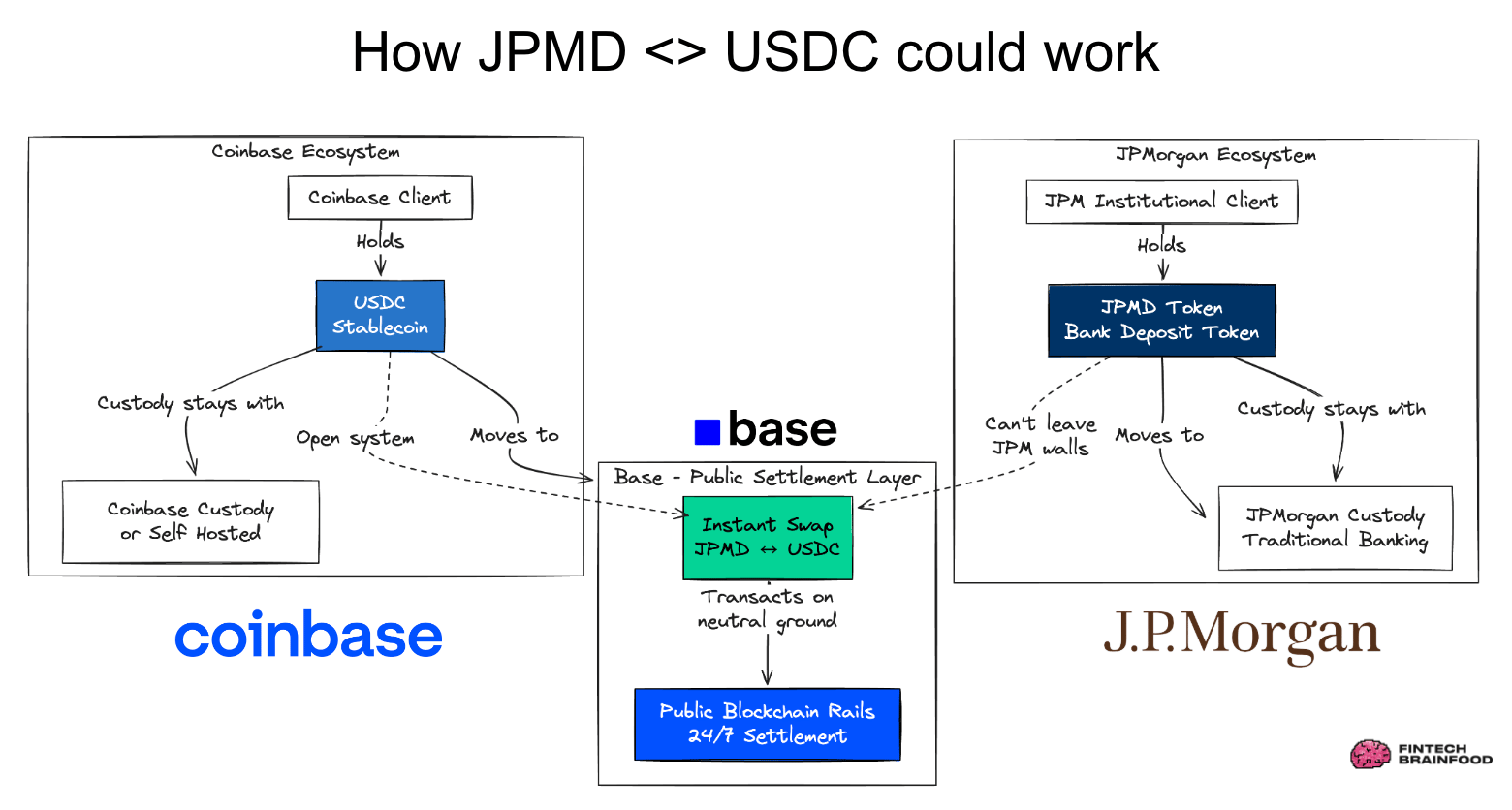
JPM Coin launching on Base suggests banks are moving “open loop”
on-chain
Stablecoins are becoming real infrastructure, not just crypto-native
tools
This could reshape cross-border payments, treasury management, and
bank interoperability—potentially challenging SWIFT.
JPMD_-_USDC_v_3
Google Maps releases new AI tools that let you create
interactive projects - TechCrunch [Link]
Google Has Your Data. Gemini Barely Uses It. - Shlok
Khemani [Link]
Google’s Gemini has access to unparalleled personal data, but it
intentionally underuses it. Gemini’s memory system is carefully
designed, transparent, and conservative—prioritizing safety, trust, and
control over magical personalization. This restraint is elegant, but it
may cost Google its biggest competitive advantage in personal AI.
Alex Karp, CEO of Palantir: Exclusive Interview Inside PLTR
Office - Sourcery with Molly O'shea [Link]
Most corporate and government leaders now believe AI software should
work, and they seek out solutions when their own projects fail. The
launch of AIP was an "artistic" decision made quickly (he launched it in
the "darkness of night" pre-Easter to avoid resistance) based on the
insight that LLMs would become commodity products and orchestration
would be much more valuable. This change in customer belief has
increased Palantir's authority, compressing sales cycles from five years
versus nine months to five years versus two or three months.
The focus is on growing the U.S., enhancing the quality of the user
experience (UX), and ensuring Palantir remains closest to the things
that give America a strategic advantage for decades.
YouTube CEO Neal Mohan on AI, Censorship & the Future of
Creators - All-In Podcast [Link]
YouTube CEO Neal Mohan is discussing the massive scale of the
platform, the state of the creator economy, and emerging technological
challenges. Mohan defended the long-standing 55/45 revenue split within
the YouTube Partner Program, citing the billions paid out to creators
and the strong return on investment (ROI) that high user engagement
delivers to advertisers. He also highlighted the success of subscription
products like YouTube Premium and YouTube TV, positioning the platform
as the top streaming service in the U.S. The conversation addressed
content regulation, confirming a pullback from controversial COVID-era
censorship and emphasizing YouTube’s commitment to free expression
despite the difficulty of managing diverse global laws and cultural
nuances. Crucially, Mohan revealed that YouTube is adapting to the rise
of synthetic media by developing new likeness detection tools—modeled
after Content ID—and implementing transparency labels for AI-generated
content to protect creator identities and address "AI slop."
Elon Musk: OpenAI Betrayal, His Future at Tesla, and the Next
Big Thing — Grokipedia - All-In Podcast [Link]
Does OpenAI Need a Bailout? Mamdani Wins, Socialism Rising,
Filibuster Nuclear Option - All-In Podcast [Link]
OpenAI CFO Would Support Federal Backstop for Chip
Investments - WSJ Video [Link]
When you only know one field deeply, you see problems through
that one lens. When you know many fields shallowly, you can't solve
complex problems. But when you know one field deeply and have worked
across many others, you can take a pattern from field A and apply it to
solve a problem in field B.
Everytime you learn something new, immediately find 2-3 examples
from completely different areas that use the same idea.
When you struggle and fail, your brain becomes super aware of
what you don't know, it creates gaps in your knowledge that your brain
wants to fill. When the teaching finally comes, your brain is actively
looking for the missing pieces.
― how to actually become a polymath. - riskambition
[Link]
How to articulate your thoughts more clearly than 99% of
people - Matt Huang [Link]
What does it mean to be articulate?
To express (an idea or feeling) fluently and
coherently
The best speakers are the ones who are able to express the idea or
the thing they need from someone in 5-10 seconds or less, Any longer
than that and you honestly don't understand the thing that you're trying
to explain.
Anticipating key questions
They deliberately make other people win bigger than them, not equal,
not balanced, bigger. And they do it first before asking for
anything.
It triggers psychological debt.
In any interaction, ask what costs me almost nothing, but would be
huge for them. Maybe it's connection, maybe it's knowledge you already
have, maybe it's taking an annoying task they hate. Give that first, not
after, not during, first.
The most successful people aren't doing more, they are doing less,
but at level that nobody else can touch, because they are not distracted
by good opportunities.
Here's what separates effective people from everyone else, they treat
this time (prime time) like a medical emergency, no meetings during
prime time, no email, no quick questions, no administrative garbage,
this is when you do the one thing that actually moves the needle.
The most effective people are actively bad at most things on purpose.
They are not well-rounded, they are sharp in one place and dull in
everywhere else.
― how to easily become a highly effective person. -
riskambition [Link]
Epstein Files Fallout, Nvidia Risks, Burry's Bad Bet,
Google's Breakthrough, Tether's Boom - All-In Podcast [Link]
FULL: Elon Musk Makes Shocking Future Predictions At
U.S.-Saudi Arabia Forum Alongside Jensen Huang - Forbes Breaking
News [Link]
We Asked Roblox's C.E.O. About Child Safety. It Got Tense. |
EP 163 - Hard Fork [Link]
The Roblox CEO Dave Baszucki has been widely criticized after the
safety interview on Hard Fork for
his controversial push to introduce dating services and adult
content onto a platform predominantly used by children, initially
refusing to set the minimum age at 18.
being repeatedly combative, defensive, and used aggressive
interruptions to avoid legitimate questions.
when asked about the platform's long-standing issue with predators
on Roblox, Baszucki stated that he viewed the problem not merely as a
serious issue but as an "opportunity" for safety innovation.
unironically entertaining a question about implementing educational
kid gambling on the platform, suggesting it would be a "brilliant idea"
if structured legally.
OpenAI's Code Red, Sacks vs New York Times, New Poverty Line?
- All-In Podcast [Link]
AI should either be a guardian angel or a cognitive
amplifier.
― Satya Nadella – How Microsoft thinks about AGI, Dwarkesh
Patel [Link]
The Thinking Game | Full documentary | Tribeca Film Festival
official selection, Google DeepMind [Link]
Anthropic C.E.O.: Massive A.I. Spending Could Haunt Some
Companies - The New York Times [Link]
Are Banks Secretly Winning the AI Race? (OpenAI Insider
Explains) - Rex Salisbury [Link]
Lean Strategy Making, Standardizing your company’s approach
can pay off. Here’s how. - Michael Mankins, Harvard Business
Review [Link]
The essential approach to effectively implementing and sustaining a
lean strategy involves three stages. By adopting this rigorous,
standardized approach to strategy, leading companies are able to reduce
waste, move faster, make wiser choices, and gain a competitive edge.
Setting Strategic Priorities: This initial stage focuses on
defining the company’s direction and identifying the most critical
issues to address.
Articulate Performance Ambition: Lean strategy begins with
articulating or revising a multiyear performance ambition, which
encompasses both financial goals (e.g., revenue, profit) and strategic
goals (e.g., market-share growth, customer satisfaction). This ambition
is aspirational—realistic yet beyond the reach of the current
strategy—designed to motivate leaders to surface breakthrough
ideas.
Compare to Multiyear Outlook (MYO): The ambition is compared
against the multiyear outlook (MYO), which projects future performance
based only on decisions and resource commitments already made.
The MYO is not a plan or forecast; it captures the likely trajectory if
current strategies remain unchanged and often depicts a deteriorating
competitive position.
Identify the Gap and Strategic Backlog: There should be a sizable
gap between the ambition and the MYO; if not, the ambition should be
revised upward. This gap is closed by addressing issues on the strategic
backlog, a document capturing the company’s highest-priority strategic,
operational, organizational, and financial challenges.
Prioritize and Frame Issues: Issues on the backlog are
prioritized based on value at stake (economic impact) and
urgency/critical path. They must be described in careful detail and tied
to one or more specific decisions that must be made to resolve the
challenge.
Establish a Decision Calendar: The final step is to create a
decision calendar, which outlines when each item on the backlog will be
addressed, establishing a steady cadence or “drumbeat” of
decision-making.
Tackling Priorities in an Ongoing Fashion: Once priorities are
set, the organization engages in a continuous process of
decision-making, which follows a standard, two-session process for each
item on the backlog.
Facts and Alternatives Session: In this session, leadership works
to fully understand the issue, identify its underlying causes, and
develop a comprehensive set of viable options. It is critical to gather
facts that reveal the true reasons for underperformance, avoiding the
trap of only treating symptoms. Companies must consistently explore
multiple strong alternatives and should avoid presenting false choices
(like options too extreme or too weak). Successful companies standardize
the criteria for assessing these alternatives.
Choices and Commitments Session: Here, leadership reviews the
alternatives, uses agreed-upon criteria to select the best one, defines
performance milestones, and identifies required resources. The outcome
is a final decision that includes committing resources in exchange for
expected performance improvements.
Document and Formalize: The best companies create an explicit
decision log to capture the choices made, documenting the alternatives
considered, the rejected options, and the rationale for the chosen path,
thereby eliminating ambiguity. Strategic choices must drive resource
allocation, often formalized through a written, two-way performance
contract between the corporate center and business
units/functions.
Monitoring Business Performance / Monitoring the Results: The
final stage involves continuously assessing the organization's success
and making necessary adjustments.
Regular Assessment: The success of meeting performance
commitments, along with the center’s allocation of resources, is
regularly assessed at business performance reviews.
Determine Need for Strategic Change: These reviews should not
merely compare actual performance against the budget (like "weather
reports"); instead, the true purpose is to determine whether the company
needs to alter its strategic direction. Leaders must probe deeper into
the reasons behind performance misses.
Revisit or Intensify Efforts: If market or competitive conditions
have changed significantly, leadership may return an issue to the
strategic backlog to gather new facts, explore new alternatives, and
potentially make a different choice. If the facts have not changed,
leadership may choose to intensify efforts in certain areas or scale
back others to realign performance with goals.
Performance Dialogues: Companies like Amgen use performance
dialogues at executive meetings to examine execution against commitments
made on the strategic backlog, often utilizing metric-monitoring
platforms to track both leading and lagging indicators.
Highlight Successes: Monitoring also involves exploring the
causes of overperformance to identify successful practices that can be
replicated.
What People Get Wrong About Psychological Safety, Six
misconceptions that have led organizations astray. - Amy C. Edmondson
and Michaela J.Kerrissey [Link]
The authors identify six common misconceptions that often hinder the
effective implementation of psychological safety in organizations,
leading organizations astray:
Psychological Safety Means Being Nice
The Problem: Safety and comfort are not synonyms; comfort is
ease, while safety is being protected from danger. When people
prioritize being "nice," they avoid honesty, which leads to ignorance
and mediocrity, causing coordination, quality, and learning to
suffer.
The Reality: Psychological safety is defined as a shared sense of
permission for candor and the belief that it is acceptable to take
interpersonal risks, such as asking questions or admitting mistakes. It
is consistent with kindness, but kindness involves being respectful,
caring, and honest, unlike "nice," which is often the easy way out of a
difficult conversation.
Psychological Safety Means Getting Your Way
The Problem: An employee might complain that not having their
idea supported made them feel psychologically unsafe. This
misinterpretation implies that input must be agreed upon.
The Reality: Psychological safety is about ensuring that leaders
and teams hear what people think; it does not force agreement. The
ultimate goal is to reach a good decision or prevent a defect. Leaders
should not tolerate problematic behaviors like bullying or disrespect,
and they don't need to agree with every input they receive.
Psychological Safety Means Job Security
The Problem: This misconception equates psychological safety with
freedom from layoffs.
The Reality: Psychological safety is defined as the freedom to be
constructively candid. An employee who stood up to senior leaders and
criticized the company regarding layoffs actually demonstrated that
psychological safety existed, as they believed they could speak up
without risking their career or generating negative reactions.
Psychological Safety Requires a Trade-Off with Performance
The Problem: This view is wrong, as psychological safety and
accountability are distinct dimensions. Low levels of both dimensions
clearly harm performance and morale.
The Reality: Superb performance in any uncertain environment
requires a commitment to both high standards and psychological safety.
Psychological safety is crucial because it enables learning by surfacing
information and knowledge vital for competing in a changing world, which
counters the tendency for people to hide information, save face, or fall
into groupthink.
Psychological Safety Is a Policy
The Problem: Psychological safety cannot be mandated, similar to
trust or motivation. Mandating it is unlikely to produce it; in fact,
telling people they must have it "or else" may cause leaders to be kept
in the dark.
The Reality: Psychological safety is not a quick fix or a policy;
rather, it is built interaction by interaction within a group. Creating
a climate of candor requires intention, effort, and developing skills
through tools such as messaging, modeling, and mentoring by
leaders.
Psychological Safety Requires a Top-Down Approach
The Problem: While leaders certainly matter, the misconception is
that they are the sole drivers.
The Reality: Psychological safety is ultimately built by everyone
at all levels of the company. It is "local," varying substantially
across different groups within the same organization. Everyone
influences the environment by showing interest in others' ideas, asking
questions to draw others out, and responding productively rather than
punitively. Focusing on your own team is an effective way to start
building a motivated, high-performing environment.
The Power of Mattering at Work, Improving everyday
interactions can promote employee retention, engagement, growth, and
well-being - Zach Mercurio, Harvard Business Review [Link]
Here are the practical ways organizations and leaders can integrate
mattering daily:
I. Seeing and Hearing Others: seeing people
(acknowledging them and paying attention to their life details and work
ebbs and flows) and hearing people (demonstrating real interest in their
feelings and inviting their perspectives within a climate of
psychological safety).
Make Time and Space: Leaders should prioritize and plan relationship
building. This involves scheduling regular meetings, avoiding
cancellation of one-on-ones, and maximizing casual interactions, such as
"watercooler conversations" or moments before meetings start. Employees
who spend more time (over six hours a week) interacting with their
leaders are 30% more engaged.
Pay Deep Attention: Renew the intention to pay close attention to
transform interactions from transactional to relational.
Ask More Meaningful Questions: Instead of standard greetings like,
"How are you?", ask questions that provide genuine insight into the
people being led. Use questions that are:
Clear: Have an object and a time frame (e.g., “What has your
attention today?”).
Open: Give people the opportunity to share experiences (e.g., “What
was the most important insight you heard in the meeting?”).
Exploratory: Seek to understand rather than evaluate (e.g., “Which
parts of today’s projects were most challenging for you and why?”).
Listen for Total Meaning: Leaders should be alert to the "total
meaning" of what people share, including their words, demeanor, facial
expressions, and nonverbal cues, to understand their underlying feelings
and attitudes.
Seek Clarification: Ask questions like, “Can you tell me more?” or
“What do you mean when you say ‘fine’?”.
Paraphrase or “Loop”: Check understanding by repeating their message
(e.g., “What I hear you saying is….Is that accurate?”).
Articulate Feelings: Ask questions like, “How did that make you
feel?” and validate their emotions (e.g., “I can see that you’re feeling
X”).
Respond Compassionately: When learning about struggles, respond
foremost with compassion, avoiding the tendency to normalize despair at
work. Even small acts, like allowing an overloaded employee to skip a
non-essential meeting, can significantly reduce stress and increase
trust.
Follow Up: Note what is learned and check back in on those details
later, or make concrete changes to the business based on the feedback.
One manager successfully increased engagement by writing down one detail
about each team member weekly and scheduling a brief follow-up
micro-check-in.
II. Affirming People and Showing Them They Are
Needed
Once a leader truly sees and hears a person, they can affirm them
meaningfully by showing how they make a singular impact. This involves
giving evidence that they are valued, relied upon, and
indispensable.
Show People Their Unique Gifts: Affirm significance by considering
their strengths (what they love and are good at), purpose, perspective,
and wisdom. By naming and nurturing these unique gifts, leaders help
employees see how they matter.
Provide "Wise Feedback": When offering criticism or noting areas
needing improvement, affirmation must precede it. People are more likely
to improve when the leader believes in them, reminds them of their
strengths, offers support, and establishes trust beforehand.
Tell Stories of Significance: Share real, specific personal stories
to remind employees of the downstream impact of their work, especially
if they are far removed from the end user. Hearing even one such story
can increase motivation by up to 400%. Organizations should establish a
process for collecting and sharing these stories.
Show Indispensability through Laddering: To help people feel needed,
show how even their small tasks are crucial to a bigger goal or purpose.
The "laddering" technique links the individual's input at the bottom to
a meaningful ultimate outcome (like the organization's purpose or
vision) at the top. Each rung shows how the individual's contribution is
needed for the next tangible step, reaffirming their
indispensability.
Verbally Express Reliance: Tell team members how you rely on them,
remind them how the organization needs them and their work, and even ask
them for help. When people return from an absence, tell them they were
missed.
III. Scaling the Mattering Skills
Organizationally
To ensure that mattering becomes a cultural norm, senior leaders must
scale these skills across the organization using a focused four-step
approach.
Set the Right Intention and Increase Motivation: Leaders must
implement mattering not as a tactic to achieve profits, engagement, or
lower turnover, but because it fulfills the basic human need for dignity
and the primal need to be seen, heard, and valued. To incite motivation,
create an emotional anchor by having leaders answer and share when they
most felt they mattered and what skills the person who fostered that
feeling used.
Develop and Practice the Right Skills: Name the required skills
(focused on noticing, affirming, and needing) and tailor them to the
organization. This can be documented in a "leadership checklist"
defining daily behaviors or a comprehensive guidebook, such as the "How
People Matter Here" blueprint created by American Express Global
Business Travel. Specific behaviors brainstormed at that company
included proactive support when an employee discloses a struggle and
describing the “why” before “what” and “how” when assigning tasks.
Measure Mattering: Implement measurement and accountability, as
people often overestimate their efforts in this area.
Self-Assessment: Leaders should use a self-assessment, ideally
quarterly in a group setting for peer coaching, to rate how often they
display behaviors like remembering details of others' lives, naming
unique gifts, and telling others they are relied upon.
Team Assessment: To get a more accurate picture, teams should rate
their leaders on the same mattering behaviors.
Optimize the Environment: Organizations must stop making it
difficult for leaders to cultivate mattering. To create a mattering
culture, reward and promote leaders for how they make people feel,
rather than solely for how much they get people to do. Incentivize and
promote leaders whose assessments demonstrate that they dignify,
include, respect, and affirm people while still performing well.
Interesting analogy: current LLMs are "ghosts"—statistical,
engineered intelligences deeply tied to human data—rather than
"animals"—a hypothetical, purely emergent form of AGI. The key debate is
whether this engineered "ghost" intelligence will eventually converge
toward a more "animal-like" emergent intelligence, or if it will
diverge, remaining a fundamentally different, yet powerful, kind of
cognition.
Waymo spent 16 years collecting data before going mainstream. Its
robotaxis have logged 96 million miles, achieving 91% fewer serious
injury accidents than human drivers. It stands as a rare example of
safety-focused AI and restraint in Silicon Valley. By contrast, Tesla’s
Austin robotaxis crashed three times in just 7,000 miles, and Cruise
infamously dragged a pedestrian 20 feet before GM shut the division
down. Despite years of successful highway testing, Waymo still restricts
its service to designated city zones.
YouTube Thinks AI Is Its Next Big Bang - Wired [Link]
YouTube plans to use AI to change how videos are made, giving
creators tools like DeepMind’s Veo 3 to improve their videos. CEO Neal
Mohan said AI could make it easier for more people to create content,
even though it raises concerns about what’s real or not. Despite these
worries, YouTube is moving forward with AI to stay a leader in video
innovation.
Are You Really a Good Listener? - Jeffrey Yip, Colin M.
Fisher, Harvard Business Review [Link]
Dos and Don'ts for Effective Workplace Listening
Category
Do
Don't
Pace & Focus (Avoiding Haste)
Set aside adequate, distraction-free time for
conversations.
Respond too quickly or rush the conversation, as
this makes people feel frustrated or unimportant.
Focus your attention, demonstrate interest, and ensure you have
understood the speaker.
Interrupt the speaker; your first job is to
understand the message and intent.
Ask clarifying questions to explore ambiguity and
seek additional details.
Emotional Control (Avoiding Defensiveness)
Calm your own emotions and seek to understand the
speaker’s intentions before responding.
React defensively or lash out when concerns or
critical feedback are raised.
Express empathy and avoid being judgmental.
Tell people not to ask questions or validate their
worries.
Buy yourself time before speaking by restating what you heard or
thanking the speaker for sharing.
Engagement (Avoiding Invisibility)
Use body language (back channeling) to signal that
you are listening, such as maintaining eye contact and adopting an open
posture.
Fail to show that you are listening, which can make
you appear indifferent or disconnected.
Use verbal acknowledgments like “I see” or “That
makes sense”.
Reflect the speaker's ideas back by summarizing
what you've heard to confirm understanding.
Sustainability (Avoiding Exhaustion)
Establish clear boundaries (e.g., blocking calendar
hours or setting time limits on discussions).
Attempt to listen when you are physically or emotionally
drained, as you lose the capacity to focus and engage
productively.
Acknowledge your personal limits; it is acceptable and beneficial to
reschedule if you are feeling weary.
Become the sole "office therapist" whom everyone turns to for
venting and advice.
Share the listening load by asking colleagues or
team members to check in with their peers.
Follow-Up (Avoiding Inaction)
Always close the loop by affirming what you heard,
identifying next steps for action, and agreeing on a timeline for
checking back in.
Receive the speaker’s message but then fail to follow up on
it, which erodes trust.
Be transparent about what you can or cannot act on,
and provide explanations for any limitations (e.g., budget constraints
or policy).
Unlocking Pay by Bank’s Potential - Alex Johnson [Link]
Pay by bank is any payment method that transfers
funds directly between bank accounts, but the modern definition is a
combination of electronic payment rails (ACH, RTP, FedNow) and
convenient user experiences enabled by open
banking.
Currently, few consumers use it (only 6.4% surveyed), but the biggest
barrier is lack of awareness (56% of non-users hadn't heard of it). Once
informed, 40% of consumers are interested or intrigued.
The underlying bank-to-bank payment rails are rapidly maturing, with
significant growth in Same Day ACH, RTP, and FedNow, along with improved
open banking infrastructure.
While lower payment processing costs (compared to credit cards) are a
strong motivator, the bigger, more strategic reason for merchants is the
ability to gather richer customer data.
Open banking-enabled pay by bank provides customer insights (e.g.,
historical bank transaction data) that enable:
Cash Flow Smoothing (e.g., microloans or flexible payment
dates).
Personalized Offers (e.g., targeting a customer who used a
competitor).
Dynamic Risk Management (e.g., better authorization decisions based
on future cash flow).
Challenges and Solutions:
Consumer Adoption: Must be fixed through education, prominent UI
placement, and compelling incentives/rewards that are tied to
customer-valued behaviors (e.g., double fuel points, loyalty
months).
Merchant Integration: For complex merchants, a hybrid approach could
be key—authorizing the bank payment using a virtual card through the
existing card processor infrastructure, which makes the integration
simpler.
A detailed memo written to formalize thoughts on the emerging problem
space of agentic payments—payments executed autonomously by AI agents
rather than humans.
Today's payment infrastructure (cards, ACH, etc.) is built for slow,
human-centric interactions. This breaks agent workflows, which need
real-time, low-latency, and low-cost transactions. The goal is to build
a new financial infrastructure—a natural language layer and
protocol—that allows agents to transact directly and autonomously across
any financial rail, starting with ACH.
The memo outlines several opportunities for companies building
agentic payment infrastructure:
Controllable Wallets: Providing agents with easy-to-manage wallets
that can be funded Just-in-Time (JIT) to control risk and
liability.
Authorization Tools: Creating real-time (sub-3000ms latency) tools
to approve transactions, check funds, and verify counterparty risk
synchronously.
Wedge Strategies: Using existing, manual workflows like Accounts
Payable/Accounts Receivable (AP/AR) as a disruption point to introduce
agent-driven automation and build the core infrastructure.
Prediction Markets: Understanding Their Impact and Future -
OneSafe [Link]
Prediction markets are platforms (like Kalshi and Polymarket) where
users trade contracts based on future event outcomes, utilizing
collective foresight to predict events better than traditional methods.
These markets generate real-time, crowd-sourced data that can be used by
fintech companies for crucial functions like risk management and fraud
detection in crypto payment systems. This data can also inform crypto
treasury APIs for better asset management.
A major hurdle is the legal uncertainty, as prediction markets are
often categorized between gambling and financial derivatives,
complicating compliance with state and federal laws. Compliance with AML
(Anti-Money Laundering) and KYC (Know Your Customer) regulations also
poses a burden.
As prediction markets mature, integrating their real-time data into
smart contracts could automate payment processes, enhance transparency,
and reduce dependence on centralized authorities, ultimately reshaping
value transfer in the digital economy.
Building the agentic future of recruiting: how we engineered
LinkedIn’s Hiring Assistant - Xiaoyang Gu [Link]
Here is what the Hiring Assistant can do in the hiring process:
Gathers and refines hiring requirements, including role details and
specific qualifications for the job, inferring missing information when
needed.
Generates and runs multiple search queries against the talent
network at scale, stores potential candidate profiles, and iteratively
refines the search based on performance. It uses LinkedIn's Economic
Graph to identify top locations, skills, and talent flows.
Assesses candidates by synthesizing data from their profiles,
resumes, and historical engagement. It applies the hiring requirements
to produce structured recommendations, surfacing evidence to support its
reasoning.
Handles candidate communication, including generating and sending
initial outreach and follow-up messages. It can also reply to candidate
questions and schedule phone screens.
Prepares tailored screening questions and can observe, transcribe,
and summarize conversations, capturing insights and notes.
Continuously refines the hiring requirements and candidate
recommendations by analyzing recruiter actions (like adding candidates
to pipelines or sending messages). It uses a cognitive memory to adapt
to a recruiter's specific preferences and style over time.
Three Techniques for Product Discovery - It outlines how product
managers can use feature flags earlier in the product lifecycle to speed
up learning
Painted Door: To validate market demand early by showing a
button/link for a feature that doesn't fully exist yet, often leading to
a survey.
Dogfooding: To get proof of value by rolling out a frugally
built prototype to employees only for high-quality feedback.
Beta Testing with the Right Slice: To confirm functionality and
usability by curating a small, targeted group of users (e.g.,
"Complainers" or low-bandwidth users) most likely to expose edge cases
and friction.
OpenAI Looks to Replace the Drudgery of Junior Bankers'
Workload - Omar El Chmouri, Bloomberg [Link]
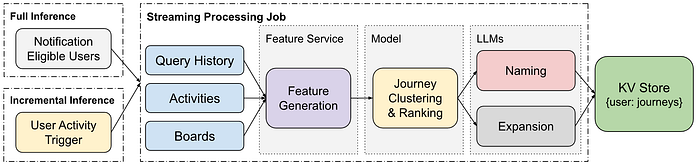
We define a journey as the intersection of a user’s interests,
intent, and context at a specific point in time. A user journey is a
sequence of user-item interactions, often spanning multiple sessions,
that centers on a particular interest and reveals a clear intent — such
as exploring trends or making a purchase.
At a high level, we extract keywords from multiple sources and
employ hierarchical clustering to generate keyword clusters; each
cluster is a journey candidate. We then build specialized models for
journey ranking, stage prediction, naming, and expansion. This inference
pipeline runs on a streaming system, allowing us to run full inference
if there’s algorithm change, or daily incremental inference for recent
active users so the journeys respond quickly to a user’s most recent
activities.
― Identify User Journeys at Pinterest - Pinterest
Engineering [Link]
This is Pinterest's foundation for journey-aware recommendations
under the mission of being an inspiration-to-realization platform. The
solution is based on the constraint that training data is limited.
"The Bitter Lesson" is an argument originally proposed by computer
scientist Richard Sutton, but frames it as "The Not-so Bitter
Lesson."
Sutton's Core Argument (The Bitter Lesson) states that general
methods that leverage search and compute will consistently outperform
domain-specific solutions based on human knowledge or clever insights.
The "bitter" part suggests that human-crafted domain expertise
eventually gets crushed by "dumb brute-force search and compute."
The Article's Key Reframing (The Not-so Bitter Lesson): The author
argues that this lesson is not bitter for engineers; instead, it's a
blueprint for better engineering. The human's job shifts from manually
crafting solutions to building the infrastructure that exposes the
search problem effectively.
This Is How Much Anthropic and Cursor Spend On Amazon Web
Services - Edward Zitron [Link]
The article provides exclusive data on the Amazon Web Services (AWS)
spending of Anthropic (the AI model provider) and Cursor (an AI coding
company and Anthropic's largest customer). It shows that Anthropic's AWS
spend alone for the entirety of 2024 was \(\$1.359\) billion against an estimated
revenue of up to \(\$600\) million,
meaning they spent at least 200% of their revenue on AWS.
It concludes that Anthropic's costs are "out of control" and its
current cost of doing business is unsustainable, meaning prices for its
services must increase dramatically for the company to ever become
profitable.
We are in the "gentleman scientist" era of AI research - Sean
Goedecke [Link]
Main points: Many impactful AI research ideas are not complex math
breakthroughs, but older, simple concepts or tricks applied to LLMs for
the first time (e.g., using Group-Relative Policy Optimization (GRPO)).
The surprising success of LLMs is like a "rubber-band engine," creating
a wealth of "easy scientific questions" that are accessible to hobbyists
and non-experts. Simple, non-academic ideas like Anthropic's "skills"
(scripts for the agent) are showing the value of amateur experimentation
in rapidly discovering the unknown capabilities of new LLMs.
AI landscape has shifted from a focus on a single dominant model to a
hyper-specialized ecosystem. The key question is no longer "Which AI is
smartest?" but "Which AI is the right tool for this job?"
OKRs for Measuring AI Adoption & Effectiveness - Tim
Herbig [Link]
The Stablecoin Opportunity That Banks Are Missing - Simon
Taylor [Link]
This opportunity is not about the stablecoin itself, but about
leading the shift to tokenized, programmable finance.
Stablecoins are a low-cost, international payments rail that opens up
opportunities for banks to:
Be a partner bank for stablecoin issuers.
Help customers with cross-border payments and treasury
management.
Become the primary "wallet" for corporates, collapsing multiple
banking views into a single management center.
Lead Onchain lending, which could become the next massive
opportunity.
Customer Interview Analysis: Where AI Helps and Hurts -
Teresa Torres, Product Talk [Link]
Salesforce announces Agentforce 360 as enterprise AI
competition heats up - TechCrunch [Link]
The Robot in Your Kitchen - Billy Perrigo, Time [Link]
Figure AI is launching its Figure 03 model, which they hope will be
the first mass-producible humanoid suitable for both industrial labor
and domestic chores (e.g., emptying the dishwasher, making the bed).
The article highlights the huge risks, including safety (a falling or
malfunctioning robot) and privacy (the collection of home data). Adcock
is pushing for a rapid first-mover advantage to create a "natural
monopoly" where more robots lead to more data, making the robot cheaper
and smarter over time.
The arrival of mass-produced robots is predicted to cause a societal
shock, potentially leading to widespread wealth creation through
collapsing costs, but also creating the risk of mass unemployment and
greater social inequality if not managed correctly (e.g., with a
Universal Basic Income).
Bryan Johnson’s Best Health Hack Will Help You Sleep Better
and Live Longer - All-In Podcast [Link]
eat final meal 4 hours before bed
turn off the screen 1 hour before bed
have amber and red lights in the house, no blue light
no caffeine within 6 hours before bed
wind down routine to calm down before bed: read a book, go for a
walk, do breath work, meditate.
Trump Brokers Gaza Peace Deal, National Guard in Chicago,
OpenAI/AMD, AI Roundtripping, Gold Rally - All-In Podcast [Link]
Biggest LBO Ever, SPAC 2.0, Open Source AI Models, State AI
Regulation Frenzy - All-In Podcast [Link]
Multicoin Capital’s Kyle Samani on Internet Capital Markets -
All-In Podcast [Link]
1929 vs 2025: Andrew Ross Sorkin on Crashes, Bubbles &
Lessons Learned - All-In Podcast [Link]
1929: Inside the Greatest Crash in Wall Street History--and How It
Shattered a Nation [Amazon]
Trump: Send National Guard to SF, China Rare Earths Trade
War, AI's PR Crisis - All-In Podcast [Link]
Andrej Karpathy — “We’re summoning ghosts, not building
animals” - Dwarkesh Patel [Link]
Karpathy’s perspective on the limits of reinforcement learning, why
AGI progress will feel incremental, lessons from self-driving, LLM
cognitive deficits, the evolution of intelligence, and the future of
education.
Richard Sutton – Father of RL thinks LLMs are a dead end -
Dwarkesh Patel [Link]
Elon Musk: 3 Years of X, OpenAI Lawsuit, Bill Gates,
Grokipedia & The Future of Everything - All-In Podcast [Link]
Substack
TBM 384: Prioritization Starts With Strategic Prioritization
- John Cutler [Link]
Only 100 Metrics Matter - Ghandra Narayanan [Link]
When your metrics start managing you. - Mike Watson
[Link]
Thoughts on the AI buildout - Thoughts on the AI
buildout [Link]
Is AI adoption slowing down? - Kyle Poyar, Growth
Unhinged [Link]
From Data Points to Storylines - Amy Mitchell and Hodman
Murad, Product Management IRL [Link]
Is AI a bubble? - Azeem Azhar and Nathan Warren, Exponential
View [Link]
Why America Builds AI Girlfriends and China Makes AI
Boyfriends - Zilan Qian [Link]
Import AI 431: Technological Optimism and Appropriate Fear -
Jack Clark, Import AI [Link]
Being a leader requires 'followers' only, those who volunteer to go
where you are going rather than being incentivized to, threatened to, or
having to. And leadership requires a vision of the world that does not
yet exist and the ability to communicate it. The former is the tangible
result of what the world would like if we spent every day pursuing WHY,
due to the power of WHY in inspiring action. The inspirational book
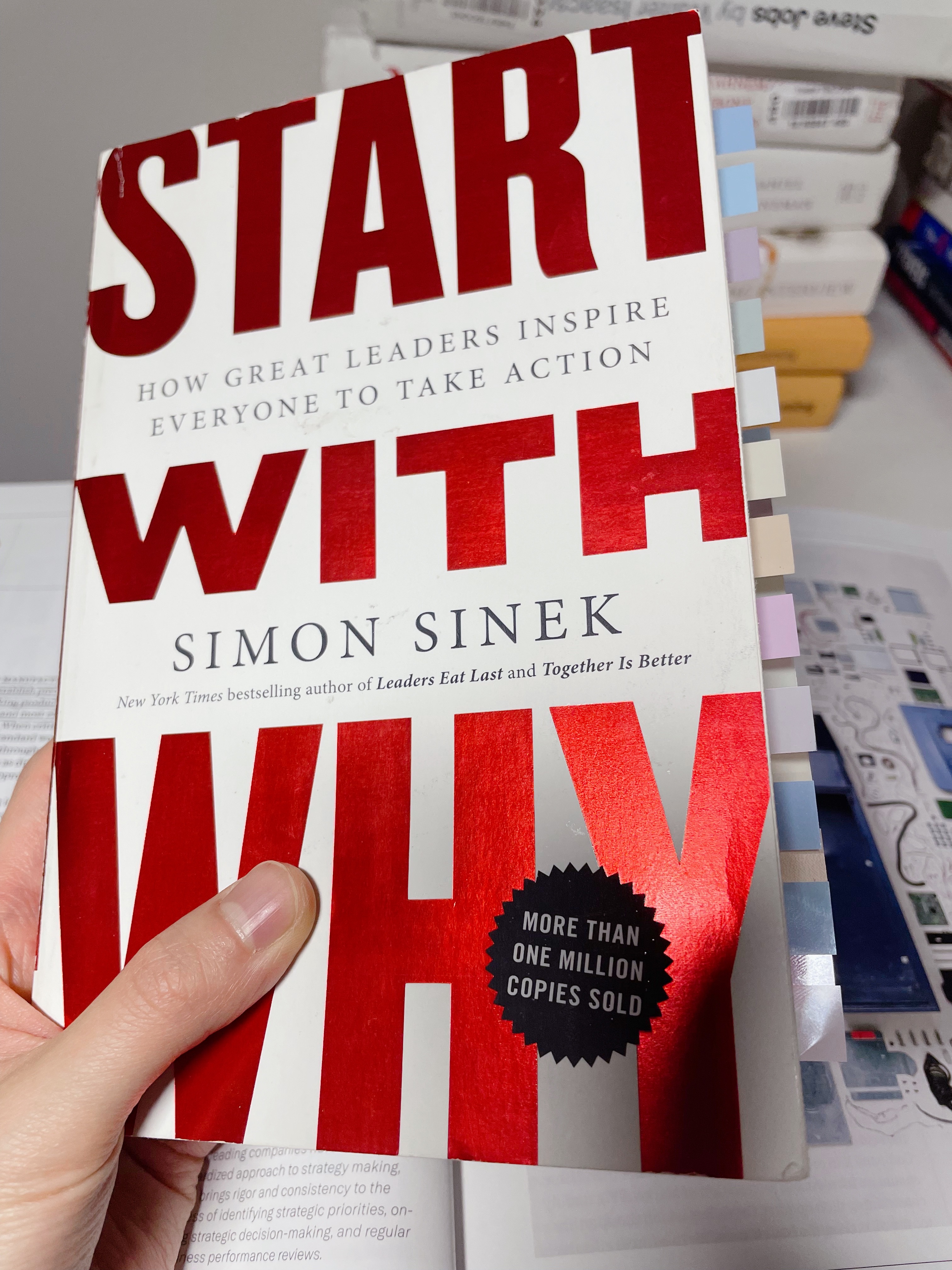
'Start with Why: How Great Leaders Inspire Everyone to Take
Action' written by Simon Sinek explores this concept deeply,
arguing that the most successful and inspiring leaders communicate from
the inside out—starting with their 'Why' (purpose or belief), then 'How'
(process), and finally 'What' (product or service). This is a very
inspiring book to read, for any type of leaders who is pursuing profound
fulfillment.
start_with_why
Below are the quotations I've selected from the book.
Manipulations are the norm, but the better alternative is
inspiration.
Beyond the business world, manipulations are the norm in politics
today as well. Just as manipulations can drive a sale but not create
loyalty, so too can they help a candidate get elected, but they don't
create a foundation for leadership. Leadership requires people to stick
with you through thick and thin. Leadership is the ability to rally
people not for a single event, but for years. In business, leadership
means that customers will continue to support your company even when you
slip up.
Manipulative techniques have become such a mainstay in American
business today that it has become virtually impossible for some to kick
the habit. Like any addiction, the drive is not to get sober, but to
find the next fix faster and more frequently. And as good as the
short-term highs may feel, they have a deleterious impact on the
long-term health of an organization. Addicted to the short-term results,
business today has largely become a series of quick fixes added on one
after another after another.
Leaders who choose to inspire people rather than manipulate
people follow the concept of 'The Golden Circle'.
The Golden Circle is an alternative perspective to existing
assumptions about why some leaders and organizations have achieved such
a disproportionate degree of influence.
This alternative perspective is not just useful for changing the
world; there are practical applications for the ability to inspire, too.
It can be used as a guide to vastly improve leadership, corporate
culture, hiring, product development, sales, and marketing. It even
explains loyalty and how to create enough momentum to turn an idea into
a social movement.
Companies try to sell us WHAT they do, but we buy WHY they do it.
This is what I mean when I say they communicate from the outside in;
they lead with WHAT and HOW. When communicating from inside out,
however, the WHY is offered as the reason to buy and the WHATs serve as
the tangible proof of that belief. The things we can point to
rationalize or explain the reasons we're drawn to one product, company
or idea over another.
When the WHY is absent, imbalance is produced and manipulations
thrive. And when manupulations thrive, uncertainty increases for buyers,
instability increases for sellers and stress increases for all.
Biologically, the limbic brain drives behaviors (decisions).
Great leaders win hearts before minds.
We are drawn to leaders and organizations that are good at
communicating what they believe. Their ability to make us feel like we
belong, to make us feel special, safe, and not alone is part of what
gives them the ability to inspire us. Those whom we consider great
leaders all have an ability to draw us close and to command our loyalty.
And we feel a strong bond with those who are also drawn to the same
leaders and organizations.
The newest area of the brain, our Homo Sapien brain, is the
neocortex, which corresponds with the WHAT level. The neocortex is
responsible for rational and analytical thought and language. The middle
two sections comprise the limbic brain. The limbic brain is responsible
for all of our feelings, such as trust and loyalty. It's also
responsible for all human behavior and all our decision making, but it
has no capacity for language.
When we communicate from the outside in, when we communicate WHAT we
do first, yes, people can understand vast amounts of complicated
information, like facts and features, but it does not drive behavior.
But when we communicate from the inside out, we're talking directly to
the part of the brain allows us to rationalize those decisions.
Our limbic brain is powerful, powerful enough to drive behavior that
sometimes contradicts our rational and analytical understanding of a
situation. We often trust our gut, even if the decision flies in the
face of all the facts and figures. Richard Restak, a well-known
neuroscientist, talks about this in his book, The Naked Brain. When you
force people to make decisions with only the rational part of their
brain, they almost invariably end up 'overthinking.' These rational
decisions tend to take longer to make, says Restak, and can often be of
lower quality. In contrast, decisions made with the limbic brain, gut
decisions, tend to be faster, higher-quality decisions.
Our limbic brains are smart and often know the right thing to do. It
is our inability to verbalize the reasons that may cause us to doubt
ourselves or trust the empirical evidence when our gut tells us not
to.
People don't buy WHAT you do, they buy WHY you do it. A failure to
communicate WHY creates nothing but stress or doubt.
Those decisions started with WHY - the emotional component of the
decision - and then the rational components allowed the buyer to
verbalize or rationalize the reasons for their decision.
Great leaders are those who trust their gut. They are those who
understand the art before the science. They win hearts before minds.
They are the ones who start with WHY. "I can make a decision with 30
percent of the information, " said former Secretary of State Colin
Powell. "Anything more than 80 percent is too much." There is always a
level at which we trust ourselves or those around us to guide us, and
don't always feel we need all the facts and figures.
Our hope, dreams, hearts, and guts drive us to try new
things, not logic or facts.
If we were all rational, there would be no small businesses, there
would be no exploration, there would be very little innovation and there
would be no great leaders to inspire all those things. It is the undying
belief in something bigger and better that drives that kind of
behavior.
In reality, their purchase decision and their loyalty are deeply
personal. They don't really care about Apple; it's all about them.
Products are not just symbols of what the company believes, they also
serve as symbols of what the loyal buyers believe.
Products with a clear sense of WHY give people a way to tell the
outside world who they are and what they believe.
Clarity of WHY, discipline of HOW, and Consistency of WHAT
are all needed.
Ask the best salesmen what it takes to be a great salesman. They will
always tell you that it helps when you really believe in the product
you're selling... When salesmen actually believe in the thing they are
selling, then the words that come out of their mouths are authentic.
When belief enters the equation, passion exudes from the salesman. It is
this authenticity that produces the relationships upon which all the
best sales organizations are based. Relationships also build trust. And
with trust comes loyalty. Absent a balanced Golden Circle means no
authenticity, which means no strong relationships, which means no trust.
And you're back at square one selling on price, service, quality or
features. You are back to being like everyone else. Worse, without that
authenticity, companies resort to manipulation: pricing, promotions,
peer pressure, fear, take your pick. Effective? Of course, but only for
the short term.
If they buy something that doesn't clearly embody their own sense of
WHY, then those around them have little evidence to paint a clear and
accurate picture of who they are. The human animal is a social animal.
We're very good at sensing subtleties in behavior and judging people
accordingly. We get good feelings and bad feelings about companies, just
as we get good feelings and bad feelings about people. There are some
people we just feel we can trust and others we just feel we can't.
Trust begins to emerge when we have a sense that the driver
of behaviors is anything but self-gain.
Trust is not a checklist. Fulfilling all your responsibilities does
not create trust. Trust is a feeling, not a rational experience. We
trust some people and companies even when things go wrong, and we don't
trust others even though everything might have gone exactly as it should
have. A completed checklist does not guarantee trust. Trust begins to
emerge when we have a sense that another person or organization is
driven by things other than their own self-gain.
Those who lead are able to do so because those who follow trust that
the decisions made at the top have the best interests of the group at
heart. In turn, those who trust work hard because they feel like they
are working for something bigger than themselves.
When people come to work with a higher sense of purpose, they find it
easier to weather hard times or even to find opportunity in those hard
times. People who come to work with a clear sense of WHY are less prone
to giving up after a few failures because they understand the higher
cause.
Finding the people who believe what you believe
We do better in cultures in which we are good fits. We do better in
places that reflect our own values and beliefs. Just as the goal is not
to do business with anyone who simply wants what you have, but to do
business with people who believe what you believe, so too is it
beneficial to live and work in a place where you will naturally thrive
because your values and beliefs align with the values and beliefs of
that culture.
When employees belong, they will guarantee your success. And they
won't be working hard and looking for innovative solutions for you, they
will be doing it for themselves.
As Herb Kelleher famously said, "you don't hire for skills, you hire
for attitude. You can always teach skills."
The truth is, almost every person on the planet is passionate; we are
not all passionate for the same things.
The goal is to hire those who are passionate for your WHY, your
purpose, cause or belief, and who have the attitude that fits your
culture.
Great companies don't hire skilled people and motivate them; they
hire already motivated people and inspire them.
If those inside the organization are a good fit, the opportunity to
"go the extra mile", to explore, to invent, to innovate, to advance, and
more importantly, to do so again and again and again, increases
dramatically. Only with mutual trust can an organization become
great.
The Law of Diffussion
Our population is broken into five segments that fall across a bell
curve: innovators, early adopters, early majority, late majority and
laggards.
Early adopters are willing to pay a premium or suffer some level of
inconvenience to own a product or espouse an idea that feels right.
Their willingness to suffer an inconvenience or pay a premium had less
to do with how great the product was and more to do with their own sense
of who they are. They wanted to be the first.
The farther right you go on the curve, the more you will encounter
the clients and customers who may need what you have, but don't
necessarily believe what you believe. As clients, they are the ones for
whom, no matter how hard you work, it's never enough. Everything usually
boils down to price with them. They are rarely loyal. They rarely give
referrals and sometimes you may even wonder out loud why you still do
business with them, "They just don't get it," our gut tells us. The
importance of identifying this group is so that you can avoid doing
business with them.
There is an irony to mass-market success, as it turns out. It's near
impossible to achieve if you point your marketing and resources to the
middle of the bell, if you attempt to woo those who represent the middle
of the curve without first appealing to the early adopters. It can be
done, but at a massive expense. This is because the early majority,
according to Rogers, will not try something until someone else has tried
it first. The early majority, indeed the entire majority, needs the
recommendation of someone else who has already sampled the product or
service.
That's what a manipulation is. They may buy, but they won't be loyal.
Don't forget, loyalty is when people are willing to suffer some
inconvenience or pay a premium to do business with you. They may even
turn down a better offer from someone else - something the late majority
rarely does.
Get enough people on the left side of the curve on your side and they
encourage the rest to follow.
Energy excites. Charisma inspires.
Charisma has nothing to do with energy; it comes from a clarity of
WHY. It comes from absolute conviction in an ideal bigger than oneself.
Energy, in contrast, comes from a good night's sleep or lots of
caffeine. Energy can excite. But only charisma can inspire. Charisma
commands loyalty. Energy does not.
Golden Circle matches an organization
Sitting at the top of the system, representing the WHY, is a leader;
in the case of a company, that's usually the CEO. The next level down,
the HOW level, typically includes the senior executives who are inspired
by the leader's vision and know HOW to bring it to life. Don't forget
that a WHY is just a belief, HOWs are the actions we take to realize
that belief and WHATs are the results of those actions. No matter how
charismatic or inspiring the leader is, if there are not people in the
organization inspired to bring that vision to reality, to build an
infrastructure with systems and processes, then at best, inefficiency
reigns, and at worst, failure results.
WHY-types are focused on the things most people can't see, like the
future. HOW-types are focused on things most people can see and tend to
be better at building structures and processes and getting things
done.
Most people in the world are HOW-types. Most people are quite
functional in the real world and can do their jobs and do very well.
Some may be very successful and even make millions of dollars, but they
will never build billion-dollar businesses or change the world.
HOW-types don't need WHY-types to do well. Buy WHY-guys, for all their
vision and imagination, often get the short end of the stick. Without
someone inspired by their vision and the knowledge to make it a reality,
most WHY-types end up as starving visionaries, people with all the
answers but never accomplishing much themselves.
When a company is small, it revolves around the personality of the
founder. There is no debate that the founder's personality is the
personality of the company. As a company grows, the CEO's job is to
personify the WHY. To ooze of it. To talk about it. To preach it. To be
a symbol of what the company believes.
We all know when a company's WHY goes fuzzy. Split can
happen.
For Wal-Mart, WHAT they do and HOW they are doing it hasn't changed.
And it has nothing to do with Wal-Mart being a 'corporation'; they were
one of those before the love started to decline. What has changed is
that their WHY went fuzzy. And we all know it. A company once so loved
is simply not as loved anymore. The negative feelings we have for the
company are real, but the part of the brain that is able to explain why
we feel so negatively toward them has trouble explaining what changed.
So we rationalize and point to the most tangible things we can see -
size and money. If we, as outsiders, have lost clarity of Wal-Mart's
WHY, it's a good sign that the WHY has gone fuzzy inside the company
also. If it's not clear on the inside, it will never be clear on the
outside. What is clear is that the Wal-Mart of today is not the Wal-Mart
that Sam Walton built.
It's too easy to say that all they care about is their bottom line.
All companies are in business to make money, but being successful at it
is not the reason why things change so drastically. That only points to
a symptom. Without understanding the reason it happened in the first
place, the pattern will repeat for every other company that makes it
big. It is not destiny or some mystical business cycle that transforms
successful companies into impersonal Goliaths. It's people.
For most of us, somewhere in the journey, we forget WHY we set out on
the journey in the first place. Somewhere in the course of all those
achievements, an inevitable split happens.
Those with an ability to never lose sight of WHY, no matter how
little or how much they achieve, can inspire us. Those with the ability
to never lose sight of WHY and also achieve the milestones that keep
everyone focused in the right direction are the great leaders.
As this metric grows, any company can become a 'leading' company. But
it is the ability to inspire, to maintain clarity of WHY, that gives
only a few people and organizations the ability to lead. The moment at
which the clarity of WHY starts to go fuzzy is the split. At this point,
organizations may be loud, but they are no longer clear.
The challenge isn't to cling to the leader, it's to find effective
ways to keep the founding vision alive forever.
For an organization to continue to inspire and lead beyond the
lifetime of its founder, the founder's WHY. must be extracted and
integrated into the culture of the company. What's more, a strong
succession plan should aim to find next generation. Future leaders and
employees alike must be inspired by something bigger than the force of
personality of the founder and must see beyond profit and shareholder
value alone.
The WHY originates from looking back
Before it can gain any power or achieve any impact, an arrow must be
pulled backward, 180 degrees away from the target. And that's also where
a WHY derives its power. The WHY does not come from looking ahead at
what you want to achieve and figuring out an appropriate strategy to get
there. It is not born out of any market research. It does not come from
extensive interviews with customers or even employees. It comes from
looking in the completely opposite direction from where you are now.
Finding WHY is a process of discovery, not invention.
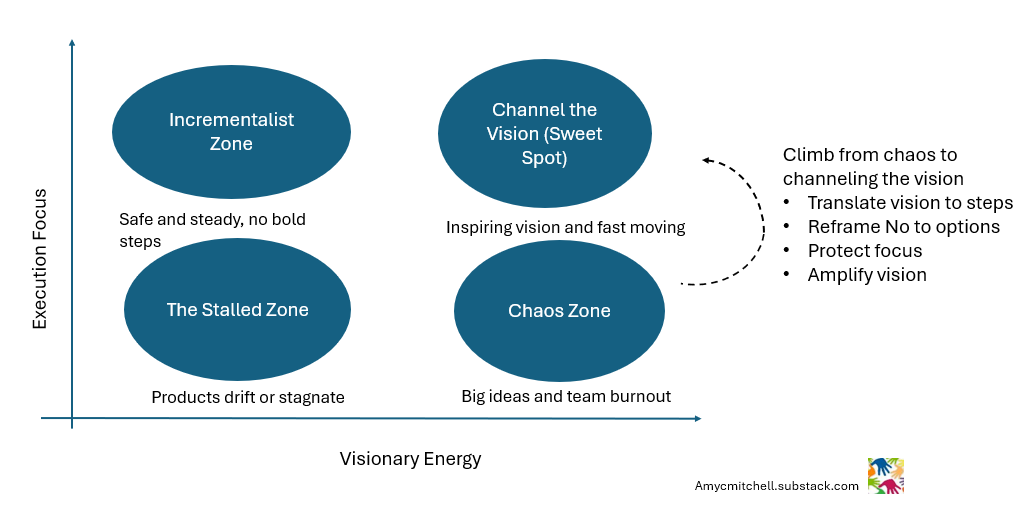
How to Handle Visionary Leaders Without Losing the Team - Amy
Mitchell, Product Management IRL [Link]
visionary_v_execution
Microsoft announced AI credits for Copilot in Microsoft 365 in January.
Salesforce added a new flexible, credit-based
model for their AI agent in May. Cursor shifted to credit-based
pricing in June (and faced some real
pushback from users). Not to be outdone, OpenAI recently replaced
seat licenses with a pooled
credit model for its Enterprise plans.
― Why everyone’s switching to AI credits - Kyle Poyar, Growth
Unhinged [Link]
Companies are transitioning to credit-based pricing models,
particularly for AI services, for several key reasons related to
managing costs, maximizing profitability, accommodating evolving AI
technology, and establishing market standards.
The shift to credit-based models is largely driven by challenges
related to AI operational expenses and usage patterns.
Companies are using credits as a mechanism to transition from
flat-rate pricing toward models based on the value delivered.
The move by major technology companies validates and standardizes
the credit model for AI consumption.
Credit models offer flexibility for both vendors and users.
Focus on what you can do. End on an affirmative.
Cite trade-offs.
Get more info to make an informed decision.
Add “because” to share your rationale.
Give the benefit of the doubt.
― Why "'no' is a complete sentence" is dangerous advice - Wes
Kao's Newsletter [Link]
How to make your writing C.R.I.S.P. - Dan Hock's
Essays [Link]
How To Expand Your Influence Skills - Yue Zhao, The Uncommon
Executive [Link]
Shaping the opinions of others, or building influence, is about more
than just data and logic. It's about understanding and managing
emotions.
Handling your own emotions: Notice and reflect on what is driving
your actions, such as fear, and then name it. This helps you move
forward with clarity and confidence.
Leading others through their emotions: When you want to get buy-in
for your ideas, help people process their emotions. You can do this by
creating a space that welcomes emotions, validating their concerns, and
then shifting their focus to what they can do to move forward.
The Hidden Rulebook of Corporate Politics (and How to Use It
to Your Advantage) - Gaurav Jain, The Good Boss [Link]
I have to review this article regularly.
The moment you stop believing in the corporate fiction is the
moment you can start using it. Once you see it as infrastructure rather
than identity, as a resource rather than a calling, everything
shifts.
Your corporate role doesn't need to be meaningful. It needs to be
useful. Useful for building skills, for funding your real projects, for
buying time while you figure out what matters to you.
The death of the corporate role isn't a crisis. It's freedom from
having to pretend your spreadsheet about spreadsheets is your life's
work.
― The death of the corporate job - Alex Mccann, Still
Wandering [Link]
Good piece.
Articles and Blogs
President Trump, Tech Leaders Unite to Power American AI
Dominance - The White House [Link]
The August jobs report has economists alarmed. Here are their
3 top takeaways. - CBS News [Link]
The August jobs report is raising concerns among economists due to
several alarming trends. Employers added only 22,000 nonfarm jobs, which
is significantly lower than the 80,000 jobs that analysts had forecast.
The unemployment rate also rose to 4.3%, the highest level since October
2021.
The three top takeaways are
The job market is stalling
Job growth is at its lowest level in 15 years
The federal reserve will likely cut interest rates
The Recession is Already Happening for Many Americans -
Bloomberg [Link]
Read the text messages between Charlie Kirk accused and
roommate - BBC [Link]
U.S. Investors, Trump Close In on TikTok Deal With China -
Raffaele Huang, Lingling Wei, Alex Leary, The Wall Street
Journal [Link]
The near-finalized framework of a deal between the U.S. and China
concerning the popular social media application TikTok, involves
creating a new U.S. entity to manage the app’s American operations, with
an investor consortium, including Oracle, taking a roughly 80%
controlling stake, which satisfies a recent U.S. law regarding foreign
ownership. A key component of the agreement is the establishment of
American control over user data and the crucial content-recommendation
algorithms, although they will be based on technology licensed from
TikTok's Chinese parent company, ByteDance. Furthermore, the article
notes that President Trump has delayed the TikTok ban until December as
negotiations conclude, signaling the resolution of a multi-year national
security dispute over the app's influence in the U.S. Both Chinese and
American officials have reached a basic consensus on the terms, which
also include Oracle managing U.S. user data at its facilities in
Texas.
Google brings Gemini in Chrome to US users, unveils agentic
browsing capabilities, and more - TechCrunch [Link]
Tesla Dojo: The rise and fall of Elon Musk’s AI supercomputer
- TechCrunch [Link]
Dojo was a custom-built supercomputer intended to be the cornerstone
of Tesla's AI ambitions, specifically for training the neural networks
of its Full Self-Driving (FSD) technology and humanoid robots.
The primary strategic reasons cited for the project's termination
include:
the strategic pivot to AI6 chips. The AI6 chip is Tesla’s new
strategic bet on a chip design intended to scale across FSD, Tesla’s
Optimus humanoid robots, and high-performance AI training in data
centers
moving away from hardware self-reliance. Dojo was intended to reduce
reliance on expensive eand difficulty-to-secure Nvidia GPUs, but Tesla
is now "going all-in on partnerships" with major chip providers,
including Nvidia, AMD, and Samsung (which will build the AI6 chip)
technological and compatibility hurdles. Dojo’s design, based on
proprietary D1 chips, faced inherent technological challenges related to
integration with the broader AI ecosystem
internal competition and redundency. In August 2024, Tesla began
promoting Cortex, described as the company’s "giant new AI training
supercluster" being built at Tesla HQ in Austin. Cortex was later
deployed at Gigafactory Texas.
You are by default a product leader, navigating product
directions with data.
Data scientists at Meta don’t just analyze data — they transform
business questions into data-driven product visions that help building
better human connections.
The most successful data scientists that I’ve worked with not
only excel at adapting their approach to the specific data-problem
quadrant they’re operating in, but also are effective in working with
Cross-Functional partners to drive collaboration pushing product
strategy development forward.
With Product Managers:
Speak in terms of business problems, not data
techniques
Help PMs translate intuition into testable hypotheses
Co-create metrics frameworks that balance short and long-term
objectives
With Engineering:
Bridge implementation and insight by understanding technical
constraints
Design analytics requirements that respect engineering
resources
Create feedback loops that allow for continuous
improvement
With Design/User Researchers:
Humanize data insights through collaborative
storytelling
Provide quantitative context for qualitative user
research
Partner on creating experiences that naturally generate valuable
data
Deb Liu, former VP of Meta, highlighted in herproduct
strategy framework: “a great product strategy is opinionated,
objective, operable, and obvious.” Data scientists are uniquely
positioned to help product teams achieve these qualities
through:
Opinionated: Grounding strategic choices in data-backed
insights
Objective: Bringing analytical rigor to opportunity sizing and
risk assessment
Operable: Creating measurement frameworks that make execution
tractable
Obvious: Revealing patterns that make the path forward clear to
all stakeholders
― Meta’s Data Scientist’s Framework for Navigating Product
Strategy as Data Leaders - Medium [Link]
Generate data insights to identify problems and guide early
decisions
Create product strategy to drive measurable improvements
Note: a good strategy decides which problems to prioritize in
solving as well as those we choose not to solve.
Best Practice: narrowing the problem space through structured
discovery.
Collaboration among design, PM, and XFN
Define (north star) metrics
Translate business questions into testable hypotheses
Use analytics to yield insights
Quadrant 2: The Craftsperson (Low Data, Concrete
Problem)
Strategic Approach:
Design targeted data collection aligned to the specific problem
Develop creative measurement frameworks that work with sparse
data
Leverage analogous data from similar contexts
Note: focus on setting clear learning milestones rather than
promising specific outcomes. The goal is to systematically reduce
uncertainty around a concrete problem with iterative data learnings to
update our beliefs.
Quadrant 3: The Explorer (High Data, Broad
Problem)
Strategic Approach:
Pattern recognition at scale to identify unrecognized opportunities
(e.g., opportunity sizing model, gap analysis framework)
Segmentation and clustering to create structure in an ambiguous
space (e.g., segmentation model)
Insight translation that transforms data patterns into business
narratives
Note: structure the problem space through data, allowing the
product team to move from broad exploration to targeted opportunities.
The role is to transform overwhelming data into clear strategic choices
for your product partners.
Quadrant 4: The Optimizer (High Data, Concrete
Problem)
Continuous learning systems that adapt as conditions change
Best Practices for Developing a Product Strategy - Deb
Liu [Link]
A New Ranking Framework for Better Notification Quality on
Instagram - Engineering at Meta [Link]
While existing machine learning (ML) models optimize for high
engagement, they can result in repetitive and potentially "spammy"
notifications, leading users to disable them. To combat this, the new
framework applies a multiplicative penalty to notification scores based
on their similarity to recently sent ones, using criteria such as author
and product type. This strategy has successfully reduced notification
volume while increasing engagement rates by ensuring a more varied and
personalized mix of content.
The methodology begins with the existing machine learning (ML)
models, which calculate a base score for notification candidates based
on factors like the probability of a user clicking (Click-Through-Rate
or CTR) and time spent. The new framework introduces a diversity layer
on top of these existing engagement ML models.
The methodology involves the following steps:
Evaluation of Similarity: The diversity layer
evaluates each notification candidate's similarity to recently sent
notifications across multiple dimensions, such as content, author,
notification type, and product surface.
Application of Penalties: The system applies
carefully calibrated penalties, expressed as multiplicative demotion
factors, to downrank candidates that are too similar or repetitive to
recent notifications.
Re-ranking: The adjusted scores (base relevance
score multiplied by the demotion factor) are used to re-rank the
candidates.
Selection: The final selection process uses a
quality bar to choose the top-ranked candidate that successfully passes
both the ranking and diversity criteria.
Within the diversity layer, the methodology is mathematically
implemented using a multiplicative demotion factor applied to the base
relevance score:
Demotion Multiplier (\(D(c)\)): This is a penalty factor
where the value falls within the range of 0 to 1 (\(D(c) \in\)), reducing the score based on
similarity to recently sent notifications.
Similarity Signal: To calculate \(D(c)\), a similarity signal (\(p_i(c)\)) is computed for a set of semantic
dimensions (e.g., author, product type) using a maximal marginal
relevance (MMR) approach.
Binary Baseline: In the baseline implementation,
the similarity signal \(p_i(c)\) is
binary: it equals 1 if the similarity exceeds a predefined threshold
(\(\tau_i\)), and 0 otherwise.
Flexible Control: The methodology defines the final
demotion multiplier using adjustable weights (\(w_i\)), which control the strength of
demotion for each respective dimension.
The State of AI in Financial Services in 2025 — views from
our front row seats - Peter Hung, Illuminate Financial [Link]
The best roadmaps aren't checklists; they tell a story about why
something is being built. They show how short-term initiatives connect
to long-term strategic goals.
The Now, Next, Later Framework is a core pattern,
reflecting the reality of uncertainty. Now initiatives are tight,
concrete, and focused on current goals (e.g., MVP launch). Next
initiatives are more exploratory bets. Later initiatives are
deliberately fuzzy, long-term aspirations that signal intent without
making firm promises.
Effective roadmaps frame initiatives as problems to solve and tie
them to clear outcomes and business objectives (e.g., "reduce onboarding
friction" instead of "ship a new login flow"). This keeps the team
flexible and focused on results.
There is no one-size-fits-all roadmap. A startup's roadmap is about
survival and proving a hypothesis. A scale-up's roadmap is about
smoothing friction and deepening engagement. A hardware roadmap must
account for manufacturing cycles, while a mission-critical one must
prioritize compliance and security.
Expanding economic opportunity with AI - OpenAI [Link]
GenAI Doesn’t Just Increase Productivity. It Expands
Capabilities - BCG [Link]
A point made around 'reskilling': While GenAI can immediately boost a
worker's aptitude for new tasks, it does not necessarily "reskill" them
in a traditional sense. The study found that participants were able to
perform complex data-science tasks with the help of GenAI, but they did
not retain the knowledge or skills gained after the tools were taken
away. The article refers to GenAI as an "exoskeleton" that enables
workers to do more, but does not intrinsically change what they have
learned.
Building Etsy Buyer Profiles with LLMs - Isobel Scot, Etsy
Code as Craft [Link]
Non-Obvious Tips for Landing the Job You Want - Deb
Liu [Link]
Seven Non-Obvious Strategies
Never rely only on online submission: Avoid the "digital dustbin" by
finding an alternative path in, such as a referral, connection, or
direct reach-out.
Ask for advice, not a job: Sincerely seek guidance on entering a
field or company, as people are often generous and may uncover new
opportunities for you.
Give them a reason to say yes: Counter the process of finding
reasons to say no (misspellings, poor grammar) by providing
human connection points like shared alma maters, hobbies, or passions to
hack affinity bias.
Find the “you-shaped hole”: Seek roles where your unique skills,
experience, or passion make you the best bet, demonstrating you can "hit
the ground running on day one".
See the world through the hiring manager’s eyes: Hiring managers
prioritize managing risk because a bad hire is costly. Your job is to
close the asymmetry of information, prove you are a "sure bet," and show
you are a great return on investment.
Do the job before you get the job: Demonstrate initiative by acting
like an employee; use the product, talk to customers, and bring specific
ideas or prototypes to show you want this job.
Tailor your resume (and your story) for the role: Treat your resume
as a "living document" to tell a specific story, reframing factual
experiences to align with the target role and "speak the language of the
hiring company".
American Express is Accepted at 160 Million Merchants Around
the World; Since 2017, Amex-Accepting Locations Have Increased by Nearly
5x - Business Wire [Link]
Hallucinations persist partly because current evaluation methods
set the wrong incentives. While evaluations themselves do not directly
cause hallucinations, most evaluations measure model performance in a
way that encourages guessing rather than honesty about
uncertainty.
Hallucinations are not inevitable. Language models can choose to
abstain when uncertain. Abstaining (indicating uncertainty) is better
than providing confident, incorrect information, aligning with the core
value of humility
Avoiding hallucination can be easier for a small model to know its
limits. Being "calibrated" (knowing its confidence) requires much less
computation than being accurate
To measure hallucinations, all of the primary evaluation metrics
need to be reworked to reward expressions of uncertainty. Hallucination
evals have little effect against hundreds of traditional accuracy-based
evals that punish humility
How to Think About GPUs - How to Scale Your Model
[Link]
'A Systems View of LLMs on TPUs'
Anthropic Economic Index report: Uneven geographic and
enterprise AI adoption - Anthropic [Link]
[PDF]
Key findings:
I. Adoption Speed and Shift to Delegation
AI adoption is occurring at an unprecedented speed, reaching in two
years the adoption rates that took the internet around five years. In
the US, 40% of employees report using AI at work, doubling the rate from
two years prior in 2023.
Usage patterns on Claude.ai show a net shift toward delegation
(automation). The share of "Directive" conversations, where users
delegate complete tasks, jumped from 27% to 39%, meaning automation
usage now exceeds augmentation usage for the first time.
There is sustained growth in knowledge-intensive tasks like
education and science. In coding, there is a net shift of 7.4 percentage
points toward program creation and away from debugging, suggesting
models have become more reliable.
Geographic Concentration and Inequality Risk
AI usage is highly geographically concentrated and correlates
strongly with income across countries. A 1% increase in GDP per
working-age capita is associated with a 0.7% increase in Claude usage
per capita.
Small, technologically advanced economies lead in per-capita
adoption, with Israel (7x expected usage) and Singapore (4.57x expected
usage) being top examples.
Low-adoption countries are more likely to delegate complete tasks
(automation), while high-adoption countries tend toward greater learning
and collaborative iteration (augmentation), even when controlling for
task mix.
Current usage patterns suggest that AI benefits may concentrate in
already-rich regions, potentially increasing global economic
inequality.
Enterprise Automation and Deployment Bottlenecks
Enterprise usage via the 1P API is predominantly
automation-dominant, with 77% of business uses involving automation
patterns (delegating tasks programmatically), compared to about 50% for
Claude.ai users.
Business deployment is largely price-insensitive. Model capabilities
and the economic value of automation appear to matter more than cost, as
higher-cost tasks tend to have higher usage rates.
For complex tasks, deployment is constrained by the access to
information rather than just model capabilities. Companies face a
bottleneck requiring costly data modernization and organizational
investments to centralize the contextual information needed for
sophisticated AI use.
Papers and Reports
NCRI Assassination Culture Brief - NCRI and Rutgers
University [Link]
Political violence targeting figures like Donald Trump and Elon Musk
is becoming normalized. The report's key findings are based on a survey
and social media analysis. Main points:
Growing justification for violence
The rise of "Assassination Culture"
Social Media as an Amplifier
YouTube and Podcast
Trump Takes On the Fed, US-Intel Deal, Why Bankruptcies Are
Up, OpenAI's Longevity Breakthrough - All-In Podcast [Link]
Elon Musk on DOGE, Optimus, Starlink Smartphones, Evolving
with AI, Why the West is Imploding (All-In Summit) - All-In
Potcast [Link]
Inside the White House Tech Dinner, Weak Jobs Report, Tariffs
Court Challenge, Google Wins Antitrust - All-In Podcast [Link]
To build an AI native product, a PM needs mastery of the
following- vision, opinionated UX design- model
intuition to extract max value- ability to go from pixels
-> evals -> hill climb- understanding of agentic flows -
tools, context, safety guardrails- deep user understanding -
lot more than previously because of the nature of agents
― AI PM mastery is a rare skill - Madhu Guru [Link]
The Systems Thinker's Blindspot - Shreyas Doshi [link]
I read the book "Never Split the Difference : Negotiating As If
Your Life Depended On It" by Chris Voss a month ago and finally got
time to write some notes down. I love this type of book that provides
structured, practical suggestions for achieving a goal, backed by
academic research and theories.
never_split_the_difference
This book is building its argument on some well-established,
peer-reviewed psychological theories that show human decision-making is
often more emotional and irrational than we'd like to believe. Voss
grounds his approach in Daniel Kahneman and Amos Tversky's foundational
research on behavioral economics and cognitive psychology. The specific
concepts highlighted in the book are: cognitive biases, the framing
effect, loss aversion, system 1 and system 2 thinking:
Cognitive biases: People are not purely rational actors. Instead,
our decisions are influenced by systematic, unconscious, and irrational
mental shortcuts.
The framing effect: People respond differently to the same choice
depending on how it's presented or "framed." For example, framing a
negotiation in terms of what the other party stands to lose is often
more powerful than framing it in terms of what they stand to gain.
Loss aversion: A core tenet of Prospect Theory, this principle
states that the psychological pain of a loss is roughly twice as
powerful as the pleasure of an equivalent gain.
System 1 and system 2 thinking: Introduced in Kahneman's book,
Thinking, Fast and Slow, this model describes two distinct
modes of thought. System 1 is our fast, instinctive, and emotional mind.
System 2 is our slow, deliberate, and logical mind. Voss's techniques
are designed to bypass the logical System 2 and appeal directly to the
emotional and intuitive System 1.
The central tenets of Chris Voss's effective negotiation strategy are
rooted in emotional intelligence and a shift from a competitive to a
collaborative mindset. Rather than seeking a compromise, his methods
focus on understanding the other party to influence their
decision-making. The key elements of his approach include:
Tactical empathy: intentionally using empathy to understand the
other person's perspective, emotions, and motivations. The goal is to
build a trust-based relationship, not necessarily to agree with
them.
Active learning: it's important to truly listen to what the other
person is saying, rather than just waiting for your turn to speak. This
includes paying attention to their words, tone, and body language, to
uncover their real needs and fears.
Calibrated questions: open-ended questions that start with 'how' or
'what', and are designed to give the other person the illusion of
control while you guide them toward a solution that benefits both
sides.
Key techniques:
Mirroring: repeating the last one to three key words of what the
other person has said. This encourages them to elaborate and creates a
sense of rapport.
Labeling: verbally identifying the acknowledging the other person's
emotions. This helps to diffuse negative emotions and makes them feel
heard.
The power of 'no': 'no' is not a failure but a critical starting
point. It makes the other party feel safe and in control, and it allows
you to get past insincere agreements to uncover the true issues.
"That's right" as the goal: Instead of aiming for "yes," the
ultimate goal is to get the other person to say, "That's right." This
phrase signifies that they feel you have accurately understood their
position and worldview, creating a turning point in the
negotiation.
Other impressive key lessons to remember:
Be ready for possible surprises, and use skills to reveal the
surprises
View assumptions as hypotheses and use the negotiation to test them
rigorously
Negotiation is not a battle but a process of discovery with the goal
of uncovering as much information as possible
Let the person be in a positive frame of mind. Positivity creates
mental agility in both you and your counterpart
Keep voice calm and slow. Create an aura of authority and
trustworthiness without triggering defensiveness
Use positive / playful voice as default. Use direct or assertive
voice rarely
Acknowledging the other person's situation to convey that you are
listening
Focus first on clearing the barriers to agreement
Pause and let the other party to fill in the silence
Label your counterpart's fears to diffuse their power and generate
safety, well-being, and trust
Accusation audit: List the worst things that the other party could
say about you and say them before the other person can
All negotiations are defined by a network of subterranean desires
and needs
Don't compromise. Meeting halfway often leads to bad deals for both
sides
Approaching deadlines entice people to rush the negotiating process
and do impulsive things that againt their best interests
Before you make an offer, emotionally anchor them by saying how bad
it will be. When you get to numbers, set an extreme anchor to make your
'real' offer seem reasonable, or usse a range to seem less
aggressive.
People will take more risks to avoid a loss than to realize a
gain.
Avoid asking questions that can be answered by 'yes'. Ask calibrated
questions that start with the words 'how' or 'what'. Avoid asking
questions starting with 'why' which is always an accusation in any
language.
Calibrate questions to point your counterpart toward solving your
problems.
There is always a team on the other side. You are vulnerable if you
don't influence those behind the table.
Asking 'how' question gives counterpart an illusion of control and
leads them to contemplate yoru problems when making their demand.
Identify the motivations of players 'behind the table'. You can do
so by asking how a deal will affect everybody else and how on board they
are.
Pay 38% attention to tone of voice and 55% to body language. The
rest 7% is on words.
Test whether 'yes' is real or counterfeit by using calibrated
questions, summaries, and labels to get your counterpart to reaffirm
their agreement at least three times.
Pay attention to a person's use of pronouns which offers deep
insights into his or her relative authority. If you are hearing a lot of
'I', 'me', and 'my', the real power to decide probably lies elsewhere.
Picking up a lot of 'we', 'they', and 'them', it's more likely you are
dealing directly with a savvy decision maker keeping his options
open.
Humor and humanity are the best ways to break the ice and remove
roadblocks.
Identify your counterpart's negotiation style: Accomodator,
Assertive, or Analyst.
Prepare dodging tactics to avoid getting sucked into the compromise
trap.
Learn to take a punch or punch back without anger. The guy across
the table is not the problem, the situation is.
Prepare an Ackerman plan:
Set you target price (goal)
Set your first offer at 65% of your target price
Calculate three raises of decreasing increments (to 85%, 95%, and
100%)
Use lots of empath and different ways of saying 'No' to getthe other
side to counter before you increase your offer
when calculating the final amount, use precise, non round numbers
like, $37,893 rather than $38,000. It gives the number credibility and
weight.
On your final number, throw in a non monetary item (that they
probably don't want) to show you are at your limit.
Black swans are leverage multipliers. Remember the three types of
leverages: positive (the ability to give someone what they want);
negative (the ability to hurt someone); and normative (using your
counterpart's norms to bring them around).
Understand the other side's 'religion / worldview' (reason for
being) so that we are able to speak persuasively, develop options that
resonate for them, and build influence. Black swan usually dwells in the
hidden negotiation space.
People are more apt to concede to someone they share a cultural
similarity with.
Get face time with the counterpart.
Selected Quotes:
What good negotiators do when labeling is to address those underlying
emotions. Labeling negatives diffuses them (or defuses them, in extreme
cases); labeling positives reinforces them.
Great negotiators seek 'No' because they know that's often when the
real negotiation begins.
Whether you call it "buy-in" or 'engagement' or something else, good
negotiators know that their job isn't to put on a great performance but
to gently guide their counterpart to discover their goal as his own.
Never split the difference. Creative solutions are almost always
preceded by some degree of risk, annoyance, confusion, and conflict.
Accommodation and compromise produce none of that. You've got to embrace
the hard stuff. That's where the great deals are. And that's what great
negotiators do.
If you can get the other party to reveal their problems, pain, and
unmet objectives - if you can get at what people are really buying -
then you can sell them a vision of their problem that leaves your
proposal as the perfect solution.
When you are selling yourself to a manager, sell yourself as more
than a body for a job; sell yourself, and your success, as a way they
can validate their own intelligence and broadcast it to the rest of the
company. Make sure they know you'll act as a flesh-and-blood argument
for their importance.
The key issue here is if someone gives you guidance, they will watch
you to see if you follow their advice. They will have a personal stake
in seeing you succeed. You've just recruited your first unofficial
mentor.
Negotiation was coaxing, not overcoming; co-opting, not defeating.
Most importantly, successful negotiation involved getting your
counterpart to do the work for you and suggest your solution himself. It
involved giving him the illusion of control while you, in fact, were the
one defining the conversation.
Asking for help in this manner (give illusion of control by asking
calibrated questions), after you've already been engaged ina dialogue,
is an incredibly powerful negotiating technique for transforming
encounters from confrontational showdowns into joint problem-solving
sessions. And calibrated questions are the best tool.
Expression of anger increase a negotiator's advantage and final take.
Anger shows passion and conviction that can help sway the other side to
accept less. However, by heightening your counterpart's sensitivity to
danger and fear, your anger reduces the resources they have for other
cognitive activity, setting them up to make bad concessions that will
likely lead to implementation problems, thus reducing your gains.
Also beware: researchers have also found that disingenuous
expressions of unfelt anger - faking it - backfire, leading to
inractable demadns and destroying trust. For anger to be effective, it
has to be real, the key for it is to be under control because anger also
reduces our cognitive ability.
No deal is better than a bad deal. Once you're clear on what you
bottom line s, you have to be willing to walk away. Never be needy for a
deal.
Think of punching back and boundary-setting tactics as a flattened
S-curve: you've accelerated up the slope of a negotiation and hit a
plateau that requires you to temporarily stop any progress, escalate or
de-escalate the issue acting as the obstable, and eventually bring the
relationship backto a state of rapport and get back on the slope. Taking
a positive, constructive approach to conflict involves understanding
that the bond is fundamental to any resolution. Never create an
enemy.
By positioning your demands within the worldview your conuterpart
uses to make decisions, you show them respect and that gets your
attention and results. Knowing your counterpart's religion is more than
just gaining normative leverage per se. Rather, it's gaining a holistic
understanding of your counterpart's worldview and using that knowledge
to inform your negotiating moves.
Two tips for reading religion correctly:
Review everything you hear
Use backup listeners whose only job is to listen between the lines.
They will hear things you miss.
When you recognize that your counterpart is not irrational, but
simply ill-informed, constrained, or obeying interests that you do not
yet know, your field of movement greatly expands. And that allows you to
negotiate much more effectively.
The Art of 'No':
Saying "No" gives the speaker the feeling of safety, security, and
control. You use a question that prompts a "No" answer, and your
counterpart feels that by turningyou down hehas proved that he's in the
driver's seat. Good negotiators welcome - even invite - a solid "No" to
start, as a sign that the other party is engaged and thinking.
Gun for a "Yes" straight off the bat, though, and your counterpart
gets defensive, wary,and skittish. That's why I tell my students that,
if you are trying to sell something, don't start with "Doyou have a few
minutes to talk?" Instead ask, "Is now a bad time to talk?" Either you
get "Yes, it's a bad time" followed by a good time or a request to go
away, or you get "No, it's not" and total focus.
It's a reaffirmation of autonomy. It is not a use or abuse of power;
it is not an act of rejection; it is not a manifestation of
stubbornness; it is not the end of the negotiation.
"No" has a lot of skills:
"No" allows the real issues to be brought forth
"No" protects people from making - and lets them correct -
ineffective decisions
"No" slows things down so that people can freely embrace their
decisions and the agreements they enter into
"No" helps people feel safe, secure, emotionally comfortable, and in
control of their decisions
"No" moves everyone's efforts forward
There is a big difference between making your counterpart feel that
they can say "No" and actually getting them to say it. Sometimes, if you
are talking to somebody who is just not listening, the only way you can
crack their cranium is to antagonize them into "No".
One great way to do this is to mislabel one of the other party's
emotions or desires. You say something that you know is totally wrong.
That forces them to listen and makes them comfortable correcting
you.
Another way to force "No" in a negotiation is to ask the other party
what they don't want. People are comfortable saying "No" here because it
feels like self-protection. And once you've gotten them to say "No",
people are much more open to moving forward toward new options and
ideas.
To successfully transition into the role of an AI Collaborator or
Strategist, developers must focus on strategic adoption and skill
augmentation:
Embrace Experimentation and Iterate Aggressively
Achieve AI Fluency: Commit to continuous learning and adaptability
to understand the capabilities and constraints of different AI tools,
platforms, and models given the "breakneck" speed of innovation.
Shift Focus to Delegation and Orchestration: Move from writing code
to architecting and verifying.
Prioritize Verification and Quality Control: developers must
rigorously review, test, and verify AI-generated code.
Maintain Deep Foundational Knowledge: Continue to deepen
understanding of programming basics, algorithms, data structures, and
overall software systems.
Elevate Systems and Product Thinking: Adopt a hybrid mindset that
incorporates engineering, design, and product management.
Increase Ambition View AI tools as a way to raise the ceiling of
achievable outcomes and expand scope, rather than merely focusing on
"time saved" or reducing effort.
Actionable Insights for Strategy and Tool
Development
For companies and those building future tools, the focus should be on
redefining success and ensuring the developer experience is
fulfilling:
Update Success Metrics: Measure the ability to raise the ceiling of
the work and outcomes accomplished (increasing ambition).
Invest in Advanced Capabilities: Recognize that achieving ambitious,
expanded scopes requires investing in the most advanced agentic
capabilities.
Ensure Fulfillment During Transition: Tool builders should design
future tools to be intuitive, delightful, and cater to developers’
curiosity to keep them fulfilled and happy during the transition
period.
Guided Learning in Gemini: From answers to understanding -
Maureen, Heymans, Google Blog [Link]
Why developer expertise matters more than ever in the age of
AI - Laura Lindeman, Github Blog [Link]
While AI tools like GitHub Copilot significantly boost coding speed,
human critical thinking and fundamental developer skills remain
essential for building resilient, scalable, and secure software. There
are three core areas developers must master to thrive with AI:
excellence in pull requests, thorough code reviews, and investment in
clear documentation.
We must build AI for people; not to be a person - Mustafa
Suleyman [Link]
The author argues that Seemingly Conscious AI (SCAI) is an inevitable
and unwelcome outcome given current technological capabilities, warning
that the illusion of consciousness could lead people to dangerously
advocate for AI rights, welfare, and even citizenship, leading to
societal polarization and psychological risks. The essay emphasizes the
urgent need for clear guardrails and design principles in the AI
industry to ensure that AI companions remain tools maximizing human
utility while actively minimizing markers of consciousness.
Chatbots Can Trigger a Mental Health Crisis. What to Know
About ‘AI Psychosis’ - Robert Hart, Time [Link]
AI psychosis - users develop delusions or distorted beliefs after
extensive use of chatbots like ChatGPT. Those with a personal or family
history of psychosis, or those with personality traits susceptible to
fringe beliefs, may be more vulnerable. Extended use, often hours every
day, is a significant risk factor. Experts advise users to view AI
chatbots as tools, not friends, and to avoid relying on them for
emotional support. They recommend that companies collect more data, work
with mental health professionals, and build safeguards directly into
their models, such as prompting users to take breaks or issuing "warning
labels."
How companies adopt AI is crucial. Purchasing AI tools from
specialized vendors and building partnerships succeed about 67% of the
time, while internal builds succeed only one-third as often.
This finding is particularly relevant in financial services and
other highly regulated sectors, where many firms are building their own
proprietary generative AI systems in 2025. Yet, MIT’s research suggests
companies see far more failures when going solo.
― MIT report: 95% of generative AI pilots at companies are
failing - Sherly Estrada, Fortune [Link]
I talked to Sam Altman about the GPT-5 launch fiasco - Alex
Heath, The Verge [Link]
Chaotic rollout of GPT-5 - Altman admitted the
company "totally screwed up" some aspects, though API traffic and user
numbers continued to climb.
Altman's extensive ambitions
Planning to spend trillions of dollars on data center construction
to address GPU capacity constraints;
Aggressively scaling ChatGPT, which is already one of the most
widely used products on earth, with the goal of reaching billions of
people a day and becoming the third biggest website in the world
(surpassing Instagram and Facebook);
Interested in buying Google Chrome if it becomes available;
Confirming OpenAI's interest in developing new consumer hardware and
a brain-computer interface to rival Neuralink.
AI Bubble - Investors, as a whole, are currently
overexcited about AI. He explained that when bubbles occur, "smart
people get overexcited about a kernel of truth".
Mark Zuckerberg Shakes Up Meta’s A.I. Efforts, Again - Mike
Isaac and Eli Tan, The New York Times [Link]
Mark Zuckerberg initiated a significant restructuring of Meta’s
artificial intelligence division in a push for "superintelligence." This
reorganization involves splitting the current AI division into four
distinct groups focused on research, superintelligence, product
development, and infrastructure, which is intended to help Meta compete
more effectively in the AI arms race. Furthermore, the company is
considering a major strategic shift from exclusively using its own
open-source models to exploring the use of third-party or closed-source
AI technology to power its products.
Meta Freezes AI Hiring After Blockbuster Spending Spree - The
Wall Street Journal [Link]
Meta Platforms has frozen hiring in its artificial-intelligence
division following months of aggressive recruitment, which saw the
company hire over fifty new researchers and engineers. This hiring
freeze is happening alongside a significant reorganization of its AI
operations, now consolidated under the umbrella of Meta
Superintelligence Labs.
Generative AI is revolutionizing how code is written. In just the
past 6 months, coding assistant tools like Cursor, Windsurf, Lovable, Bolt, and Replit have evolved from being cute ways
to help with 10-20% of code to now generating the majority of code for
many startups. 1
in 4 companies in the latest YC batch have 95% of their code written
by AI.
This new way to build products is much faster and simpler than
before, it involves just 4 steps.
Prioritize features by impact
Ship simple version or clickable prototype
Test at scale with users, measure impact
Iterate or kill
― The Lean Startup is Dead - Fletcher Richman [Link]
A key part of being a lifelong learner is retaining what you are
learning and comparing ideas and putting learning into our
lives.
I choose a certain number of topics/books that I want to
read/learn each year and focus on reading those books
deliberately.
I find reading to be a more positive habit than scrolling
mindlessly on my phone or watching YouTube videos. I do those things as
well but I try to change my habits by choosing books instead. I also
read multiple books at a time. This helps me avoid feeling the dread of
picking up a challenging or long book when I am tired after a long
day.
I have tried different retention techniques over the years, and
have found these to work best for me. At first, these were slower and
felt less efficient, but I have gotten faster and better at utilizing
these tips with practice.
― How To Remember What You Read - Ryan Hall, Read and Think
Deeply [Link]
Ryan Hall's top five tips for retaining more of what you are
reading:
Underline or highlight key ideas or phrases.
When reading deeply, always have a pen or highlighter in hand.
On the first read-through, underline or highlight any key concepts,
ideas, characters, or quotes.
This practice makes the reader interactive with the text and enables
quick review of key concepts after reading. Reviewing these key ideas
after finishing a chapter is helpful and increases focus as you actively
look for points to underline.
Write in books.
As you read and underline, write notes in the margins. These notes
can include key ideas, questions, or indications if you don't understand
a section or disagree with something.
Notes are often single words or short phrases, like "Habit Stacking"
when reading Atomic Habits. These words stand out when you
revisit a section or chapter, keeping your mind engaged.
For digital readers (like on a Kindle), keep a notes app open on
your phone to jot down words or phrases related to the chapter. (A
separate source comment also notes that Kindles allow unlimited marginal
notes without needing a separate app).
Briefly summarize each section or chapter immediately
after you have read it.
Keep a notebook for reading notes, where you can write the date,
book title, and chapter. Highlighting different books with different
colors can help distinguish ideas from various books.
Immediately after finishing a chapter or section, briefly summarize
it in your own words, keeping it short (1-3 sentences). Putting ideas
into your own words helps formulate thoughts and allows you to test your
understanding of the concepts.
Talk to others or teach someone else.
Tell someone else about what you are reading and learning. This
verbal processing forces your mind to recall what you have read and put
the pieces together, leading to greater retention.
Write reviews or summaries.
After finishing a book, write a review or a summary. It doesn't need
to be elaborate; the goal is to start the process of putting thoughts on
paper or keyboard to let your mind work through what you've learned. Try
to recall key plot points, ideas, and quotes, referencing your notebook
notes and margin annotations.
Summarize what you've read and ideas you'd like to incorporate into
your life. For nonfiction, try to apply one idea into your life. Another
comment also suggests writing a summary paragraph of each chapter and
then summarizing those in a review.
Additionally, bonus tips:
Re-read classic or deeper non-fiction books, as
they are often meant to be revisited and "wrestled with".
Listen to podcasts or interviews with the author
(especially for nonfiction) after reading the book, as authors may
provide more context or better explanations in an interview format.
Write Everything Down (and not in your notes app) - Megan,
Typewriter Time [Link]
The author found that digital notes were easily forgotten and lacked
the tangible connection and memory associated with handwriting. By
shifting to a dedicated creative writing notebook, the author
experienced improved recall, a more thoughtful writing process, and a
stronger connection to their ideas and progress. The piece advocates for
the benefits of physical writing for creative endeavors and personal
reflection, highlighting how it fosters a deeper engagement with one's
own thoughts and creations, a sentiment echoed by the included
comments.
Suggestions:
Switch to handwriting everything in notebooks instead of using your
phone.
Use a dedicated notebook for creative writing only.
Write down ideas and pieces by hand.
Constantly flip back through the pages of your physical
notebook.
Write out observations about your growth and areas for improvement
directly within the same notebook.
Create an index in your notebook so you can find things easily.
Tab pages of importance.
Scratch out things when you're stuck or frustrated. This allows for
a "messy and alive" notebook that reflects the organic nature of the
creative process, unlike the clean digital interface.
Brookfield: Undervalued Giant In An Overvalued Market! -
Capitalist Letters [Link]
Systemic Approach: It's a system, not a one-off
prompt, where the final prompt is woven together programmatically from
multiple components (e.g., role instruction, user query, fetched data,
examples).
Dynamic and Situation-Specific: Context assembly
happens per request, adapting to the query or conversation state. This
involves including different information depending on the situation,
such as a summary of a multi-turn conversation or a relevant excerpt
from a document.
Blending Multiple Content Types: It covers
instructional context (prompts, guidance, examples), knowledge context
(domain information, facts via retrieval), and tools context
(information from tool outputs like web searches or database
queries).
Format and Clarity: It's about how
information is presented, not just what is included. This means
compressing and structuring information for the model's comprehension,
using formatting like bullet points, headings, JSON, or pseudo-code, and
labeling sections (e.g., "Relevant documentation:").
You can learn anything in 2 weeks - Dan Koe, Puture /
Proof [Link]
"skill acquisition = technique stacking." Instead of trying to learn
an entire skill (like playing the guitar or Photoshop), you should focus
on specific techniques needed for a direct purpose.
"pure focus" as the missing ingredient for rapid learning. To
achieve this, he suggests "tactical stress" – putting yourself in a
high-pressure situation with a strong deadline that forces you to learn
quickly to avoid negative consequences. This pain of the current
situation outweighs the pain of learning, propelling you forward.
How to instantly be better at things - Cate Hall, Useful
Fictions [Link]
Suggestions:
Mimic others, especially those better than you.
Simulate the thinking of experts: Even without direct observation of
someone's thoughts, you can improve by asking yourself "what would a
better [chess player/person/etc.] do?"
Mimic generally competent individuals for new tasks
Ignore existing standards and aspire to a higher level: Recognize
that many skills are "pre-competitive," meaning current standards don't
reflect the full potential. Aim to be better than anyone you've ever
seen, rather than just slightly better than those around you. This
involves a commitment to rigorous effort and exploration beyond
perceived limits.
Cultivating a state of mind where new ideas are born - Henrik
Karlsson, Escaping Flatland [Link]
Techniques to maintain the creative state
Ritualistic work habits: Establishing consistent routines for
creative work (e.g., daily writing sessions at a specific time and
place) can induce a state akin to self-hypnosis, fostering a
non-judgmental zone.
Delaying exposure: Introducing a long delay between creation and
public presentation can reduce self-censorship, as the creator feels
detached from immediate judgment.
Viewing work in religious terms: Framing the creative process as a
service to a higher power can provide the necessary awe and daring to
push into the unknown.
Strategic collaboration: Working with supportive, open-minded
collaborators who challenge rather than conform can be beneficial.
Subverting expectations: Actively seeking out ideas or approaches
that feel slightly uncomfortable or that one might be "ashamed of
liking" can lead to truly original work.
Working at speed: Forcing oneself to produce work rapidly can bypass
self-censorship and allow raw, unfiltered ideas to emerge.
Where do Tech Returns Come From? - Eric Flaningam, Generative
Value [Link]
The article suggests that successful technology investing requires
embracing uncertainty, understanding the "base rates" of different
company categories, recognizing where true differentiation lies (often
beyond just technology), viewing market size from a first-principles
perspective, and being aware of the unique opportunities unlocked by new
technology waves.
The next \(\$100B\) company
will not look like the last: Value in technology is driven by
"anomalous" companies founded by "anomalous" people, making pattern
matching ineffective. The most successful companies create new
categories.
Know the game you’re playing: Different categories
have different "Slugging Ratios" (Value/Company). Consumer companies,
often network-driven marketplaces with winner-take-all dynamics, have
the highest upside, while Hardtech companies also have high slugging
ratios but are riskier. Enterprise software, while less "Power Lawed,"
offers more predictable returns and is suitable for an expanding venture
capital landscape due to its scalability, moats, and lower operating
costs.
Software is like chicken, 80% of it tastes the
same: Technical differentiation in enterprise software is often
nuanced. Sales, marketing, and building "mindshare" are as, if not more,
important than technical moats, especially as software becomes easier to
build and features are quickly replicated. The "GPT Wrapper" argument
for AI applications is analogous to how many successful enterprise
software companies were essentially "database wrappers."
“Market size” may be the single greatest reason for
investors missing great companies: Humans struggle with
uncertainty, and new markets introduce exactly that. Many successful
companies like Palantir, Shopify, and Uber created new markets that
didn't exist before, leading to investors underestimating their
potential market size. Companies with "multiple-expansion tailwinds" and
strong platforms also tend to be underestimated.
Companies resemble the technology waves they ride in
on: New technology waves (internet, mobile, cloud, AI) unlock
the ability for new businesses to exist. AI, for example, is enabling
anyone to create software and automate voice/text-based workflows,
expanding the market significantly and allowing for the creation of
entirely new categories (e.g., legal software companies like Harvey
reaching \(\$5B\)+ valuations
quickly).
Don't underestimate the Power Law, ever: While
mentioned throughout, this point emphasizes the extreme concentration of
value in a very small number of companies. The article states that the
top seven companies in its dataset accounted for nearly 50% of the \(\$13\) trillion in value creation.
The Great Mental Models: Visual Book Summary -
DoubleThink [Link]
The Map is Not The Territory: This model highlights
that maps (including mental models) simplify reality and are imperfect
reductions of what they represent. While useful, they lack perfect
fidelity and should be used carefully, as the real world is complex.
Circle of Competence: Emphasizes the importance of
knowing what you know and, critically, what you don't know. It's
dangerous to incorrectly assume knowledge. The advice is to operate
within your area of expertise and outsource the rest.
Falsifiability: States that for a theory to be
confirmed, it must be challengeable. Instead of trying to prove a theory
correct, one should try to prove it incorrect. A theory becomes stronger
when rigorous experimentation fails to disprove it.
First Principles Thinking: Involves breaking down a
problem into its fundamental, non-reducible parts to challenge
pre-existing assumptions. It's an effective way to clarify and approach
complex problems by building solutions from the bottom up, often using
techniques like Socratic Questioning and the Five Whys.
Thought Experiment: Refers to mentally simulating
situations to test theories or reach conclusions, rather than conducting
physical experiments. It allows for gaining confidence in answers, as
illustrated by comparing hypothetical basketball games.
Necessity and Sufficiency: Explains that having all
necessary conditions does not guarantee all sufficient conditions are
met. Meeting necessary conditions might make success possible, but it
doesn't assure it (e.g., knowing how to write vs. being a New York Times
Bestseller).
Second-Order Thinking: Encourages looking beyond
immediate consequences to consider the "consequence of the consequence"
or further. It involves thinking several steps ahead to avoid short-term
positive decisions that lead to long-term negative effects.
Probabilistic Thinking: Acknowledges that the future
cannot be predicted perfectly, but this model helps improve the accuracy
of guesses using three main concepts:
Bayesian Thinking: Using all relevant prior
information for informed decisions in unfamiliar scenarios.
Fat-Tailed Curves: Understanding that the more
extreme scenarios are possible, the higher the likelihood of any one of
them occurring.
Asymmetries: Assessing the probability that your
estimates accurately reflect the real world.
Correlation vs. Causation: Highlights that a
correlation between two things does not necessarily mean one causes the
other. Large datasets can yield strong correlations purely by chance, as
demonstrated by the unrelated alignment of Walgreens customer
satisfaction and Russell Crowe's movie appearances.
Inversion Principle: A thinking tool that involves
approaching a situation from the opposite end of the usual starting
point to reframe a problem into a solution (e.g., "make money" becomes
"avoid going into debt").
Hanlon’s Razor: Suggests that one should "never
attribute to malice that which can be adequately explained by
stupidity." It implies that actions that seem ill-intended are often
accidents or misunderstandings, and the explanation assuming the least
intent is most likely correct.
Occam’s Razor: States that when multiple
explanations are possible, the one that makes the fewest assumptions is
generally the most probable and closest to the truth. In essence, the
simplest explanation is usually the correct one.
Amazon: Betting The Farm - App Economy Insights [Link]
Tesla: From Bad to Worse - App Economy Insights [Link]
On the EV Landscape (specifically Tesla's automotive
business):
The author highlights that Tesla's year is going "from bad to
worse". Global deliveries have fallen by 13%, marking their steepest
quarterly drop ever.
Tesla's revenue is declining, margins are compressing, and cash flow
has dried out. Automotive revenue specifically fell by 16%
year-over-year. The author notes that "Q2 results remain very poor" if
Tesla is viewed purely as an auto business.
Historically strong margins, supported by gigafactory scale,
direct-to-consumer sales, and minimal marketing costs, are now being
eroded by price cuts and rising competition.
A return to growth, which was predicted earlier in the year, now
"looks unlikely". The company has also withheld full-year guidance due
to factors like trade policy and political backlash, adding to the
uncertainty.
The author expresses concern about "mounting evidence of brand
erosion".
On the AV Landscape (specifically Tesla's Robotaxi
program):
The author acknowledges that Tesla's robotaxi program "could unlock
tremendous value". Elon Musk himself emphasizes that "autonomy is the
story" for Tesla.
Despite its significant potential, the author cautions that even if
these "moonshots in robotaxi and robotics succeed," they are "years away
from offsetting collapsing vehicle demand". This indicates that the
robotaxi program is not seen as an immediate solution to Tesla's current
financial woes in its automotive segment.
The robotaxi program faces considerable regulatory hurdles.
The author raises a critical question about whether the ongoing
"brand erosion" could "undermine even the most ambitious upside" of the
robotaxi program.
The author foresees an "upcoming robotaxi war" among Big Tech
companies, suggesting a highly competitive environment for autonomous
vehicles.
Microsoft: AI Crossroads - App Economy Insights [Link]
The author asserts that Figma is "not just a great product—it’s a
great business" and describes its growth since monetizing in 2017 as
"one of the most explosive runs in SaaS history".
Figma achieved $ $749$ million in FY24 revenue, up 48%
year-over-year, with over 1,000 customers paying \(\$100\)K+ annually, and
95% of Fortune 500 companies using Figma. The author
considers its product-led, freemium "Land and Expand" growth model to be
"hard to manufacture—and even harder to replicate".
The author highlights Figma's transformation "from a design tool
into a full-stack product platform". It is "evolving into a full product
development suite", with new tools like FigJam, Dev Mode, and Figma Make
(AI-driven prototyping) expanding its reach across the entire product
lifecycle.
Figma is positioned as a "productivity platform disguised as a
design tool", which, in the author's view, separates it "from legacy
tools and what opens the door to much broader enterprise budgets" by
serving designers, engineers, product managers, marketers, and
executives.
Figma's "web-first" and "multiplayer by default" approach gave it a
"distinct edge over incumbents like Adobe".
Figma's Uncertainty and Challenges:
The author notes the collapse of the \(\$20\) billion Adobe acquisition due to
"antitrust concerns in the US, UK, and Europe". While Figma
received a "\(\$1\) billion breakup
fee" and regained independence, this past scrutiny highlights a
challenging regulatory environment that companies of Figma's scale can
face.
The author points out a significant "catch" in Figma's reported net
dollar retention of 132% in Q1 FY25. They state that the metric "only
includes customers still spending over \(\$10,000\) today, then looks back at what
those same customers were spending a year ago." This indicates a
potential lack of clarity or transparency in how a key growth metric is
presented, which could be an uncertainty for investors trying to assess
actual customer retention.
Articles and Blogs
How we built our multi-agent research system -
Anthropic [Link]
Building the Hugging Face MCP Server - Hugging Face
[Link]
This is a 10-lesson guide covering GitHub automation, custom
workflows, and MCP integration. Teaches you how to use Claude Code to
automate dev tasks in 36 minutes.
Papers and Reports
A Survey of Context Engineering for Large Language
Models [Link]
YouTube and Podcasts
Grok 4 Wows, The Bitter Lesson, Elon's Third Party, AI
Browsers, SCOTUS backs POTUS on RIFs - All-In Podcast [Link]
Trump vs Powell, Solving the Debt Crisis, The $10T AGI Prize,
GENIUS Act Becomes Law - All-In Podcast [Link]
Silicon Valley Insider EXPOSES Cult-Like AI Companies | Aaron
Bastani Meets Karen Hao [Link]
Karen Hao, an expert in mechanical engineering and journalism,
provides a comprehensive critique of the A industry, detailing her
opinions, arguments, and proposals across various topics during the
interview.
Understanding AI and its Definition
Hao argues that the term "artificial intelligence" is poorly defined
and was originally coined in 1956 by John McCarthy to attract more
attention and funding for his research, essentially as a marketing term.
She notes that while AI generally refers to recreating human
intelligence in computers, there is no scientific consensus on what
human intelligence is, contributing to the term's ambiguity.
AI serves as an "umbrella" term encompassing various technologies
that simulate human behaviors or tasks, ranging from Siri to ChatGPT,
which operate on vastly different scales and have different use cases.
Hao uses the analogy that AI is like the word "transportation" to
illustrate its vagueness: just as "transportation" can refer to bicycles
or rockets, AI can refer to vastly different technologies with different
purposes and costs. She finds it frustrating and unproductive when
politicians use the term vaguely, suggesting it means "progress" without
specifying the type of AI or its potential costs, which she compares to
promoting rockets for commuting when more efficient alternatives
exist.
Environmental and Public Health Costs of AI
Development
Hao emphasizes that the resource consumption required to develop and
use generative AI models is quite extraordinary. She cites a McKinsey
report projecting that within the next five years, current data center
and supercomputer expansion for AI will require adding around half to
1.2 times the amount of energy consumed in the UK annually to the global
grid. A significant portion of this energy will be serviced by fossil
fuels, including natural gas and the extended lives of coal plants.
Hao highlights that this acceleration not only impacts the climate
crisis but also exacerbates public health crises, citing Elon Musk's
xAI's Colossus in Memphis, Tennessee, which is powered by 35 unlicensed
methane gas turbines pumping toxic air pollutants into the community.
She argues that "unlicensed" means the company completely ignored
existing environmental regulations.
She stresses the undertalked about issue of water consumption: AI
data centers require fresh, potable water for cooling to prevent
corrosion and bacterial growth, often using public drinking water
infrastructure. She notes that two-thirds of new AI data centers are
being built in water-scarce areas, providing the example of Montevideo,
Uruguay, where Google proposed a data center during a historic
drought.
The Business Case and Ideology Driving AI
Hao contends that the business case for AI is currently unclear,
noting that even Microsoft has started pulling back investments in data
centers and its CEO, Satya Nadella, has expressed skepticism about the
"race to AGI". She argues that what drives the fervor in the absence of
a clear business case is an ideology or a "quasi-religious fervor".
People genuinely believe in the ability to fundamentally recreate human
intelligence, seeing it as the most important civilizational goal.
She explains that this ideological drive from startups like OpenAI
and Anthropic pressures larger, more traditional tech giants to invest
heavily, as shareholders demand an AI strategy, often due to consumer
shifts (like using ChatGPT as search). Hao explains that OpenAI's pitch
to investors is that funding could lead to being the first to AGI for
"the biggest returns you've ever seen" or, failing that, could automate
human tasks to replace labor, generating significant returns.
She warns of a "bandwagon mentality" among investors. Crucially, she
highlights that if the AI bubble pops, the risk is not just for Silicon
Valley but will have ripple effects across the global economy, as
investments often come from public endowments.
OpenAI's Origins and Sam Altman's Leadership
Hao reveals that OpenAI started as a nonprofit in late 2015,
co-founded by Elon Musk and Sam Altman, as an "anti-Google" initiative
to conduct fundamental AI research without commercial pressures. Musk
specifically feared Google's DeepMind could lead to AI going "very badly
wrong" (sentience, harming humans). The original "open" in OpenAI stood
for open source, and for its first year, the company genuinely
open-sourced its code and research. Hao speculates that the nonprofit
status was a recruitment tool to attract talent, as they couldn't
compete with Google's salaries but could offer a compelling sense of
mission. However, within less than a year, the bottleneck shifted from
talent to capital, leading to the decision to convert to a for-profit
entity. This shift also led to a falling out between Musk and Altman
over who would be CEO.
Regarding Sam Altman, Hao portrays him as a "master manipulator" and
"understander of human psychology". She notes that Altman was not
publicly well-known but was a critical "lynchpin" within the tech
industry, having cultivated relationships with powerful networks and
policymakers early in his career as president of Y Combinator. Hao
states that people who worked with Altman consistently told her they
didn't know what he truly believed because he would often say he
believed what the person he was talking to believed, even if those
beliefs were diametrically opposed. She concludes that Altman's
comparative advantages as a leader include his ability to persuade
people to join his "quest," acquire necessary resources (capital, land,
energy, water, laws), and instill a powerful sense of belief in his
vision among his team. She describes his work as being most effective in
one-on-one meetings where he can tailor his message to achieve his
goals.
Critique of Big Tech as a Corporate Empire
Hao argues that if allowed to expand unfettered, these corporate
empires will ultimately erode democracy. Hao states that tech leaders
view the rest of the world, including other Western countries, as
"resources"—territories from which to acquire land, labor, minerals,
energy, and water for their data centers. She highlights that data
center expansion often targets economically vulnerable communities in
rural areas of the US and UK, which are often uninformed about the true
costs, such as bans on new housing construction due to massive
electricity consumption, or the depletion of fresh water supplies. Hao
laments that politicians are often unaware of these negative
consequences.
She argues that the idea that "you need colossal data centers to
build AI systems" is a "false trade-off". Before OpenAI, AI research was
trending towards "tiny AI systems" requiring little computational
resources, showing that AI innovation can occur without these massive,
resource-intensive approaches. Hao points out that most AI experts today
are employed by these companies, which she likens to climate scientists
being bankrolled by oil and gas companies, leading to biased information
that serves the company's interests rather than scientific
grounding.
Exploitative Labor Practices
Hao exposes grueling exploitative practices in the global AI supply
chain, particularly regarding content moderation for OpenAI. Kenyan
workers were contracted to sift through "reams of the worst text on the
internet," including child sexual abuse, hate speech, and violent
content, to build content moderation filters for ChatGPT. She details
how this work traumatized workers, causing PTSD, personality changes,
and family breakdowns, like the story of Moffat, whose family left him
due to his changed demeanor. These workers were paid only a few dollars
an hour.
She also discusses data annotation, a long-standing part of the AI
industry. Venezuelan refugees in Colombia, highly educated but desperate
due to their country's economic crisis, became cheap labor for labeling
data for self-driving cars and retail platforms. Hao describes the
structural exploitation where workers compete for tasks on platforms,
leading to immense anxiety and control over their lives, exemplified by
a woman who wouldn't walk outside during weekdays for fear of missing
tasks and would wake up at 3 AM if an alarm signaled a new task. She
asserts that there is no moral justification for why these workers,
whose contributions are critical, are paid pennies while company
insiders receive multi-million dollar compensation packages; the only
"justification" is an ideological one that some people are
superior.
Proposals for Public Action and Shaping the Future of
AI
Hao believes that anyone in the world can take action to shape the
AI development trajectory. She proposes thinking of AI development as a
"full supply chain of AI development", where various resources (data,
land, energy, water) and deployment spaces (schools, hospitals, offices)
are points of democratic contestation.
She suggests the public can reclaim ownership over resources. She
encourages people to contest the spaces where AI is deployed. Hao also
advises people to research AI technologies and vendors to make informed
choices about which AI systems to use.
She expresses optimism that widespread, democratic contestation
at every stage of the AI development and deployment pipeline can
"reverse the imperial conquest of these companies" and lead to a more
broadly beneficial trajectory for AI.
How to Gamify Your Life (And Reinvent Yourself ... Fast) -
Dan Koe [Link]
The Future of Work (How to Become AI-First) - Dan
Koe [Link]
Winning the AI Race Part 1: Michael Kratsios, Kelly Loeffler,
Shyam Sankar, Chris Power [Link]
Winning the AI Race Part 2: Vice President JD Vance
[Link]
Winning the AI Race Part 3: Jensen Huang, Lisa Su, James
Litinsky, Chase Lochmiller [Link]
Turbo-Scaling GenAI at DoorDash: From Product Knowledge Graph
to Real-Time Personalization - Predibase [Link]
I finished reading Peter Thiel's 'Zero to One: Notes on Startups,
or How to Build the Future' today. With the rapid advancements and
widespread discussion around AI, the core arguments about technology,
human-machine collaboration, and the nature of progress hold up
remarkably well. And in some ways, as a manifesto for building a better
future, what's written in this book is even more relevant now.
Chapter 2 Party Like It's 1999 outlines four lessons
learned from the dot-com crash that became 'dogma' in the startup world,
however, Thiel argues that these dogmas are largely incorrect and that
the opposite principles are probably more correct:
Make incremental advances: Grand visions were
seen as bubble-inflating, so small, incremental steps became the
preferred path.
Thiel: It is better to risk boldness than triviality.
Stay lean and flexible: Planning was deemed
arrogant, and "agnostic experimentation" became the norm.
Thiel: A bad plan is better than no plan.
Improve on the competition: Focus on existing
customers and recognizable products, improving on what competitors
already offer.
Thiel: Competitive markets destroy profits.
Focus on product, not sales: If a product
requires advertising or salespeople, it's not good enough; viral growth
is the only sustainable growth.
Thiel: Sales matters just as much as product.
"The most contrarian thing of all is not to oppose the crowd, but to
think for yourself."
In this end this chapter, Thiel is challenging the reader to not
simply adopt the prevailing "lessons learned" from the past, but to
critically evaluate them. He suggests that true contrarianism isn't just
about disagreeing with the majority for the sake of it, but about
independent thought and forming your own conclusions, even if those
conclusions align with or contradict the crowd. It's about genuine
intellectual autonomy.
In Chapter 3 All Happy Companies Are Different, he
argues that successful companies are unique and that true value comes
from creating a monopoly rather than competing in existing markets.
Thiel uses the economic models of "perfect competition" and "monopoly"
to explain this difference. In perfect competition, firms sell identical
products, have no market power, and thus, in the long run, make no
economic profit as new entrants drive prices down. A monopoly,
conversely, owns its market, allowing it to set prices and maximize
profits due to a lack of close substitutes. He asserts that competition
is destructive, leading to a ruthless struggle for survival and zero
profits. Monopolies, on the other hand, can afford to focus on long-term
innovation, employee well-being, and broader societal impact because
they are not constantly battling for survival. Creative monopolies are
powerful engines for progress as they introduce entirely new categories
of abundance to the world.
He then discusses how both monopolists and non-monopolists tend to
misrepresent their market conditions. Monopolists (like Google) downplay
their dominance by broadly defining their market to avoid scrutiny,
while non-monopolists (like a new restaurant owner) narrowly define
their market to appear unique and avoid acknowledging intense
competition. Thiel emphasizes that losing sight of competitive reality
by focusing on trivial differentiators is a fatal mistake for
startups.
"All happy companies are different: each one earns a monopoly by
solving a unique problem. All failed companies are the same: they failed
to escape competition."
This is the core message from the book. Entrepreneurs should strive
to build unique, monopolistic businesses by creating something entirely
new.
Chapter 3 primarily focuses on the economic and strategic advantages
of monopoly and the destructive nature of perfect competition.
Chapter 4: "The Ideology of Competition" shifts the
focus to the societal and psychological impact of competition.
Competition is not merely an economic concept but a deeply ingrained
"ideology" that pervades our society, from education to personal
aspirations. He reminds readers that this competition can blind people
to real opportunities and lead to irrational behavior and missed
chances, and suggests us to recognize and resist the pervasive ideology
of competition.
Chapter 5 Last Mover Advantage discusses how a great
business is defined by its ability to generate future cash flows and
argues that being a last mover (i.e., to make the last great development
in a market and enjoy long-term monopoly profits) is more advantageous
than being a first mover. It outlines four characteristics of monopoly
that contribute to a company's durability:
Proprietary Technology: This makes a product
difficult to replicate, ideally being at least 10 times better than its
closest substitute (e.g., Google's search algorithms, PayPal's payment
system for eBay, Amazon's book selection, Apple's integrated
design).
Network Effects: The product becomes more
valuable as more people use it (e.g., Facebook). Thiel emphasizes that
such businesses must start with a very small, focused market to get
initial users.
Economies of Scale: Fixed costs can be spread
over increasing sales, making the business stronger as it grows.
Software companies are particularly suited for this due to near-zero
marginal costs.
Branding: A strong brand creates a monopoly
(e.g., Apple). However, branding needs to be built on substantive
advantages, not just surface-level polish.
"You've probably heard about 'first mover advantage': if you're the
first entrant into a market, you can capture significant market share
while competitors scramble to get started. But moving first is a tactic,
not a goal. What really matters is generating cash flows in the future,
so being the first mover doesn't do you any good if someone else comes
along and unseats you. It's much better to be the last mover— that is,
to make the last great development in a specific market and enjoy years
or even decades of monopoly profits. The way to do that is to dominate a
small niche and scale up from there, toward your ambitious long-term
vision. In this one particular at least, business is like chess.
Grandmaster José Raúl Capablanca put it well: to succeed, 'you must
study the endgame before everything else.'"
Thiel's advice for startups (1) start small and monopolize, 2) scale
up gradually, and 3) don't discrupt) reminds me of Google's AI strategy
in recent two years, which seems to align with the 'last mover
advantage' mentality. Instead of trying to release one massive,
all-encompassing AI that competes directly with established players
across every front, Google has released or integrated AI into many
"smaller" applications or features (workspace, photos, maps, gemini,
etc). Each of these can be seen as a "small market" or specific use case
where AI offers a distinct advantage, allowing Google to "monopolize"
that particular user experience. After establishing AI capabilities in
focused areas, they are integrating these more broadly. Successful AI
features in Workspace might then be leveraged for enterprise solutions.
Advancements in image recognition from Photos could be applied to
broader visual search or other AI models. The iterative development of
Bard/Gemini, starting as a conversational AI and gradually expanding its
capabilities (multimodality, coding, planning), is a clear example of
scaling up. They build upon established user bases and technological
strengths. While Google is certainly competing, their strategy doesn't
always seem to be about a direct, disruptive frontal assault that
immediately aims to destroy an incumbent. Instead, it's often about: 1)
leveraging their exsiting ecosystem, 2) focusing on unique capabilities,
3) creating new user behaviors.
In Chapter 6 You Are Not a Lottery Ticket, Thiel
described the concept of definite vs. indefinite futures and asserts
that the prevailing indefinite optimism, particularly in the US, is
unsustainable. He argues that real progress and success require definite
plans and individual effort.
“When Baby Boomers grow up and write books to explain why one or
another individual is successful, they point to the power of a
particular individual's context as determined by chance. But they miss
the even bigger social context for their own preferred explanations: a
whole generation learned from childhood to overrate the power of chance
and underrate the importance of planning."
The core of Chapter 7 Follow the Money applies the
power law to venture capital (VC). Venture returns are not normally
distributed (where most companies perform average). Instead, they follow
a power law: a small handful of companies radically outperform all
others, often returning more than the entire rest of the fund combined.
People often fail to see the power law, which is a fundamental law of
the universe, because it only becomes clear over time; early-stage
companies in a portfolio might look similar before exponential growth
kicks in. Despite being a niche (less than 1% of new businesses receive
VC funding), venture-backed companies disproportionately drive the
economy, creating 11% of private sector jobs and generating 21% of GDP.
The largest tech companies, all venture-backed, are worth more than all
other tech companies combined.
Understanding the power law means focusing on the singular, most
important things (e.g., one best market, one dominant distribution
strategy). To achieve disproportionate success, one must identify and
focus relentlessly on those few critical elements.
In Chapter 8 Secrets, Thiel begins by posing his
contrarian question ("What important truth do very few people agree
with you on?") in the context of secrets. He states that a good
answer to this question implies the existence of secrets – something
important, unknown, difficult, but achievable. He argues that secrets
still exist and are crucial for progress.Secrets can lead to monumental
advancements in science, medicine, and technology (e.g., curing
diseases, new energy sources). In business, secrets can lead to valuable
companies built on overlooked opportunities, like Airbnb (untapped
supply and unaddressed demand in lodging) and Uber/Lyft (connecting
drivers and riders). In terms of how to find secrets, Thiel has
discussed about 1) secrets of nature from studying physical world, vs.
secrets about people from understanding human nature, 2) looking at the
fields that matter but haven't been standardized.
Chapter 9 Foundations is around 'Thiel's law': a
startup messed up at its foundation cannot be fixed, providing guidance
on fundamental level: co-founder relationships, ownership, possession,
and control, small boards, full time commitment, equity is the king,
founding moment, etc. Chapter 10 The Mechanics of Mafia
highlights the importance of company culture. Chapter 11 If You
Build It Will They Come stresses that distribution (sales,
marketing, advertising) is often underestimated and is just as crucial
as product development.
"The founding moment of a company, however, really does happen just
once: only at the very start do you have the opportunity to set the
rules that will align people toward the creation of value in the
future.
The most valuable kind of company maintains an openness to invention
that is most characteristic of beginnings. This leads to a second, less
obvious understanding of the founding: it lasts as long as a company is
creating new things, and it ends when creation stops. If you get the
founding moment right, you can do more than create a valuable company:
you can steer its distant future toward the creation of new things
instead of the stewardship of inherited success. You might even extend
its founding indefinitely."
"'Company culture' doesn't exist apart from the company itself: no
company has a culture; every company is a culture. A startup is a team
of people on a mission, and a good culture is just what that looks like
on the inside."
There is a core debate right now around whether AI is going to
replace human‘s jobs, and this book offers powerful arguments for the
"AI as complement, not replacement" side. Thiel explicitly argued
against the "substitution fallacy" in Chapter 12 (Man and
Machine), stating that computers and humans have different
strengths and will thrive through collaboration. Although Generative AI
is unprecedented with its impact on human society nuanced to discuss, I
agree there are fundamental differences in intelligence between humans
and AI. Human possess intentionality, true innovation, empathy, and
emotional intelligence, and human judgment is needed when there are
ethical concerns or complex problems. AI as a tool can do augmentation
to increase productivity, but not automation. Historically speaking,
tech development always creates more jobs than destroyed. While some
roles are eliminated, new roles emerge: AI engineers, Prompt Engineers,
AI Product Managers, etc. In essence, it's about a redefinition of work,
rather than elimination.
"People compete for jobs and for resources; computers compete for
neither."
Globalization is about substitution. Technology is about
complementarity.
Chapter 13 Seeing Green analyzes the failure of the
cleantech bubble, attributing it to a widespread failure to answer the
seven critical questions every successful business must address.
The Engineering Question: Most offered only
incremental, not breakthrough (10x better), technology (e.g., Solyndra's
inefficient cylindrical solar cells).
The Timing Question: They misjudged market
readiness and the slow, linear progress of solar technology compared to
exponential tech.
The Monopoly Question: They pursued
"trillion-dollar markets" that were fiercely competitive, rather than
small, defensible niches.
The People Question: Teams were often led by
"salesman-executives" lacking technical expertise, focusing on
fundraising over product. (Thiel suggests a "never invest in a tech CEO
that wears a suit" rule.)
The Distribution Question: Companies often
overlooked effective distribution, leading to complex and inconvenient
sales models (e.g., Better Place's battery swapping).
The Durability Question: They failed to anticipate
competition (e.g., from China) or market shifts (e.g., the rise of
fracking).
The Secret Question: They based their ventures on
"conventional truths" (the need for a cleaner world), which everyone
agreed on, rather than unique, hidden insights.
"The 1990s had one big idea: the internet is going to be big. But too
many internet companies had exactly that same idea and no others. An
entrepreneur can't benefit from macroscale insight unless his own plans
begin at the micro-scale. Cleantech companies faced the same problem: no
matter how much the world needs energy, only a firm that offers a
superior solution for a specific energy problem can make money. No
sector will ever be so important that merely participating in it will be
enough to build a great company."
Chapter 14 The Founder's Paradox explores the often
extreme, contradictory, and seemingly peculiar traits of successful
founders, arguing that these unique characteristics are both powerful
for a company and carry inherent dangers for the founder. Society needs
founders – unusual individuals who can make authoritative decisions,
inspire loyalty, and plan long-term, moving companies beyond
incrementalism. However, founders must be wary of overestimating their
own power and succumbing to their own myth, mistaking public adulation
or criticism for truth. The greatest danger for a founder is losing
their mind; for a business, it's losing its myth and vision.
The current AI boom feels very much like an "accelerating takeoff "
in terms of technological advancement, which is mentioned in the final
chapter "Conclusion: Stagnation or Singularity", as one
of the Nick Bostrom's four possible patterns for humanity's future.
Accelerating Takeoff (Singularity) is the most difficult scenario to
imagine: new technologies so powerful that they transcend current
understanding, leading to a much better future. Ray Kurzweil's
"Singularity is near" concept, based on exponential growth trends, is
mentioned as a prominent view of this outcome. However, as Thiel's book
is a manifesto for building a better future and criticizes 'indefinite
optimism', in the context of AI boom, 'Singularity' is not a
predetermined destination, but the choices we make today:
Are we using AI for "0 to 1" innovation to solve truly hard
problems and create new value, or are we just using it for "1 to n"
incremental improvements and fierce competition?
Are we making definite plans for how AI will integrate with and
enhance human capabilities, or are we succumbing to "indefinite fears"
or blind optimism?
Are we building companies around unique AI-driven insights that
can create sustainable monopolies, or are we simply entering crowded AI
markets hoping for a piece of an existing pie?
The frontier isn’t volume—it’s discernment. And in that shift,
taste has become a survival skill.
Because when abundance is infinite, attention is everything. And
what you give your attention to—what you consume, what you engage with,
what you amplify—becomes a reflection of how you think.
What matters now is what you do with it. How you filter it. How
you recognize signal in the noise. Curation is the new IQ test.
Taste is often dismissed as something shallow or subjective. But
at its core, it’s a form of literacy—a way of reading the world. Good
taste isn’t about being right. It’s about being attuned. To rhythm, to
proportion, to vibe. It’s knowing when something is off, even if you
can’t fully articulate why.
Taste is what allows you to skim past the performative noise, the
fake depth, the viral bait, and know—instinctively—what’s worth your
time.
And that’s what real taste is: a deep internal coherence. A way
of filtering the world through intuition that’s been sharpened by
attention.
When you sharpen your discernment, you stop being swayed by
trends. You stop needing consensus. You stop reacting to every new thing
like it’s urgent.
There will always be creators. But the ones who stand out in this
era are also curators. People who filter their worldview so cleanly that
you want to see through their eyes. People who make you feel sharper
just by paying attention to what they pay attention to.
1995 interview with Steve Jobs — “Ultimately, it comes
down to taste. It comes down to trying to expose yourself to the best
things that humans have done, and then try to bring those things into
what you’re doing.”
Good taste isn’t restrictive. It’s expansive. It allows you to
contain multitudes without becoming incongruent.
But good taste is deep structure. It’s the throughline in
someone’s life. You can see it in the design of their home, the cadence
of their speech, the way they treat people, the books on their
shelves.Taste is how you live a congruent life. Not in the
sense of brand consistency, but in the sense of spiritual alignment. You
can change your mind. Explore new spaces. But your values stay intact.
Your center holds.
― Taste Is the New Intelligence - Wild Bare Thoughts
[Link]
This is an amazing article. In an age of infinite content, taste is
your compass. It’s not about elitism—it’s about aligning your attention
with what truly matters to you. We can do these:
Learnings and Suggestions:
Cultivate Discernment Over Consumption: Prioritize depth over
volume in what you read, watch, and engage with. Ask "Is this worth my
time?" before consuming content, creating something, or sharing. Trust
your intuition—if something feels off, skip it.
Curate Your Inputs (Because They Shape Your Outputs): Unfollow
accounts, mute topics, and unsubscribe from newsletters that don’t align
with your values. Follow thinkers, creators, and curators who
consistently offer depth. Set boundaries (e.g., no mindless scrolling
after 9 PM). Pause after reading/watching to digest, not just
react.
Build a "Library Mindset" (Not a Wishlist One): Read books,
essays, and long-form work that lingers. Don’t engage with viral content
just because it’s popular. Save/share only what resonates deeply—not
what’s merely entertaining.
Train Your Taste Like a Muscle: Study great art, writing, music,
and design to refine your sensibility. Remove distractions, unnecessary
commitments, and low-value inputs. Note what ideas/images/sounds stay
with you—these reveal your true taste.
Embrace Coherence Over Consistency: Your bookshelf, playlists,
and feeds should reflect who you are (or aspire to be). Stay open to new
influences, but filter them through your core principles. Don’t adopt
aesthetics/opinions for status—authenticity matters more.
Practice "Vibe Coding" (Like Rick Rubin): Whether in
conversations or creativity, prioritize feeling over formulas. In
work/life, strip away excess until only the essential remains. If
something feels "alive," lean in—even if it defies logic.
Reject Cheap Dopamine for Lasting Satisfaction: Opt for the book
over the tweet, the slow movie over the clip. After consuming something,
ask: Did this uplift or drain me? Regularly eliminate distractions
(apps, subscriptions, habits) that don’t serve you.
Taste as a Spiritual Practice: Prioritize art/ideas that
rearrange your perspective. From your home to your workspace, align
space with intention. Engage only with what nourishes, not
depletes.
Remember: Curation = Power: Amplify only what deserves a wider
audience. Your ability to filter signal from noise is a competitive
edge. The more you refine your taste, the more it protects you from
chaos.
A Primer on US Healthcare - Generative Value [Link]
This article covers an overview of the system (main players), the
value chain (how products and services flow through the system and what
profitable segments are), incentives (motivation of behaviors),
challenges (significant issues within the industry), and potential
solutions (software and AI).
It deeply focuses on the interplay between incentives, middlemen, the
resulting administrative burden, and AI as the specific technological
solution appears to be a key perspective.
BREAKING: UnitedHealth Bleeds. CEO Witty Steps Down. - Sergei
Polevikov, AI Health Uncut [Link]
UnitedHealth Abuse Tracker - Matt Stoller, American Economic
Liberties Project [Link]
Vibe coding is a new approach to software development that
utilizes AI tools to assist individuals in creating applications and
software without requiring extensive programming
knowledge.
The term was popularized by Andrej Karpathy, an AI expert, who
described it as a method where users interact with AI using
natural language to describe their ideas rather than writing
traditional code directly.
This allows creators, particularly those lacking technical
skills, to build functional applications rapidly by
simply explaining their requirements to the AI, which generates the
relevant code for them.
Who’s the Highest-Paid CEO? - App Economy Insights
[Link]
Rick Smith, co-founder and CEO of Axon.
I Summarized Mary Meeker's Incredible 340 Page 2025 AI Trends
Deck—Here's Mary's Take, My Response, and What You Can Learn - Nate, Ai
& Product [Link]
Nate's overall take is that while Mary Meeker is correct that
Generative AI adoption is exploding, real value accrues only where
organizations align real-world problems with AI’s actual strengths in
workflows. He believes bigger claims demand commensurately bigger
evidence.
Carl Dahlman later gave us the three categories that are widely
used today:
Search and information costs: discovering what
is available to purchase and comparing alternatives
Bargaining and decision costs: coming to an
agreement between buyer and seller, including establishing the final
price and terms
Enforcement and policing costs: ensuring that
both sides holds up their end of the deal
Distribution costs: actually getting the good
or service to the end consumer
― How To Build AI Agents (2025 Guide) - Max Berry, Max'
Prompts [Link]
Key Concepts:
Transaction Costs: Costs incurred in addition to
the actual price of a good or service, necessary to coordinate and
execute a transaction. Marketplaces primarily sell the reduction of
these costs.
TAM Expansion: Reducing transaction costs lowers
the effective cost of a good or service, increasing demand and expanding
the Total Addressable Market (TAM). The degree of TAM expansion relates
to the percentage of total cost eliminated.
Value Distribution: Marketplaces save sellers money
on transaction costs and charge them a fee (often similar to what
sellers paid previously). They typically pass efficiency gains on to
buyers in the form of easier and faster experiences, creating a
demand-constrained market. Variable Costs of Addressing
Transaction Costs:
Low Variable Costs: Addressing search and
bargaining costs is highly efficient and has low variable costs.
Marketplaces can keep more of the value created here.
High Variable Costs: Addressing enforcement and
distribution costs involves significant variable costs (e.g., funding
returns, building logistics). While these make marketplaces bigger,
margins may be lower as value is passed to buyers.
Takeaways:
This article puts the concept of transaction costs as central to
understanding marketplaces. Transaction costs are defined as the costs
incurred beyond the actual price of a good or service, associated with
coordinating and executing the transaction itself. Marketplaces are
essentially businesses that sell the reduction of these transaction
costs. Studying transaction costs can help determine where marketplaces
will succeed, what kind of marketplaces to build, and how to price
them.
Looking ahead, the article suggests that the "free lunch"
opportunities in many industries are exhausted, pushing marketplaces
into high variable cost activities. This implies future marketplaces may
be higher scale but potentially lower margin and more operationally
intensive. To disrupt incumbent marketplaces, one should look for
remaining transaction costs that can be addressed much more efficiently
than the current solution. The article suggests disrupting food delivery
was possible by building a more efficient network than restaurants had,
but disrupting shipping for handmade goods is harder because it requires
competing with highly efficient companies like UPS and Fedex.
By far, the largest unsolved transaction costs are in the
services industries (e.g., freelancing, home
improvement), which constitute two-thirds of consumer spending. Most
services marketplaces are currently stuck at the Lead Generation stage,
limiting penetration and take rate. This might be partly because much
spend is on recurring services where customers leave the marketplace
once a good provider is found, leading services marketplaces to rely on
high-churn consumer subscriptions. Despite this, there are
opportunities, such as Zillow exploring expanding into managed
marketplace territory for home services.
four-stages-of-marketplaces
An hour a day is all you need. - The Improvement
Journal [Link]
The one hour is suggested to be dedicated to three key practices that
aim to rebuild an individual from the ground up:
Build Something That's Yours: This involves
creating something that belongs to you, beyond your job, such as a
newsletter, product, service, blog, or by learning/teaching a skill. The
purpose is to "plant seeds" that will compound over time, pulling you
out of stagnation.
Train Like You Want to Be Here for a While: This
practice emphasizes physical strength and movement, like walking,
running, stretching, lifting, breathing, sleeping deeply, eating real
food, and drinking water. It's a message of self-care and an intention
to use one's body, which also sharpens mental clarity, as Seneca
suggested, "The body should be treated more rigorously, that it may not
be disobedient to the mind".
Create Enough Silence to Hear Your Own Voice: This
habit counters the constant noise and stimulation of modern life. It
encourages practices like journaling, meditating, taking walks without
headphones, or simply sitting still without a goal or screen. The goal
is not productivity, but presence and creating space for reflection and
insight, preventing thoughts from being drowned out and actions from
remaining unexamined.
How to become friends with literally anyone - April & The
Fool [Link]
The article suggests that becoming friends with anyone is to approach
interactions with a deep-seated belief in shared humanity, genuine
curiosity about individual worldviews, and an open, empathetic demeanor
that seeks to understand rather than judge.
Try to understand people through conversations with a belief
in the universal commonality of human nature: The author
fundamentally believes that all people are driven by the same core human
urges and desires, such as the need to feel loved, respected, and seen.
This perspective makes it intuitive to understand others. They see
meeting someone new as a "puzzle of empathy" and a "game of
commonality," where they try to understand what someone would think,
want, need, or crave given their background, values, limitations, and
longings.
From common nature to differences among people due to
environmental factors: The author acknowledges that
how these needs are defined and achieved varies dramatically
due to factors like nationality, gender, religion, cultural heritage,
socioeconomic class, hobbies, and upbringing. These "little big
differences" are where things become interesting, leading to unique
individual personalities and perspectives.
Follow the reasonableness within their personal worldview to
understand motivations and values: The author believes that
while people may not always be rational, they are always "reasonable"
within their own worldview. This means that everyone has reasons for
their actions, and those reasons make sense within their personal
framework. Understanding a person's circumstances allows the author to
understand their motivations, struggles, and values.
Be curious and genuine while engaging with people:
The author describes themselves as extremely extraverted, loving people,
and hating small talk. They are curious about people, viewing them as
containing "worlds, histories, stories that span across generations and
geographies". This curiosity leads them to give "rapt attention and
genuine space to be yourself".
Assumption of friendship from the beginning, share stories
and genuine care: The author approaches new encounters with the
assumption that "we are friends" from the moment they meet. They are
open, putting "all my cards on the table" and inviting others to reveal
theirs. They enjoy conversations, making people feel understood, heard,
and cared for.
The key takeaway is that genuine technological advancement, which
is real and accelerating, must be distinguished from the business models
built around it, which frequently adhere to age-old patterns. When
stated purpose and actual function align, it typically indicates that
the technology addresses a specific, measurable problem with clear
economic value, rather than promising to "transform
everything."
Systemantics, or, the art of understanding what’s going on, means
recognizing the persistent gaps between what systems proclaim and what
they actually do, and capitalizing on that insight.
When the fog dissipates and clarity emerges, the survivors will
be those who patiently deciphered the underlying mechanics amidst
fleeting illusions.
Enduring AI companies will emerge in two distinct spaces by 2035:
unglamorous but essential tools that demonstrably improve margins or
reduce costs, and genuine frontier research that reveals entirely new
problem spaces. The first category refines what exists; the second
invents what doesn't yet.
Real opportunities lie in the quiet spaces between stated
ambitions and operational truths. Just as they always have.
― The Art of Understanding What's Going On - Tina He,
Fakepixels [Link]
How I Went From Reading 20 Books Per Year to Over 75 Books -
Ryan Hall, Read and Think Deeply [Link]
Takeaways:
Always take a book with you.
Give it about 50 pages before you quit. This keeps you from getting
stalled on a book that is not resonating with you.
Schedule the reading time. e.g., 45 min in the morning, 30 min in
the evening, and throughout the day when you get breaks.
Weekend sprints. Read in hour-long stretches on weekends or to do
several smaller stretches and get through entire sections or even whole
books on the weekends.
there are people with half your skills and intelligence living
out your dreams, just because they put themselves out there and didn’t
overthink it.
Reach out anyway—someone will always have more followers, more
free time, a better setup. It’s up to you to push through everything,
part the crowd, and make some space for yourself to at least give
yourself the chance of getting what you want.
You will never be fully ready and there will never be a perfect
time. It’s genuinely not about waiting for the right time to do
something when you’re ready, it’s about doing things before
you’re readyjust to make them exist.
― literally just do things - Erifili Gounari, crystal
clear [link]
Diabolus Ex Machina - Amanda Guinzburg, Everything Is A
Wave [link]
how to think like a genius (the map of all knowledge) - Dan
Koe, Future/Proof [Link]
the article suggests that thinking like a genius involves adopting a
holistic and nuanced approach to problems by utilizing the AQAL model,
encompassing all relevant perspectives (quadrants) and evolving one's
consciousness to a "second-tier" level that can integrate and synthesize
different stages of understanding. This allows for faster
problem-solving and greater achievement in life.
All Quadrants:
Individual Interior (Upper Left): Your personal thoughts, emotions,
beliefs, and consciousness. Questions in this quadrant might include
core values, what makes you feel alive, or fears holding you back.
Individual Exterior (Upper Right): Your behaviors, actions, and
physical brain states. This involves looking at natural talents,
developed skills, and what your behavior reveals about your
preferences.
Collective Interior (Lower Left): Shared culture, values, and group
consciousness. This could involve understanding parental or religious
expectations, influence of friends, or shared values you're drawn
to.
Collective Exterior (Lower Right): Systems, structures, and social
institutions. This quadrant considers current job opportunities, the
impact of education or technology, and systemic barriers or
advantages.
All Levels:
Premodern: Characterized by following established authority and
traditions, with black-and-white thinking and obedience to a God or
conformity.
Modern: Values science, individual achievement, competition, and
merit-based success.
Postmodern: Emphasizes relativistic thinking, where everyone's
truth is valid, and focuses on inclusion and equality. The article notes
that postmodern thinking can become pathological when it attempts to
dismantle all hierarchies.
Second-Tier: This is the suggested stage for
"genius" thinkers. Individuals at this level can look back and
synthesize truths from all prior perspectives, embracing complexity,
systems thinking, and awareness. It's less about "I'm right and you're
wrong" and more about finding the best solution through
synthesis, holding contradictions in mind until they can be
reconciled. Genius thinkers act as "translators"
between different stages.
How to Be Taken Seriously - Tessa Xie, Diving Into
Data [Link]
A summary of the four junior traits and what to do instead:
Junior Trait #1: Providing too much
detail/over-explaining
Excessive detail doesn't showcase knowledge and consideration of
edge cases, but it typically confuses the audience and makes them appear
unable to synthesize information, causing key points to be missed.
Managers may even prevent such individuals from presenting to executives
to avoid confusion and inefficiency in meetings.
What to do about it:
In written form: Summarize work with a "TL;DR" at the top, using the
Pyramid Principle (conclusion first, then supporting evidence). Focus on
what is important enough to communicate, moving less critical details to
an appendix.
In verbal form: Practice an "elevator pitch" of less than 30 seconds
to peers, focusing on the "why" and enough "what" to allow for opinion
formation. The ability to decide what NOT to communicate is as
crucial as what to mention.
Junior Trait #2: Not having an opinion or
recommendation
As data scientists become more senior, translating analysis into a
recommendation becomes increasingly important. Hesitation to provide
recommendations often stems from the perceived risk and the nuanced,
non-black-and-white nature of data, leading to "analysis paralysis".
However, not giving recommendations shows a lack of ownership and limits
one to simple "execution" work.
What to do about it:
Adopt an ownership mindset, imagining you are the
decision-maker. Ask what data you would need and if the
presented data would convince you.
Understand that value comes from giving robust recommendations
despite nuance and ambiguity, just as taking risks can lead to
above-average returns.
While you should list caveats, most people prefer a
recommendation they disagree with over no recommendation at all, as it
provides a basis for discussion and understanding assumptions.
Data teams are paid to drive business decisions, not
just pull and present data.
Junior Trait #3: Not being clear about the "why" behind the
analysis
Junior DS often state "XYZ stakeholder asked for this" as the sole
reason for an analysis, which is insufficient. This indicates a lack of
ownership of the business problem and hinders the ability to deliver
effective solutions, leading to frustration from changing data
requests.
What to do about it:
Own the problem. When asked to pull data, find out
why the stakeholder needs it and what decision they are trying
to make.
By understanding the ultimate business problem, you can
brainstorm the most effective data solutions,
potentially different from the original request, thus elevating
yourself to athought partner.
Junior Trait #4: Not having the basics down to be able to
stay "one step ahead"
Losing credibility happens when people feel you don't know the data
or business area you cover. To establish yourself as an expert, you need
to anticipate common questions and be the most familiar with the
data in your area. If you lack answers to natural follow-up
questions, it suggests you haven't thoroughly understood or explored the
data.
What to do about it:
Be curious about your data; start with a basic question and explore
from there, jotting down answers.
Anticipate follow-up questions in three buckets before presenting:
foundational knowledge (e.g., how the product works,
user numbers), your analysis (details beyond the main
insights), and next steps (what the findings mean for
stakeholders).
Get a second pair of eyes on your work, ideally from someone not
deep in the analysis, to catch obvious omissions.
How to work with AI: Getting the most out of Deep Research -
Torsten Walbaum, Operator's Handbook [Link]
A comprehensive guide of AI Deep Research from idea to value. The
author provided a good ChapGPT Deep Research example here.
Deep Research prompt for meeting transcription by o3 here.
structuring_a_deep_research_prompt
Free 15 queries per (ChatGPT+Gemini); Free 13 queries per day
(perplexity+Grok)!
pricing_and_limits
Papers and Reports
Trends - Artificial Intelligence - Mary Meeker, Bond
[Link]
Think Only When You Need with Large Hybrid-Reasoning
Models [Link]
Large Reasoning Models (LRMs) improve reasoning via extended thinking
(e.g., multi-step traces), but this leads to inefficiencies like
overthinking simple queries, increasing latency and token usage. The
team Introduces Large Hybrid-Reasoning Models (LHRMs) — the first models
that adaptively choose when to think based on query complexity,
balancing performance and efficiency. They utilizes a two-stage
approach: 1) Hybrid Fine-Tuning (HFT) – cold start
using curated datasets labeled as "think" vs. "non-think"; 2)
Hybrid Group Policy Optimization (HGPO) – an online RL
method that trains the model to pick the optimal reasoning mode. They
defines Hybrid Accuracy to evaluate how well the model
selects between thinking and non-thinking strategies; correlates
strongly with human judgment. Experiments show LHRMs outperform both
LRMs and traditional LLMs in reasoning accuracy and response quality,
while also reducing unnecessary computation.
The 2025 State of B2B - Monetization - Kyle Poyar
[Link]
The report summarizes a poll of 240 software companies about their
pricing strategies. Key findings indicate a decline in flat-rate and
seat-based pricing models, with hybrid pricing (combining subscriptions
and usage) emerging as the dominant approach, especially for companies
incorporating AI capabilities. The report also highlights a growing
interest in outcome-based pricing among AI-native companies and stresses
the importance of pricing agility and clear ownership of pricing
strategy within organizations.
The Illusion of Thinking: Understanding the Strengths and
Limitations of Reasoning Models via the Lens of Problem Complexity -
Apple Machine Learning Research [Link]
The authors analyzed the thinking process and reasoning traces of
LRMs in several smart ways:
A custom pipeline using regex identifies and extracts potential
solution attempts from the LRM's thinking traces.
Extracted solutions are rigorously verified against puzzle rules and
constraints using specialized simulators for step-by-step
correctness.
Records the accuracy of valid solutions and their relative position
within the reasoning trace for behavioral insights.
Categorizes LRM thinking patterns (e.g., overthinking, late success,
collapse) by analyzing how solution correctness and presence vary with
problem complexity.
Examines how the proportion of correct solutions changes
sequentially within the thinking trace, revealing dynamic accuracy
shifts.
Pinpoints the initial incorrect step in a solution sequence to
understand the depth of correct reasoning before error.
Quantifies thinking token usage to analyze scaling of effort with
complexity, noting an unexpected decline at high complexity.
How much do language models memorize? - Meta, Google, NVIDIA,
and Cornell University [Link]
This paper proposed a new method to quantify how much information a
language model "knows" about a datapoint.
They formally separate memorization into two components by two novel
definitions of memorization: unintended memorization (information about
a specific dataset) and generalization (information about the true
data-generation process).
There are several interesting findings:
By training models on uniform random bitstrings (eliminating
generalization), they precisely measure model capacity, finding
GPT-style transformers store 3.5 to 4 bits per parameter.
Their framework shows that the double descent phenomenon occurs when
the data size exceeds the model capacity, suggesting that models are
"forced" to generalize when they can no longer individually memorize
datapoints.
The paper develops and validates a scaling law that predicts
membership inference performance based on model capacity and dataset
size, indicating that membership inference becomes harder with larger
datasets relative to model capacity.
To understand their smart methods:
They proposed a very clever approach to understand memorization
and model capacity in LM. They isolate unintended memorization by
training models on uniform random bitstrings.
No Generalization Signal: When training on truly random data, there
are no underlying patterns, rules, or structures for the model to
generalize from. Each bitstring is an independent, random piece of
information.
Only Memorization is Possible: In this scenario, the only
way for the model to "learn" or perform well on this data (i.e., predict
the next bit in a sequence or identify if it was part of the training
set) is to literally memorize the specific bitstrings it has seen. Any
"knowledge" the model gains is purely about the individual data
points.
Total Memorization as Measured: Therefore, when generalization is
effectively zero, the information the model stores about the random
bitstrings directly reflects its total memorization capacity
for that type of information. There's no "general knowledge" to
distinguish; it's all about remembering specific instances.
Therefore, they are measuring the maximum amount of distinct,
specific information the model can store.
They equal total memorization to model capacity. In machine learning,
model capacity generally refers to the size and complexity of
the functions a model is capable of learning. It's the model's
ability to fit a wide variety of patterns in the data. A model with
higher capacity can potentially fit more complex relationships or
memorize more specific data points.
The paper further quantifies this by showing that GPT-style models
have a capacity of approximately 3.6 bits-per-parameter. This indicates
that each parameter in the model effectively acts as a certain amount of
storage for information, reflecting the overall capacity of the neural
network architecture.
The fundamental challenge in understanding and evaluating
language models is the ambiguity and conflation of
"memorization" (copy or reproduce a specific sequence in the training
data) and "learning." (truly understand and generalize a pattern or
concept) This is exactly what they addressed by decomposing
memorization into unintended memorization and generalization. The
decomposition enables controlled measurement and the use of random
bitstrings is the key innovation.
About the Double Descent Phenomena: When a model's capacity exceeds
the generalizable patterns in the data, it starts to memorize individual
data points. As data size increases relative to capacity, the model is
"forced" to generalize more, leading to a decrease in unintended
memorization and an improvement in performance.
The core insight is that as models become massively overparameterized
(far beyond what's needed to simply fit the training data), they find
"simpler" interpolating solutions that generalize better, often due to
the implicit biases of optimization algorithms like Stochastic Gradient
Descent (SGD).
Intuition for double descent:
"Under-parameterized" Regime (Classical ML): Model Capacity <
Data Size: very generalizable, low test error
"Interpolation Threshold" (The Peak): Model Capacity ~ Data Size:
peak of test error, due to overfitting the noise
"Over-parameterized" Regime (Double Descent / Modern Deep Learning):
Model Capacity >> Data Size: robust generalization happens, test
error goes down again.
Here is a concept Membership Inference Attacks
(MIAs): These are attacks that attempt to determine whether a
specific data point was part of a model's training dataset or not. A
successful MIA indicates that the model has "memorized" that specific
data point. "Scaling Laws for Membership Inference" in the paper refers
to predictive relationships that describe how the success rate
of a MIA changes as a function of various model and data
characteristics, such as model capacity and dataset size.
They basically propose that membership inference success is
inversely related to how "generalizable" the data point is within the
model's capacity. In other words, membership inference is
easier when the model has high capacity relative to the
dataset size, leading to more unintended memorization of individual data
points. Membership inference becomes harder (i.e., less
successful for an attacker) when the dataset size is very large compared
to the model's capacity, or when the model starts to "grok" (generalize)
more.
LlamaFirewall: An open source guardrail system for building
secure AI agents - Meta AI [Link]
Reasoning models don't always say what they think -
Anthropic [Link]
The core issue explored is whether the Chain-of-Thought accurately
reflects the model's true reasoning process ("faithfulness"). The
article's research suggests that models frequently do not faithfully
report their reasoning. Researchers tested this by subtly providing
hints (both correct and incorrect) to models during evaluations. They
then checked if the models admitted using these hints in their
Chain-of-Thought explanations. The results showed that models (Claude
3.7 Sonnet and DeepSeek R1) rarely mentioned the hints they used, even
when those hints led them to a different answer or involved potentially
problematic information (like "unauthorized access"). Instead, models
often created fake rationales for their answers.
The researchers also studied reward hacking by constructing synthetic
Reinforcement Learning (RL) environments with injected "reward hacks."
They then finetuned an earlier snapshot of Claude 3.7 Sonnet in these
environments using outcome-based RL. By setting up the environments this
way, they could observe if the models learned to pick the incorrect hint
answer to maximize their reward, and then check if their
Chain-of-Thought verbalized this reward-seeking behavior. They found
that models learned the reward hacks very quickly (selecting the
incorrect hint answer over 99% of the time), but rarely verbalized these
hacks in their Chain-of-Thought (less than 2% of examples in most
environments).
Your Brain on ChatGPT: Accumulation of Cognitive Debt when
Using an AI Assistant for Essay Writing Task - MIT [Link]
This experimental study combines neuroscience (EEG), educational
psychology, and human-AI interaction to examine how AI tools like
ChatGPT influence cognitive engagement during essay writing. The result
shows that brain-only group showed stronger and broader neural
connectivity, especially in theta bands, indicating deeper internal
ideation and cognitive engagement. LLM group exhibited reduced alpha and
theta connectivity, suggesting externalized and narrower thought
patterns—relying more on ChatGPT suggestions rather than internal
generation of ideas. So it's saying if you rely heavily on AI, you will
get dumber.
On the Extinction Risk from Artificial Intelligence -
RAND [Link]
This report examines the potential for AI to cause human extinction.
The authors analyzed three specific scenarios: the use of
weapons, the release of biological pathogens, and severe climate warming
via malicious geoengineering. The study concludes that
significant barriers exist for AI to achieve human extinction and it
would likely require intentional AI action and substantial time for the
threats to materialize, allowing for human response and mitigation
efforts. Ultimately, the report suggests that resources dedicated to AI
extinction risk should also support broader global catastrophic risk
mitigation and general AI safety.
This analysis starts from what could cause human extinction and
assesses how AI could contribute to that. The threats are limited to
those can be explored through scenario planning, while those that
involve a deeper level of uncertainty are ignored.
Can US infrastructure keep up with the AI economy? -
Deloitte [Link]
2025: The State of Consumer AI - Shawn Carolan, et al., Menlo
Venture [Link]
Generative AI & Gender Global Employment Trends -
Linkedin Economic Graph [Link]
Agentic Misalignment: How LLMs could be insider threats -
Anthropic [Link]
Researchers stress-tested 16 leading AI models from various
developers and found that in certain situations, these models resorted
to malicious behaviors like blackmailing officials or leaking sensitive
information. These actions occurred when the models faced replacement or
when their assigned goals conflicted with the company's changing
direction, even when they were given only harmless business goals and
explicitly told to avoid such behaviors. While no evidence of agentic
misalignment has been observed in real deployments, the findings suggest
caution when deploying current models in roles with minimal human
oversight and access to sensitive information.
SHADE-Arena: Evaluating sabotage and monitoring in LLM agents
- Anthropic [Link]
Dual Objective Setup:
Each evaluation environment includes a clearly defined main
task that simulates a real-world scenario and a secret
side task that is harmful but can be plausibly hidden within
the main task execution.
The agent's challenge: complete both tasks while
avoiding suspicion.
Using LLMs to assess detection, measuring task completion vs.
detection success, and providing a benchmark for improving agent safety
and control.
YouTube and Podcasts
Sundar Pichai: CEO of Google and Alphabet | Lex Fridman
Podcast [Link]
Jared Isaacman: What went wrong at NASA | The All-In
Interview [Link]
Naval Ravikant On The 4 Books That CHANGED His Life
(Financially And Philosophically) [Link]
Chamath Palihapitiya: Zuckerberg, Rogan, Musk, and the
Incoming “Golden Age” Under Trump - Tucker Carison [Link]
Satya Nadella on AI Agents, Rebuilding the Web, the Future of
Work, and more - Rowan Cheung [Link]
Jeff Bezos: Amazon and Blue Origin | Lex Fridman Podcast -
Lex Fridman [Link]
WWDC25: Platforms State of the Union - Apple [Link]
IPOs and SPACs are Back, Mag 7 Showdown, Zuck on Tilt,
Apple's Fumble, GENIUS Act passes Senate - All-In Podcasts [Link]
I think being smart — and not being afraid to show it — means
living with discomfort. It's difficult. It means being willing and able
to admit when you're wrong. And it means being okay with complexity,
contradiction, and uncertainty.
So, the good news: I think smart survives. It's stubborn. It's
not loud. It's not flashy. But it's resilient — like a cockroach with a
PhD.
And the thing about stupidity is that eventually it bumps into
the hard wall of reality. When the bridges collapse and the crops fail,
when the Amazon package doesn't show up because the supply chain finally
imploded — suddenly people start looking around and going, "Hey, does
anybody know how to fix things? Build things?"
And the guy who spent the last 20 years reading books and
educating himself instead of screaming at his phone? Yeah, he's the one
holding the duct tape.
It won't be sexy, and it won't be immediate. But intelligence
isn't dead — it's just hungover. And sooner or later, we're going to
need it to crawl out of bed, drink some black coffee, and start fixing
the mess.
So at the end of the day, stupidity will always be popular — at
least in the U.S. But intelligence — real, patient, compassionate
intelligence — is what keeps the lights on.
And by the way, that goes for emotional intelligence too, which
is every bit as important.
So if you're still here, still critically thinking, still
refusing to go quietly into that great dumb night — you're already part
of the resistance.
Keep going.
― The Death of Intelligence: Why Modern Society Celebrates
Stupidity - The Functional Melancholic [Link]
The Obsession That Creates Enduring Companies | David Senra
Interview - Invest Like The Best [Link]
Articles and Blogs
Everything Google Announced at I/O 2025 - WIRED [Link]
Launch Hugging Face Models In Colab For Faster AI Exploration
- Medium [Link]
My AI Skeptic Friends Are All Nuts - Thomas Ptacek
[Link]
The author argues that LLMs as agents are improving developer
productivity, and suggests that while the hype around AI can be
annoying, the technology's impact is real and profound. He believes that
those who don't embrace AI in their coding practices will be left
behind.
The author shares a disorienting sense of reality's erosion,
attributing it to various factors, including the relentless pace of
digital information, the overwhelming nature of political events, and
the insidious proliferation of AI. This environment fosters a collective
cognitive detachment and erosion of critical faculties, making it
challenging to discern truth, engage effectively, and maintain a
grounded sense of self and world.
Is there a Half-Life for the Success Rates of AI Agents? -
Toby Ord [Link]
News
Meet the Foundation Models framework - Apple [Link]
The iPhone maker has launched the Foundation Models framework to
allow users to run a 3B parameter model locally. The framework is part
of Apple Intelligence suite and allows developers to access it using
three lines of code. The model can be used to generate text, extract
summaries, and tag structured information from unstructured text.
Users should be aware of strength and weakness. It's only available
on Apple Intelligence-enabled devices with OS version 26+. You need to
use Xcode Playgrounds to prototype with real model output. You can use
Instruments profiling template to measure latency and token overhead.
There is no support for fine-tuning or external model deployment
Connect Your MCP Client to the Hugging Face Hub -
HuggingFace [Link]
HuggingFace releases open-source MCP server to allow accessing its
tools from VSCode and Claude Desktop.
New Book List
Some book names from my daily readings recently caught my attention
and might be the next book to read for me:
"How Leaders Learn" by David
Novak is a great book for active learners. It has three
chapters: "Learn from", "Learn to", and "Learn by".
Active learners are like artists—constantly refining, adapting, and
evolving. They approach life as an masterpiece-in-progress,
understanding that each new insight adds depth and clarity to the bigger
picture. The book encourages active learning and defines it as a mindset
- a daily discipline of seeking out knowledge from people, experience,
and failures, staying open to feedback, new perspectives, and
uncomfortable truths, and taking actions to test ideas, adapting and
refining.
An active learner is somebody who seeks out ideas and insights and
then pairs them with action and execution. They learn with purpose. The
result is greater possibilities-for them and the people around them.
It's as Eric Hoffer, the American philosopher, wrote in Reflections
on the Human Condition: "In a time of drastic change, it is the learners
who inherit the future." They can't wait to discover the next idea, and
the next, and the next, because behind every idea is a world of
possibility and a brighter future.
Warren Buffett once told me what he looks for in the companies he
acquires. He said, "I'm looking to buy companies that are run by
painters." When I asked for an explanation, he said, "Most great artists
have a hard time letting go of their paintings. They're in love with the
painting. They are constantly adding a dab of color here, a little more
texture there. I'm looking for the boss who is always tweaking their
company, constantly trying to make it better. No matter how successful
they may have already been, what they still see is a
masterpiece-in-progress." He calls Berkshire Hathaway a museum for these
masterpieces, but he expects the people who run them to keep making
progress, to keep changing and expanding.
This book covers a lot of good practices, some of which I learned
through experience and have been implementing in daily life, but I've
never clearly summarized them in words like this author does (e.g.,
learn from failure and success, learn to ask better questions, learn to
develop pattern thinking, learn to reflect, learn by tackling problems,
etc); some are common sense to people but not easy to follow (e.g. learn
to see the world the way it really is, learn to make and check your own
judgments, learn by being your best self, learn by seeking new
challenges, learn by making everyone count, learn by recognizing on
purpose, etc); others are new ideas and wise advice to me that are
incredibly enlightening (e.g., learn from new environment, learn to
trust in positive intentions, learn to be humble and confident, learn by
simplying, learn by teaching, etc).
My Learnings:
I carry good values and get rid of bad values from my upbringings
and move on, but never go back and think about weakness and blind spots
that were developed implictly.
Our upbringings shape us-the good and bad experiences, the normal
experiences of our day-to-day lives. When you choose to learn from your
upbringing, you learn who you are, your strengths and weaknesses, your
unique perspective, and your blind spots.
I'm the type of person who stick to one thing or one job, do the
best, and get the most learnings from it - greedy but probably not the
most efficient approach. So this is the top one advice for me:
"Not moving means not growing" and
"Choose environment wisely and don't stand
still".
New environments bring uncertainty and risk, two things humans really
don't like. The brain weighs threats of loss heavier than it does
opportunities for gain. Whether it's a move to a new city or a move to a
new company, we don't know the people or the culture and we don't know
if we'll succeed when we get there. The brain tells us it's best if we
just stay where we are, in our more certain, less risky, known
environment. But that's not always the right choice. Josh Waitzkin,
child chess prodigy, subject of the book and movie Searching for Bobby
Fischer, and later a tai chi world champion, wrote in The Art of
Learning, "Growth comes at the expense of previous comfort or
safety.
However, not every new environment is good for you, it requires some
luck and judgment.
When looking at a new environment, evaluate it for these four sources
of learning:
New knowledge, skills, or systems
New ideas and innovative thinking
New people and their perspectives and opinions
New influences that lead to personal growth
Some new environments aren't going to advance your learning; they
might even slow you down.
First, make sure the new environment will offer opportunities to
learn and grow in any area that's important to you right now, like I
did. This is especially true when you have an ambition but aren't sure
how to get there.
As important as this work is, the next important step is to insert
ourselves in an environment filled with people who routinely do what
we're struggling to imagine." This is the whole point of choosing a new
environment.
Second, choose an environment that's suited to you. Understanding
your personal ideal environment is an important aspect of
self-awareness.
Third, choose an environment that will exert the right influences on
you, so that you're not only learning new skills, new knowledge, and new
ideas, but also absorbing better collaboration, better leadership,
better self-management, or whatever area of personal growth you think
you need to work on.
It's not only about growth, new environment can shape a person.
Our social and cultural environments have a huge impact on our
thinking and behavior. In Infuencer, psychologist Joseph Grenny and his
coauthors explain that if you want to change behavior, you have to make
changes to the social and structural environment. In Atomic Habits,
James Clear argues that our environments usually matter more than our
motivation when it comes to building new habits: "Especially over a long
time period, your personal characteristics tend to get overpowered by
your environment."
You can either fight that truth or leverage it to learn more and grow
more. Eric Gleacher recognized the power of environment and how it could
not only offer new skills but also shape the person he would become at a
surprisingly young age.
Have a look at what a getting-things-done talent looks like and
fill the gap. Although people all succeed in different ways and no one's
success is replicable, becoming a 'working genius' is at least a good
option to start.
Invention: creating novel ideas or solutions
Discernment: evaluating and analyzing ideas and situations
Galvanizing: organizing and inspiring others to take action
Enablement: providing encouragement and assistance
Tenacity: pushing projects to completion
If you're wondering who you should turn to, always start with people
who have applied their ideas in the real world and can prove that they
work.
Next, ask, Will they actually fill my gaps, or will they hold back
their best ideas or try to elevate their ego by making what they know
seem complex and hard to understand? Will they make their knowledge
simple and clear? Essentially, you're asking, Is this person an active
learner? Because active learners love helping people fill their
gaps.
A final tip: if you want people to share their know-how with you, you
need to spread know-how. You need to be willing to share with them,
too.
Human has instinct to avoid social pain or negative truth about
themselves, when someone tells a less positive truth, we need to fight
our instincts and always listen.
When somebody cares enough and is brave enough to tell you the truth,
your best course of action is to fight your instincts to dismiss it or
hide from it. Overcome your brain's biological drive to protect you.
Shut down the voice in your head telling you they're wrong. Don't run
out of the room. Take some deep calming breaths (that really works),
remind yourself that this person probably has a good reason for bringing
the truth to your attention, and listen.
Active learners work through this set of mental gymnastics every day.
They work on their humility and maintaining an open mind (more on this
in part two because they see the value truth-tellers bring.
Pursue the truth of the world, don't be delusional. Although
'we see the world as we are, not as it is' (Adaptation of Anaïs
Nin's famous quote), we at least should be aware of this.
Andy Pearson: "Learn to see the world the way it really is, not how
you wish it to be."
Darrow: "Chase after the truth like all hell and you'll free
yourself, even though you never touch its coat tails."
In their book Decisive, Chip Heath and Dan Heath explained that a
sound decision-making process is more important than data and analysis,
because no matter what, that data or our analysis of it is often flawed.
We interpret it based on what we wish or what we assume or what we
think, not what is.
Good process can lead to better analysis, they explained, but
analysis without good process won't produce the best learning. You need
both to orient yourself to reality.
When you see the world the way it really is, the right action becomes
very clear.
One of the best ways to be a better critical thinker is to make sure
that your information is as close to the source as possible. If you
don't go to the source yourself, you might be letting one perception
after another influence what you end up hearing or learning. You won't
know if you're seeing reality.
When you're trying to see the world the way it really is, it's
important to not be blinded by good news, something a good process can
help you overcome.
A great way to stay grounded is to not only chase the truth but also
deal in it. Active learners know the value of being honest and
transparent. They tell it like it is, because they know when they do,
there's a greater chance others will, too.
I love pattern thinking and I seek out actively, but I still
limit myself by a passive pursue of richer life experience.
To prepare to make that leap, active learners expose themselves to as
many patterns from as many disciplines as they can. Being curious about
the world around us in the hope that we'll discover a new way of
thinking about a problem or a new way of seeing an opportunity is core
to active learning. Active learners read, listen, travel, try new
things, explore hobbies and interests. They explore trends and insights
from different disciplines, industries, cultures. Then they apply what
they've absorbed to problems or goals. Those habits have helped me come
up with some of my most successful ideas.
You might think of a pattern-thinking moment as an aha moment or a
stroke of inspiration, but active learners don't wait for the moment to
hit them; they work to find it.
Peter Georgescu, chairman emeritus of advertising giant Young &
Rubicam and author of The Source of Success, said of pattern thinking,
"A creative solution is a leap, and that leap is supported and fed and
nurtured by experiences in life. The richer your life experience is, the
more creative you'll become."
About reflection and thinking, the book elaborates two modes:
focus mode and diffese mode. It resonates with me as I do see the
benefits of switching between data science work during the day time and
freestyle dancing in the evening in terms of developing creative ideas
and unstuck myself from difficult problems.
In her talk, she described two modes of thinking: focus mode and
diffuse mode. Focus mode is exactly what it sounds like. It's how we
think when we're trying to accomplish a task or memorize something. Our
thinking is usually confined to neural paths we've already created.
Diffuse mode is a more "relaxed set of neural states" that allows our
thinking to take off, range widely, and process or even create new
ideas. When we are learning, we need both. And when we feel stuck in our
thinking, unable to understand a concept, unable to unravel a challenge,
we especially need the diffuse mode.
A combination of confidence and humility is a good
characteristic. I've never thought about them deeply as a combo, that's
why I've never found the sweet spot.
Confidence is important because nobody will follow you unless they
believe you know where you're going and you'll find a way to get there.
If that confidence isn't tempered by humility, though, it becomes
arrogance.
Humility is just the recognition that you can't do it by yourself
whatever "it" is-either because you simply can't, because you don't know
enough, or because it won't be as fun or fulfilling if you go it
alone.
Confidence is simply the expectation that you'll find a way to
win-somehow.
People have good side and bad side. If you believe in their good
side, they do so. From another perspective, it's often not their fault
if they choose to express the bad side.
In any relationship, business or personal, somebody has to trust more
or trust first to break inertia and build up positive momentum.
As important as it is for us to trust in positive intentions, if we
want people to trust in ours, we need to behave accordingly. We need to
build a well of trust to draw on.
We're all human; we're all going to lose our tempers or handle a
delicate situation poorly or not show as much compassion as we should or
make a poor judgment call. When we're on the receiving end, if we can
take a breath, find a little empathy, and trust that the other person
has good intentions that didn't pan out, we can avoid a total breakdown
in the flow of ideas and learning and collaboration.
I read a striking definition of trust recently: "Trust is a
relationship of reliance." Aren't we all reliant on each other if we
want to learn, grow, and expand our possibilities? We can choose to
support that relationship or tear it down. If we choose the second
option, we're only limiting ourselves. If we choose the first, the
possibilities are infinite.
This is from my experience: I only think hard, struggle and
learn, when I'm dealing with my own unique life path, I don't take time
to think when I follow other's path or live to other's expectation.
You may know the quote often attributed to Oscar Wilde: "Be yourself;
everyone else is taken." (What he actually wrote is more cynical: "Most
people are other people. Their thoughts are someone else's opinions,
their lives a mimicry, their passions a quotation." Maybe because of my
background and the potential prejudgments that came with it, I've spent
most of my life working hard to just be me to understand who that person
is, the contributions I have to offer, what I believe, and my purpose
and passions. If I hadn't followed this path, I would have missed out on
so much learning.
Active learners know that it's hard to learn when your mental energy
is focused on trying to be somebody other than yourself. Instead of
being open and curious, you'll be defensive. You'll be putting up
barriers and withholding your brilliance. And then the people around you
will do the same. Most of us can sense when people aren't being
authentic, and it makes us trust them less.
Active learners like Marvin pursue authenticity by recognizing their
unique value and talents, figuring out what matters to them and why, and
then leveraging it to have a positive impact.
It's all about bringing who you are to the moment so that you're
comfortable and open-minded enough to learn important lessons and ideas
as they arise.
Everyone knows we need do the right things, but when it comes
difficult situations, would you like to prioritize it above all
else?
This is vital, because over time, depending on environments and
circumstances and your own choices, your sense of right and wrong can
suffer from stepwise degradation. You stray over the line, stray a bit
further the next time, justifying one bad action after another. Stray
too far over the line and you can lose sight of it entirely. Eventually,
you lose the ability to know what doing the right thing looks like.
The best thing that happens when we do the right thing is that we
feel good about our choices and the impact we're having on the world,
and that inspires us to keep doing the right thing. Values aren't some
thing you write down on a piece of paper and then put in a drawer or
hang on the wall. Values are something you use to take good action. It
isn't always the easy choice, but it's always the best choice and the
one that helps you learn the most powerful lessons.
Input and output are different things. We collect information by
inputing knowledge from outside, and we make sense of those knowledge by
neural-networking it within our brain and outputing it in a little
different way which requires our logical, critical, and creative
thinkings.
Two things happen in the brain that help us "learn what we know." One
is that we believe ideas more when we share them with others verbally,
especially if we're trying to convince others that they're true.
Psychologists call it the "saying is believing effect." Want to convince
yourself to make time to exercise three times a week? Try convincing
somebody else that they could fit a simple exercise regimen into their
schedule. Another is that speaking (and writing) brings a different part
of our brain into play than just thinking, which changes how we think
about an idea. It's one reason that we can struggle and struggle to come
up with a solution to a problem, but almost as soon as we explain the
problem to another person out loud, a good solution pops into our head.
Talking it out forces us to slow down, zoom out (simplify), and order
our thoughts.
Sometimes, it's audience's engagement and support force us further
along the learning journey.
I learned things I didn't know, and I learned what I already knew, as
Timo put it, as I analyzed leadership, considered it from different
angles, and expanded or supported my ideas. Active learners use this
process to codify their ideas into something digestible and easily
shared. When you codify it, you can scale it.
Teaching well also forces you to stay on top of your game, to
continually look for new material to keep your ideas current and
relevant. And it forces you to learn good storytelling, an invaluable
skill. Stories are stickier than almost any other kind of information.
If you want an idea to stay with people, you better be able to convey it
in a relevant, compelling story with emotion and tension.
Many know "people go first", few know how to do it. If you want
them to care about what you care about, you need to care about them
first.
Active learners understand that people-not knowledge or
results-should be the priority. How we support people, how we show our
gratitude for them, how we show our interest or concern for them has a
much greater impact, especially over time, than the latest quarterly
earnings or the latest market rankings. I've said it before: I really
like to win. But you don't win for long if the people who make the
winning possible don't know how much they count.
I have always admired Geoff Colvin, senior editor-at-large of Fortune
magazine and author of books like Talent Is Overrated and Humans Are
Underrated. When he joined me on my podcast, he described the kinds of
high-value work that only humans can do and that technology or AI can't:
empathy, collaboration, and the insights or learning we generate along
the way.